Learning becomes more effective when students are actively involved. Instead of sitting at a desk for long hours, students can learn by moving, playing, and interacting with educational activities. This is where portable interactive floors are making a big difference.
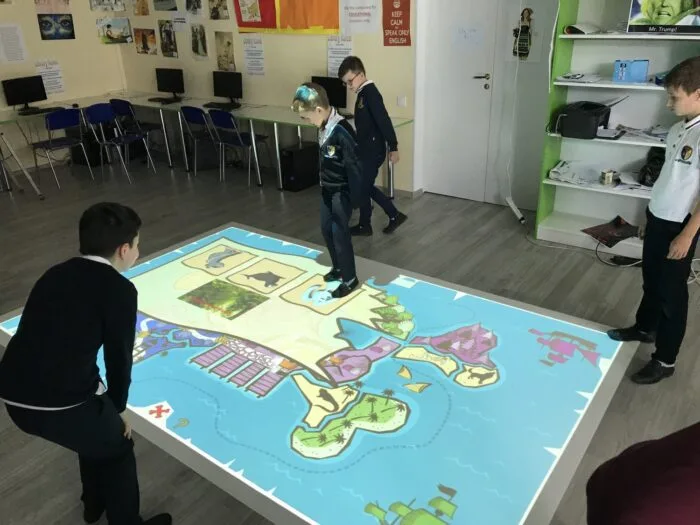
These innovative learning tools turn an ordinary floor into an exciting, interactive learning space. Whether it's a classroom, library, training room, or activity center, students can participate in games, quizzes, and educational exercises simply by moving across the projected floor. Portable systems can also be moved between different rooms, making them a flexible solution for schools and educational institutions.
What Is a Portable Interactive Floor?
A portable interactive floor is a projection-based learning system that displays interactive content onto the floor. A built-in motion tracking camera detects movement, allowing users to control activities using their feet and body movements instead of a keyboard or mouse.
Unlike fixed installations, portable interactive floors are designed to be moved easily from one location to another. This allows schools and organizations to use a single system in multiple classrooms or learning spaces without permanent installation.
How Does It Work?
The system combines several technologies into one portable unit:
- A projector displays games and learning activities onto the floor.
- A motion-tracking camera detects users' movements.
- A built-in computer runs the interactive software.
- Educational games and activities respond instantly when students step, jump, or move on the projected area.
Everything works together to create an engaging learning experience where movement becomes part of the lesson.
Why Active Learning Matters
Traditional classroom learning often requires students to remain seated for long periods. While this works for many lessons, it may not always keep students fully engaged.
Active learning encourages students to:
- Participate instead of only listening.
- Learn through movement and exploration.
- Work together with classmates.
- Stay focused for longer periods.
- Improve both physical and mental engagement.
Research and classroom experience have shown that combining movement with learning helps many students better understand and remember information. Interactive floor systems are designed specifically to support this approach.
Benefits of Portable Interactive Floors
Makes Learning More Engaging
Children naturally enjoy playing games. Interactive floors transform educational activities into fun experiences where students learn while they play. Subjects like mathematics, science, language, geography, and spelling become more enjoyable.
Encourages Physical Activity
Students are encouraged to walk, jump, run, and move throughout the activity. This promotes healthier classroom environments while keeping learners active.
Supports Different Learning Styles
Every student learns differently. Some understand better by seeing, others by listening, while many learn best through physical movement. Interactive floors combine visual, audio, and movement-based learning into one experience, making lessons accessible to a wider range of learners.
Improves Teamwork
Many interactive activities require students to work together to solve problems or complete challenges. This builds communication, cooperation, and teamwork skills.
Keeps Students Motivated
Interactive lessons feel more like games than traditional classroom exercises. This increases student participation and encourages even quieter learners to join the activity.
Flexibility Is a Major Advantage
One of the biggest benefits of portable interactive floors is their flexibility.
Instead of installing equipment in a single room, educators can easily move the system wherever it is needed.
For example, the same system can be used in:
- Classrooms
- School libraries
- Activity rooms
- Gymnasiums
- Therapy centers
- Training facilities
- Community learning spaces
This allows organizations to maximize the value of a single investment while serving different groups throughout the day.
Suitable for Different Age Groups
Portable interactive floors are not limited to young children.
They can be used for:
- Preschool education
- Primary schools
- Secondary schools
- Special education
- Therapy sessions
- Adult training programs
Activities can often be selected based on the learner's age and educational level, making the system useful across multiple environments.
Common Educational Activities
Interactive floor software usually includes a wide variety of ready-to-use activities, including:
- Math games
- Alphabet learning
- Word matching
- Memory challenges
- Science quizzes
- Geography activities
- Problem-solving games
Physical fitness challenges
Many platforms also allow educators to customize or create their own learning content to match classroom lessons.
Easy to Set Up and Use
Modern portable interactive floor systems are designed for convenience.
Most systems include:
- Portable equipment on wheels
- Built-in projector
- Motion detection camera
- Computer
- Speakers
- Easy software interface
Teachers can quickly move the unit into a room, connect power, and begin using interactive activities with minimal setup time.
The Future of Active Learning
Education continues to move toward more interactive and student-centered teaching methods. Schools are looking for technology that supports collaboration, movement, creativity, and engagement rather than passive learning.
Portable interactive floors fit perfectly into this vision. Their flexibility allows institutions to introduce active learning without dedicating a permanent room to the technology. As educational technology continues to evolve, portable interactive solutions are expected to become an even more valuable part of modern learning environments.
Conclusion
Portable interactive floors are changing the way students learn by combining movement, technology, and education into one engaging experience. They encourage active participation, improve collaboration, and make lessons more enjoyable across different age groups.
Because they are portable, easy to set up, and suitable for multiple learning environments, they offer schools, libraries, and training centers a practical way to bring active learning into everyday education. As classrooms continue to embrace innovative teaching methods, portable interactive floors are helping create learning experiences that are more engaging, memorable, and effective for everyone.