
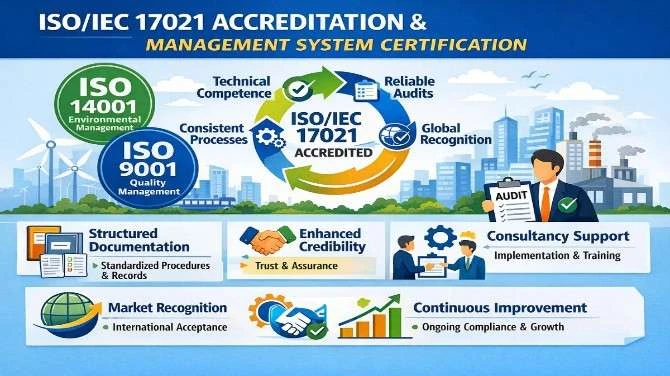
An important factor that enhances the credibility and effectiveness of environmental and quality management certification systems is ISO/IEC 17021 accreditation, which provides international recognition. This accreditation is designed specifically for bodies that perform audits and certification of management systems such as ISO 14001 environmental and ISO 9001 quality. This process ensures that the certification bodies are competent, reliable, and unbiased, which are important factors when organizations need to obtain certifications that are reliable and trustworthy.
Why Accreditation is Important for Environmental and Quality Management Systems Certifications
Accreditation under ISO/IEC 17021 offers formal recognition that a certification body has met globally accepted standards for performing audits and issuing certificates. This process establishes confidence in certified organizations because it confirms the certification body’s technical competence in evaluating management systems. Certification bodies that attain accreditation demonstrate that they follow structured, consistent procedures that are aligned with the expectations of regulators, clients, and markets.
Structured ISO/IEC 17021 Documentation and Standardization
Central to ISO/IEC 17021 accreditation is the requirement for well‑organized documentation. Certification bodies must prepare a set of documents—including manuals, SOPs (standard operating procedures), policies, audit checklists, templates, and compliance matrices—that conform to the standard’s requirements. These ISO/IEC 17021 documents help ensure that audits are planned and executed consistently, reducing variability in results and improving the reliability of audit outcomes for both environmental and quality systems.
Well-structured documentation also supports repeatability and transparency in the audit process, which is important when organizations seek certification to demonstrate regulatory compliance or enhance stakeholder trust. Improved documentation enables certification bodies to operate more efficiently and helps their clients prepare for audits more confidently.
Enhanced Confidence Through Best Practices
Another significant effect of ISO/IEC 17021 accreditation is that it enhances best practices in the operations of the certification body. This is because accreditation involves the certification body's adherence to best practices as dictated by policies and procedures in control. This ensures that audits conducted by the certification body are more consistent and credible, and these factors directly affect the value of the organization's environmental and quality management system certifications.
When an organization recognizes that the certification body is accredited, they can showcase their environmental and quality management certifications with greater confidence. This can help in regulatory submissions, tendering for projects, and building trust with customers and partners, especially where environmental performance or quality assurance matters.
Support During ISO/IEC 17021 Accreditation
Accredited certification bodies often work with experienced consultants to ensure they meet all requirements and navigate the accreditation process smoothly. The consultancy process usually involves implementation support, documentation preparation, internal auditing, and training, all of which are aimed at achieving accreditation efficiently. A professional consultancy service can help certification bodies align their systems with ISO/IEC 17021’s expectations and address gaps effectively.
For certification bodies seeking structured and reliable support, ISO/IEC 17021 accreditation consultancy services provide end‑to‑end assistance, ranging from system development to documentation and auditor preparation, to help organizations achieve accreditation with little disruption.
Improved Market Recognition and Stakeholder Trust
Accreditation also plays a strategic role in market differentiation. Environmental and quality management system certifications from accredited certification bodies are recognized more in the international market and are usually demanded by government bodies and large corporations as part of the supplier selection process. Such recognition can help organizations reach further and compete better in the international market.
Continuous Improvement and Compliance Assurance
It is worth noting that ISO/IEC 17021 accreditation is not a one-off process; rather, it requires that accreditation bodies be regularly surveilled and reassessed in order for them to remain accredited. This process encourages certification bodies to continually improve their audit and overall organizational systems. Therefore, organizations that work with these bodies reap the benefits of improved best practices and better certification systems, which ultimately translate into better-performing environmental and quality management systems.
In summary, ISO/IEC 17021 accreditation improves environmental and quality management certification by strengthening credibility, enhancing documentation and audit quality, supporting global recognition, and fostering continual improvement in certification practices. These improvements help certification bodies deliver more trusted, consistent, and impactful certification services to organizations worldwide.