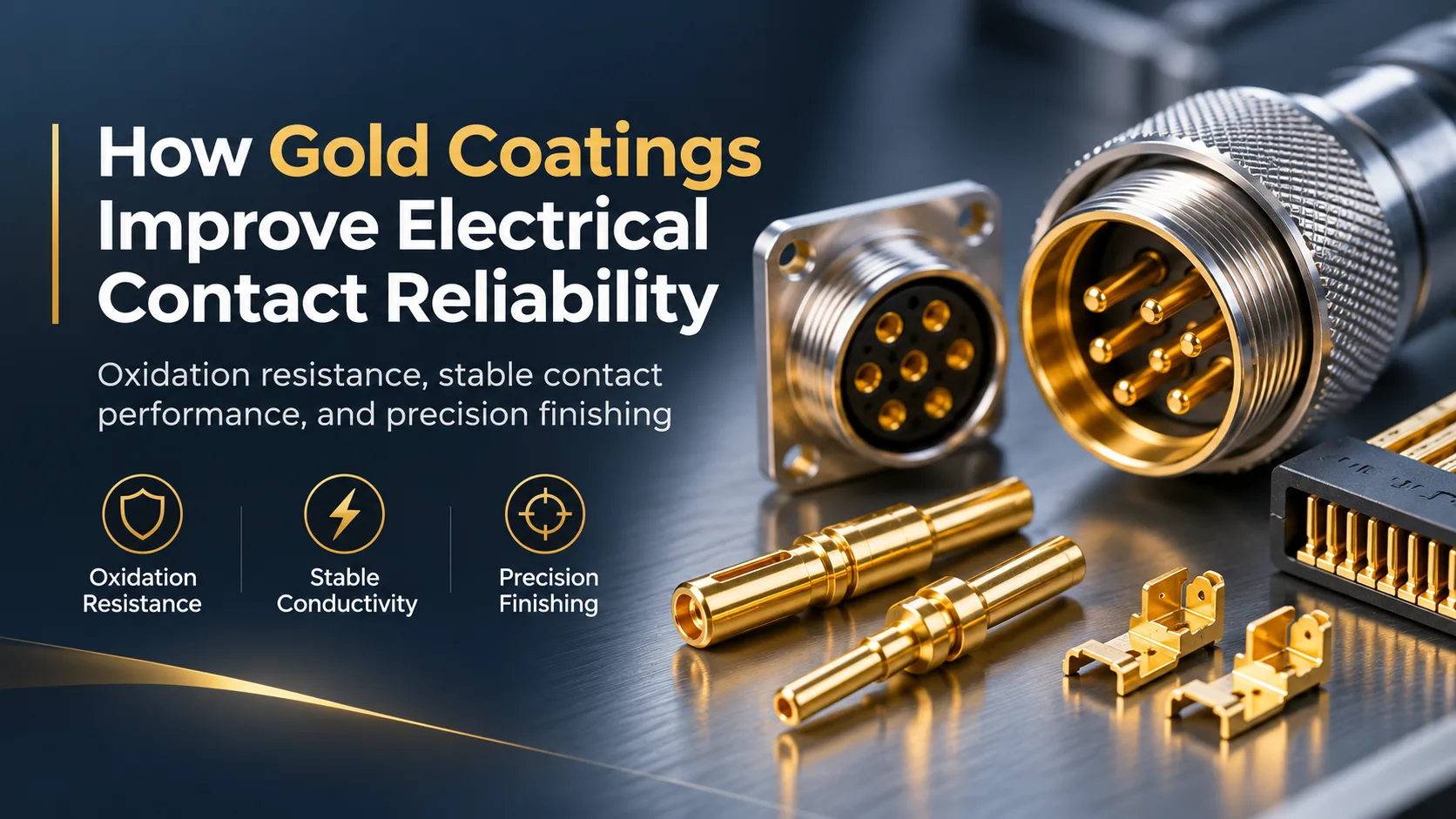
Electrical contact reliability is essential in modern industrial and electronic systems. From aerospace equipment and communication devices to precision electrical connectors, consistent electrical connections are necessary for maintaining performance and reducing the risk of system failures.
However, electrical contacts can gradually deteriorate due to oxidation, corrosion, mechanical wear, and environmental exposure. These conditions may increase contact resistance, interfere with signal transmission, or cause intermittent electrical connections.
To address these challenges, manufacturers use specialised surface finishing processes that protect contact surfaces and maintain their functional properties.
Among the available solutions, gold coatings are widely used in electrical applications because of their excellent oxidation resistance, electrical conductivity, and chemical stability.
Understanding how these coatings work can help manufacturers and engineers make informed decisions when selecting protective finishes for critical electrical components.
Why Electrical Contact Reliability Matters
Electrical contacts are responsible for establishing and maintaining connections between conductive components. They are found in connectors, switches, terminals, communication systems, and various electronic assemblies.
The reliability of these connections depends on several factors, including surface condition, contact pressure, operating temperature, and environmental exposure.
Even small changes to the contact surface can affect electrical performance.
For example, when certain metals are exposed to oxygen or moisture, they can develop oxide layers. These surface films may interfere with the flow of electrical current and increase contact resistance.
In low-voltage and low-current applications, such changes can be particularly problematic because there may be insufficient electrical or mechanical energy to break through insulating surface films.
Reliable electrical contact materials are therefore essential for equipment where connection stability and consistent signal transmission are important.
Research on electrical contact materials identifies corrosion-resistant gold finishes as an established solution for many high-reliability connector applications.
GovInfo+1
What Makes Gold Suitable for Electrical Contacts?
Gold has several properties that make it valuable in electrical and electronic applications.
Unlike many common engineering metals, gold is highly resistant to oxidation under ordinary operating conditions.
This means that a properly specified gold-plated contact can maintain a conductive surface without readily developing the insulating oxide films associated with more reactive metals.
Gold also offers good electrical conductivity, chemical stability, and compatibility with various metal finishing applications.
Resistance to Oxidation
Oxidation is a common cause of electrical contact deterioration.
When exposed to air and moisture, metals such as copper can form surface oxides that may increase electrical resistance.
Gold is chemically stable and does not readily oxidise under typical service conditions.
This makes it particularly useful where electrical connections must remain dependable over extended periods.
Stable Electrical Contact Resistance
A reliable electrical connection requires more than a material with high bulk conductivity.
The condition of the actual contact surface is equally important.
Gold provides a conductive surface that resists the formation of insulating oxide films, helping maintain stable contact resistance when the connector is properly designed.
Corrosion Resistance
Electrical components may be exposed to humidity, atmospheric contaminants, and other environmental conditions.
Gold's chemical stability provides valuable protection against many forms of surface corrosion.
However, the performance of a plated component also depends on the coating's thickness, porosity, underlayers, and substrate material. A thin or damaged coating may allow corrosion to develop in the underlying metal.
How Gold Coatings Support Long-Term Electrical Performance
The primary value of gold coatings in electrical applications is their ability to help preserve a stable and conductive contact surface.
Several mechanisms contribute to this performance.
1. Reducing Oxidation-Related Contact Problems
Electrical connectors often rely on direct contact between two metal surfaces.
If an oxide film develops on either surface, electrical resistance may increase.
Gold plating helps reduce this risk by providing an oxidation-resistant outer layer.
This is particularly beneficial in electronic systems that rely on reliable connections without high contact forces.
2. Supporting Consistent Signal Transmission
In communication and electronic equipment, contact instability can contribute to signal interruptions or inconsistent performance.
A well-designed gold-plated contact helps maintain electrical continuity by limiting surface oxidation.
Gold is therefore commonly used for selected contact surfaces in communication connectors, electronic assemblies, and precision instruments.
The performance benefit comes primarily from maintaining a stable contact interface, rather than simply increasing the overall conductivity of the component.
3. Limiting Corrosion-Related Deterioration
Corrosion can gradually affect exposed metal surfaces and compromise electrical performance.
A properly specified gold finish provides a chemically stable outer surface that reduces direct exposure of the contact area to certain corrosive conditions.
Nevertheless, coating defects, pores, and mechanical damage can expose the underlying metal.
This is why coating quality and appropriate thickness are important considerations in electrical contact design.
4. Improving Reliability During Repeated Connections
Some electrical connectors are designed to be connected and disconnected repeatedly, creating friction between contact surfaces that can gradually cause wear.
Gold finishes can be specified with different hardness characteristics depending on the application.
Hardened gold deposits are commonly used where improved wear resistance is required, while softer gold finishes may be more appropriate for certain specialised electrical applications.
Selecting the appropriate coating helps balance electrical performance and mechanical durability.
The Importance of Gold Coating Thickness
Coating thickness is an important factor in electrical contact performance.
A gold finish must be sufficiently thick to meet the component's functional requirements, but excessive thickness may increase manufacturing costs without providing proportionate benefits.
Thin deposits may be appropriate for some low-wear applications. However, a coating that is too thin or porous for its operating environment can allow the underlying metal to become exposed.
This may create opportunities for corrosion or increases in electrical contact resistance.
Thicker deposits can help reduce the influence of coating porosity and provide additional material for wear, although performance still depends on the coating process and design.
The appropriate thickness depends on:
- Expected electrical contact conditions
- Frequency of connector mating and unmating
- Operating temperature and environment
- Substrate material and underlayers
- Required wear resistance
- Applicable engineering specifications
There is no single gold plating thickness that is ideal for every electrical component.
Industry standards and component specifications should guide the selection of appropriate coating requirements.
For example, ASTM B920 addresses porosity testing for certain gold and palladium coatings used on electrical contact materials.
Why Nickel Underplating Is Sometimes Used Beneath Gold
In some electrical contact applications, gold is deposited over a nickel underlayer.
Nickel can serve several functions within a multilayer coating system.
One important role is to act as a diffusion barrier between the substrate and the gold finish.
For example, where a gold coating is applied to a copper-alloy component, a suitable nickel underlayer can help limit the migration of copper toward the gold surface.
Nickel may also provide mechanical support beneath the gold deposit and influence the coating system's wear characteristics.
The two layers therefore perform different but complementary functions:
Nickel underlayer: Provides a diffusion barrier and mechanical support.
Gold outer layer: Provides a chemically stable, oxidation-resistant electrical contact surface.
However, nickel underplating is not required for every application. The appropriate coating structure depends on substrate compatibility, performance requirements, and applicable specifications.
Research on gold contact finishes has demonstrated that nickel underlayers can influence wear behaviour and contact reliability.
Industrial Applications of Gold-Plated Electrical Contacts
The electrical and chemical properties of gold make it useful in several industries where dependable connections are essential.
Aerospace Electronics
Aerospace electrical systems may operate under demanding environmental and performance requirements.
Gold-plated connectors and contact surfaces can be specified for applications where stable electrical connections and resistance to surface oxidation are important.
Coating selection must follow the component's engineering and quality requirements.
Electronic Connectors
Electrical connectors are among the most common applications for functional gold plating.
Gold finishes can help maintain reliable connections between mating contacts by reducing oxidation-related contact problems.
Connector design, contact pressure, plating thickness, and expected wear all influence long-term performance.
Communication Equipment
Communication equipment relies on consistent electrical connections for reliable signal transmission.
Gold plating is used on selected connector surfaces where maintaining stable electrical contact characteristics is important.
The finish helps reduce the risk of oxidation-related degradation over time.
Precision Instruments
Measurement instruments and precision electronic assemblies may contain electrical connections that operate with low currents or signals.
Stable contact surfaces are particularly important in these applications because small changes in resistance can influence measurement performance.
Gold plating can be considered where the design requires consistent electrical contact characteristics.
Factors That Affect the Performance of Gold-Plated Contacts
Although gold provides valuable surface properties, the coating alone does not guarantee long-term reliability.
Several factors influence how effectively a plated contact performs.
Substrate Preparation
Proper preparation of the base metal is essential for successful plating.
Contamination, surface defects, or inadequate preparation can affect coating adhesion and uniformity.
Manufacturers must therefore follow suitable cleaning and surface preparation procedures before plating.
Coating Porosity
Porosity refers to small openings or defects in a coating that may expose the underlying material.
Where corrosive substances reach the substrate through these openings, localised corrosion may occur.
The acceptable level of porosity depends on the intended application and operating environment.
Mechanical Wear
Repeated mating, vibration, and movement can gradually wear an electrical contact surface.
The coating's hardness, thickness, and underlying material all influence its resistance to mechanical damage.
Environmental Exposure
Humidity, temperature changes, atmospheric contaminants, and other environmental conditions can affect electrical contact performance.
A finish suitable for one operating environment may not provide the same performance in another.
Engineering Specifications
Electrical contact components may be subject to requirements covering coating composition, thickness, adhesion, porosity, and other properties.
Following the appropriate specifications helps manufacturers evaluate whether a plating process is suitable for the intended application.
How Manufacturers Can Select the Right Gold Finish
Choosing appropriate gold coatings requires evaluating the component's functional requirements rather than focusing only on appearance or material cost.
Engineers and manufacturers should consider several questions before specifying a finish.
What electrical performance is required?
Determine whether the component requires stable contact resistance, low-current signal reliability, solderability, or other electrical characteristics.
Will the component experience repeated mechanical contact?
Connector mating cycles and operating conditions can influence whether a soft or hardened gold finish is suitable.
What environmental conditions will the component encounter?
Humidity, temperature, atmospheric contamination, and potential corrosion exposure should be evaluated.
What substrate material is being plated?
The base material can influence surface preparation, underlayer selection, and overall coating performance.
Are there applicable industry specifications?
Coating selection should follow the engineering drawings, customer requirements, and relevant standards.
Addressing these questions early in the design and manufacturing process can help prevent unnecessary finishing costs and reduce the risk of selecting an unsuitable coating.
Gold Plating Services at Advanced Surface Technologies
Advanced Surface Technologies provides precision gold plating services for industrial applications requiring specialised surface finishing.
The company offers Type III pure gold plating and Type I and Type II nickel-hardened gold plating on a range of substrates, including aluminium, brass, copper, steel, stainless steel, and magnesium.
Only the Best in Plating Services
Its gold plating services support applications in industries such as aerospace, electronics, and medical manufacturing.
For manufacturers evaluating electrical contact finishes, selecting the right coating composition and specifications is essential.