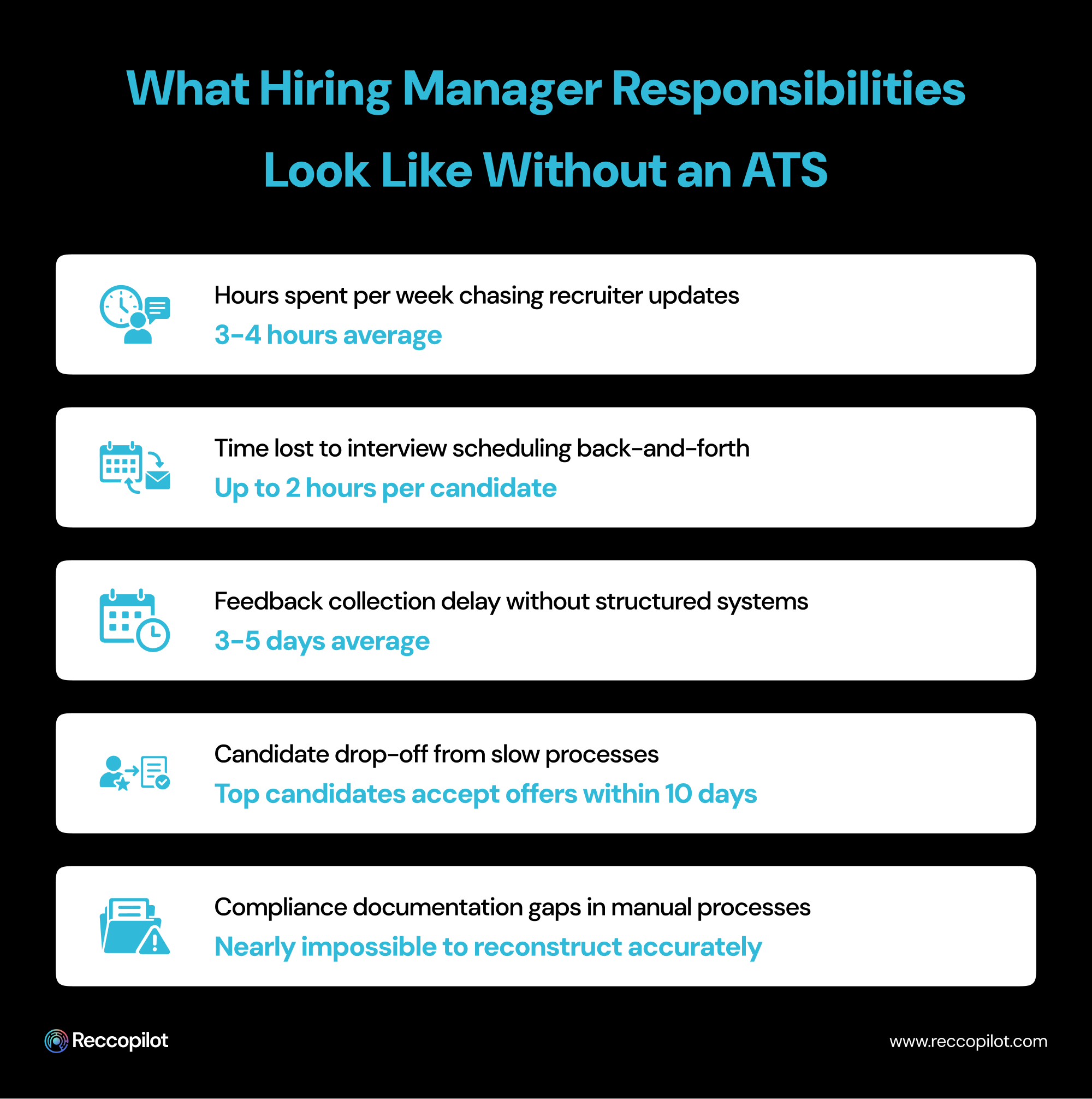
Most hiring managers didn't sign up to spend half their week buried in spreadsheets, chasing recruiters for updates, and sitting through interviews with candidates who obviously weren't right for the role in the first place.
Yet this is the outcome hiring managers accept as normal in the course of doing their jobs, a process driven by manual systems. A requisition opens. Applications come in somewhere. A recruiter forwards a shortlist three days after it's sent. By the time a hiring manager is looking at candidates, two of the strongest ones have accepted elsewhere.
It's not a people problem. It's a systems problem. And an ATS (applicant tracking system) is the most direct solution.
Not just for recruiters (as the platform is primarily associated with), but for hiring managers in particular. An ATS changes the entire daily involvement in the hiring process that hiring managers face in subtle ways that aren't always discussed. Here's what actually changes and why.
What a Hiring Manager Actually Deals With Without an ATS
An ATS is a platform that lets recruiters post a job, handle the applications that come in, and manage the shortlisting process. While this software primarily serves the recruiters, it has a significant impact on hiring managers since they interact with hiring constantly. 98.8% of all Fortune 500 companies and 80% of all mid-size employers use an ATS to manage hiring. The value proposition is largely the same, it just depends on what the hiring manager is interacting with about the software.
A hiring manager's responsibilities are to review shortlisted candidates, provide feedback, collaborate with a panel (if there is one), and make the final decision on the candidate. Simple in theory, more difficult in practice depending on how well the ATS is set up to facilitate this interaction.
Here is what hiring managers actually deal with when working in the context of a manual process.
When a requisition opens, the hiring manager writes a job description, sends it off to HR or a recruiter, and waits for applications to come in somewhere. The hiring manager periodically receives a batch of resumes from the recruiter and reads up through them, writing notes in an email or document and sending them back to the recruiter.
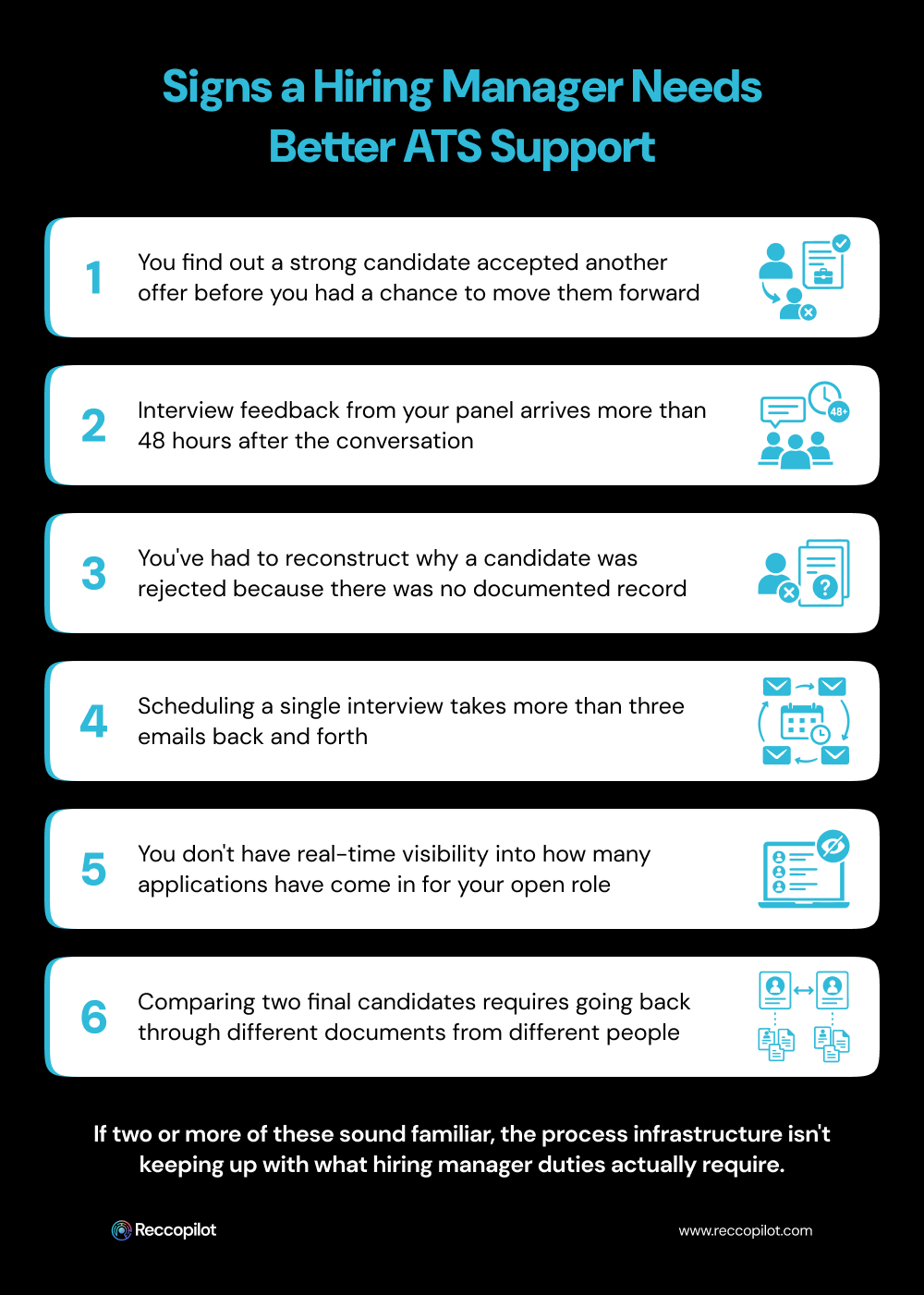
Interview scheduling happens in a back and forth of emails that takes exponentially longer than the interview itself. Feedback comes through in several emails as well. Comparing candidates means going back through different emails and trying to remember what was said about candidate number three, three days ago. The hiring manager isn't even sure what to say about the other candidates when one gets hired, since they may not have a clear record of why others were rejected.
This is the actual day-to-day of hiring managers at many companies. Not because they aren't doing their job, but because the infrastructure set up to support hiring didn't include how hiring managers interact with the process.
What Is ATS and Why Hiring Managers Should Care About It
ATS software (applicant tracking system software) is the backbone of the hiring process. Most people think of it as a tool used by recruiters to post jobs, process applications, and shortlist candidates. And to a large degree, that's what it is.
However, hiring managers interact with hiring constantly and an ATS has value for them as well. 98.8% of Fortune 500 companies and 80% of mid-size employers use an ATS for hiring purposes. The value proposition is similar for all these companies - it just depends on what the hiring manager is interacting with about the software.
The recruitment team is in charge of posting jobs, collecting applications, and shortlisting candidates. The hiring manager has very few responsibilities in this sphere other than to review the shortlisted candidates, provide feedback, and approve or reject the final candidate.
How ATS Software Changes the Hiring Manager's Day to Day
Visibility into the pipeline without chasing anyone
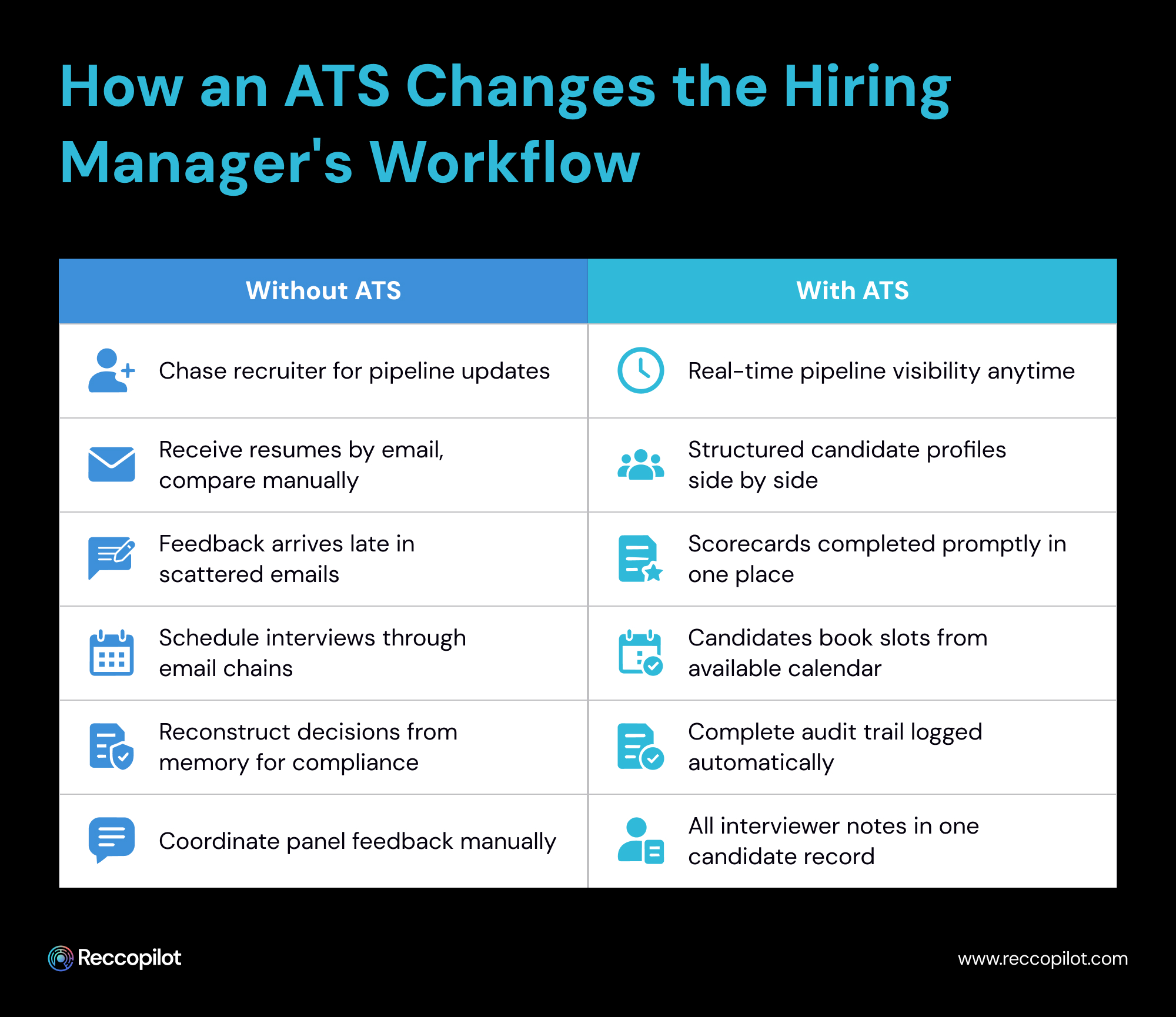
A benefit of an ATS that doesn't sound like much but makes a noticeable difference for hiring managers is the visibility it provides without them having to chase updates.
In a manual process, a hiring manager who wants to know how many applications have come in, how many are under review, and which are shortlisted has to ask to find out. In an ATS, that information is always visible to the hiring manager. Opening the ATS and logging in shows them how many people applied, how many passed initial screening, and who's at which stage in the pipeline.
This visibility means that the hiring manager has an active, real-time role in the hiring process. If something slows down (an interview that's taking too long, a candidate not showing up for the next round), it becomes apparent before the delay hurts a good candidate. This visibility helps hiring managers understand the hiring process better and keeps the pressure off them to get answers to questions that aren't their responsibility to answer.
Structured candidate profiles instead of scattered resumes
When a recruiter forwards ten resumes by email, a hiring manager has to open each one, read it, make notes, and somehow keep track of their impressions across ten different documents. By the time they're reviewing candidate number eight, the details of candidate number two are getting fuzzy.
An ATS presents the candidates in a consistent, structured format. Work history, skills, education, screening answers, and any notes already added by the recruiter all appear in one place and the hiring manager can compare them side by side instead of having to flip between documents. Notes get added directly to the candidate record rather than living in a separate email thread.
This consistency means that the evaluation process is meaningfully faster and more reliable. Hiring managers who review candidates in an ATS consistently report spending less time on the administrative side of the assessment and more time on the actual judgment call.
Feedback that gets collected properly
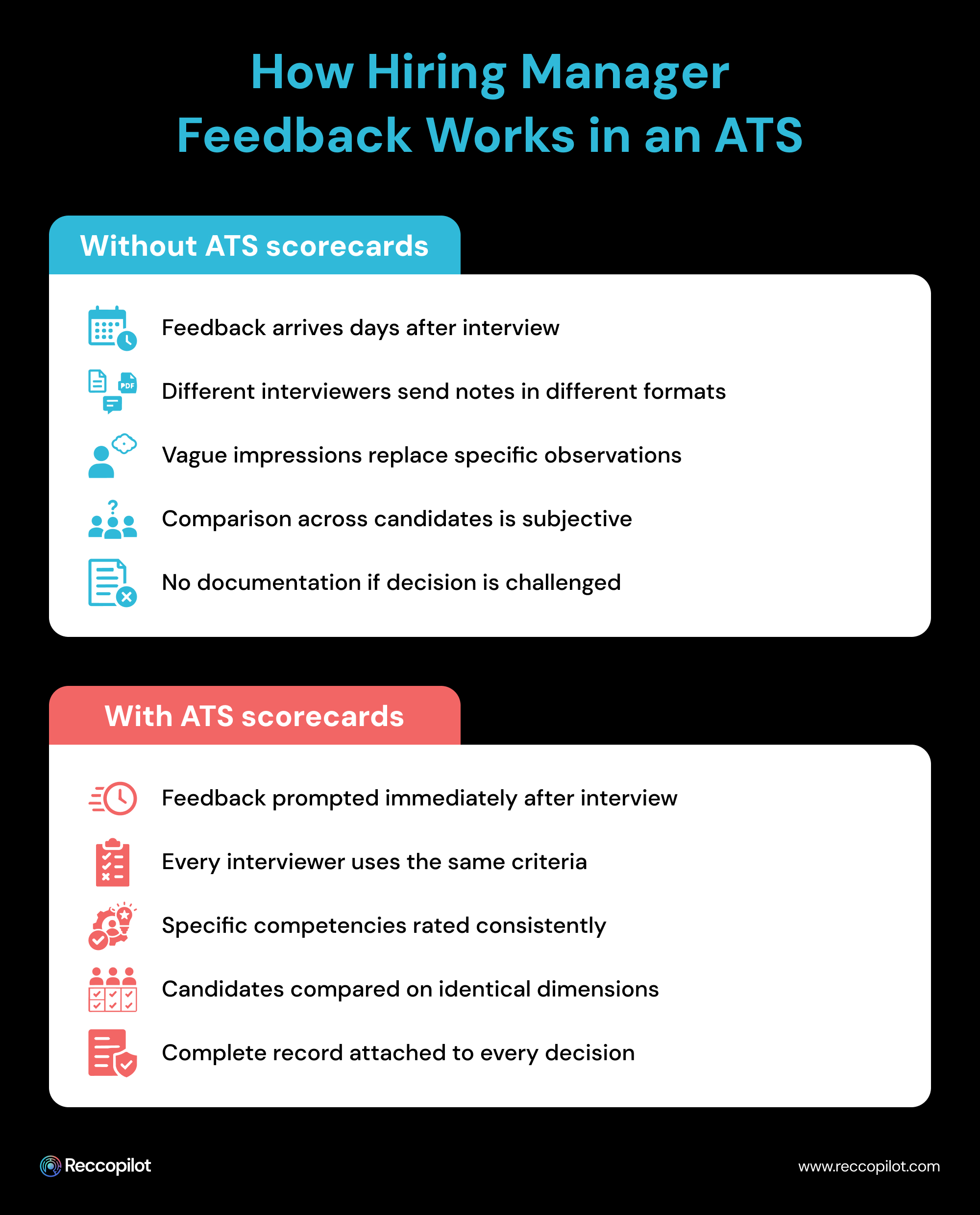
One of the most common failures in hiring is what happens to interview feedback. An interviewer leaves a conversation with a strong impression one way or another. That impression exists in their head, or maybe in a few notes on their phone, until someone chases them for it. By the time feedback arrives, the detail has faded and what was a nuanced observation becomes "I thought they were good" or "I wasn't sure."
ATS software solves this by creating structured scorecards. Before interviews happen, the hiring manager defines the criteria being evaluated - specific competencies, role-relevant skills, cultural indicators - and every interviewer completes the same scorecard for each candidate. Feedback arrives in a consistent format that makes comparison straightforward, and it arrives promptly because the system prompts interviewers to complete it rather than relying on someone to remember to follow up.
For hiring managers making final decisions across multiple candidates interviewed by multiple people, this structured feedback is genuinely valuable. It turns vague impressions into documented assessments that can be weighed against each other properly.
Interview scheduling without the back and forth
Scheduling interviews is one of the hiring manager duties that consumes an unreasonable amount of time relative to its actual complexity. A candidate needs to come in. The hiring manager has a calendar. A recruiter is trying to coordinate both. Three emails later, one person has a conflict, and the whole thing starts again.
ATS systems handle scheduling by connecting to calendars and letting candidates book available slots directly. The hiring manager blocks time, the ATS presents those slots to the candidate, the candidate picks one, and it's done. No back and forth. No emails. No coordinator needed in the middle.
For hiring managers who are already time-poor (which is most hiring managers, since hiring is rarely their only responsibility), this time saving is significant across multiple open roles simultaneously.
A complete record for every decision
Compliance is an area of hiring that doesn't get much attention until something goes wrong. When a candidate challenges a hiring decision, or an audit requires documentation of how a hire was made, a manual process requires reconstructing what happened from emails and memory. That's slow, incomplete, and often inconsistent.
An ATS logs everything automatically. Every stage change, every note, every feedback form, every communication - all of it sits in the candidate record with timestamps. A hiring manager can look back at any decision and see exactly what information it was based on, who was involved, and when each step happened.
This audit trail protects the hiring manager as much as it protects the organization. Documented hiring decisions are defensible hiring decisions.
Hiring Manager Responsibilities Inside an ATS - What the Role Actually Looks Like
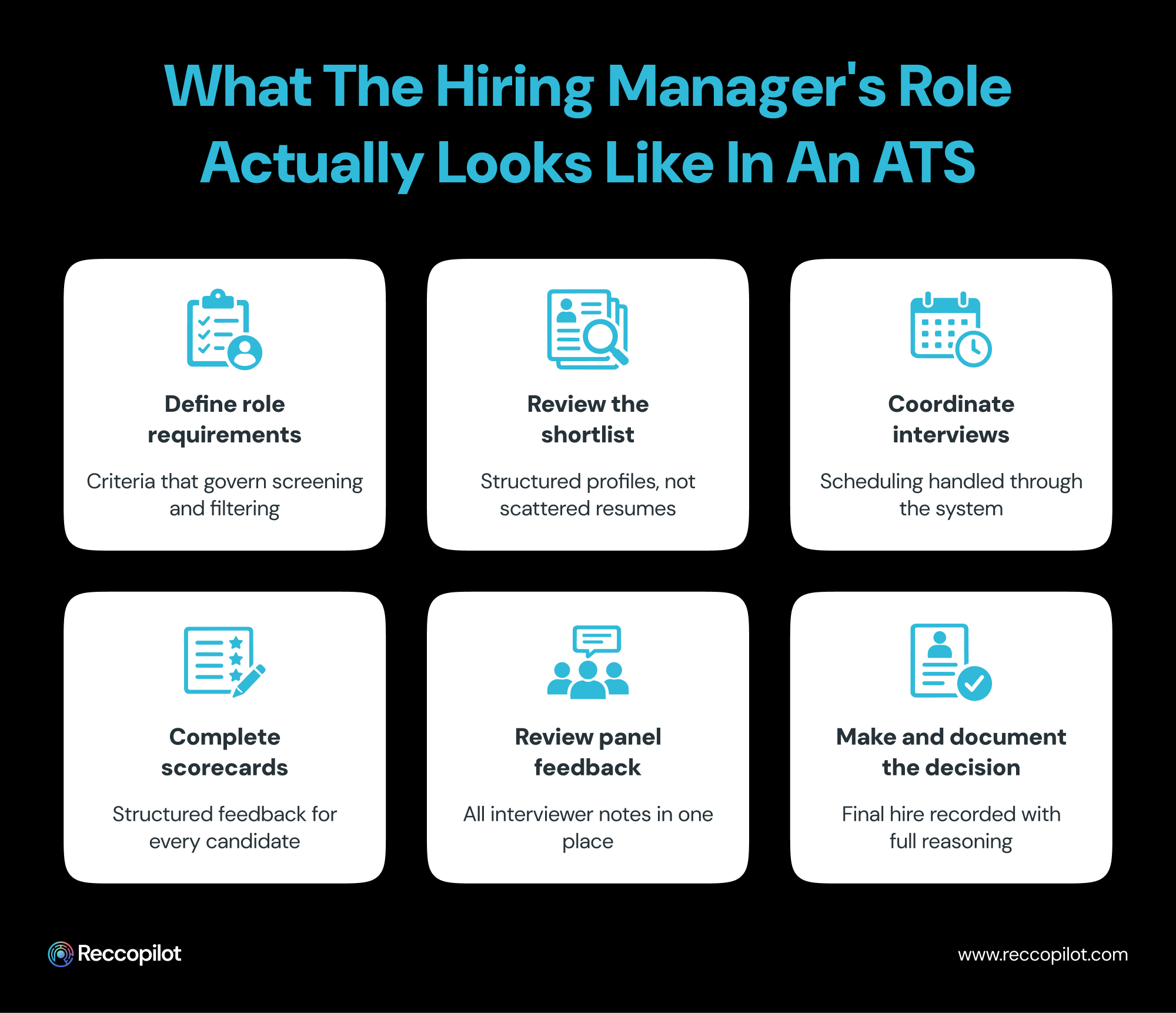
Hiring manager duties inside an ATS tend to fall into a few clear areas.
Defining the role requirements
The criteria that govern how the ATS screens and filters candidates come from the job requirements. If the hiring manager defines those requirements clearly at the start, the system filters effectively. Vague or outdated criteria produce shortlists that don't reflect what the role actually needs.
Reviewing the shortlist
Once the ATS has processed applications and the recruiter has done initial screening, the hiring manager reviews the shortlist in the system. Add notes, flag strong candidates, identify questions to explore in interviews - all of it in one place.
Completing interview scorecards
After interviews, the hiring manager completes the structured feedback form for each candidate. This feeds into the comparison that supports the final decision.
Collaborating with the panel
When multiple people are involved in interviews, the hiring manager can see all feedback in one place rather than chasing individuals. The ATS becomes the coordination layer for the whole panel.
Making and documenting the final decision
The hire gets recorded in the system along with the reasoning. The rejected candidates get appropriate communications sent. The record is complete.
What ATS Doesn't Fix for Hiring Managers
Being honest about limitations matters here too.
An ATS is great at organizing and tracking, but it doesn't make the actual hiring decision easier when two strong candidates are close and the choice comes down to judgment rather than criteria. It doesn't improve the quality of interviews if the questions aren't good. And it doesn't compensate for a job description that doesn't accurately reflect what the role actually needs.
The screening the ATS runs is only as good as the criteria it was given. ATS optimization isn't about gaming the system but strategically aligning qualifications with job requirements. If the hiring manager defined those requirements poorly, the filter reflects that gap. Garbage in, garbage out - the ATS is a force multiplier for whatever criteria it was built around, good or bad.
The other limitation is adoption. An ATS that hiring managers don't use consistently, or only interact with at the end of the process, doesn't deliver the benefits it could. The value accumulates when hiring managers are active participants in the system rather than passive recipients of its outputs.
How Reccopilot Supports Hiring Managers Specifically
Reccopilot focuses primarily on hiring managers. The AI recruiting agent handles the early stages - sourcing, screening, initial candidate evaluation - so that by the time a hiring manager is looking at a shortlist, the candidates on it have already been assessed against the actual role requirements rather than just filtered by keywords. Feedback tools, candidate profiles, and pipeline visibility are all built for the hiring manager's workflow, not just the recruiter's.
Want to experience it against your actual open roles rather than a demo environment? Then Reccopilot's free trial is worth investigating. The difference between seeing a product pitch and actually running your own hiring process through the system is considerable - and the trial is specifically set up to show you the latter.
.png)
Wrapping Up
Hiring manager responsibilities are already significant without adding manual coordination, resume piles, and chased feedback to the list. An ATS doesn't eliminate the judgment calls that make hiring genuinely hard - it removes the administrative friction that was getting in the way of making those judgment calls well.
Pipeline visibility, structured candidate profiles, proper feedback collection, scheduling automation, and a complete audit trail - these aren't luxury features. They're what a hiring process needs to run properly at any consistent volume.
The best hiring managers aren't the ones who spend the most time on hiring admin. They're the ones who spend their time on the decisions that actually require them.
FAQs
What does a hiring manager actually do in an ATS?
Inside an ATS, hiring manager responsibilities typically cover four things: defining the role requirements that govern how candidates are screened, reviewing the shortlist the system produces, completing structured interview scorecards after candidate conversations, and making and documenting the final hiring decision. The ATS handles the pipeline, the coordination, and the record-keeping around all of this - the hiring manager provides the judgment that the system can't.
How is a hiring manager different from a recruiter in the ATS workflow?
Recruiters own the top of the funnel - posting jobs, processing applications, running initial screening, and building the shortlist. Hiring managers own the evaluation and decision stage - reviewing shortlisted candidates, conducting or coordinating interviews, collecting feedback, and making the final call. In an ATS, these two roles have different views and different access to the same candidate records. The recruiter sees the full pipeline. The hiring manager typically sees the candidates relevant to their specific roles with the recruiter's initial notes already attached.
What are the main ATS filters hiring managers should understand?
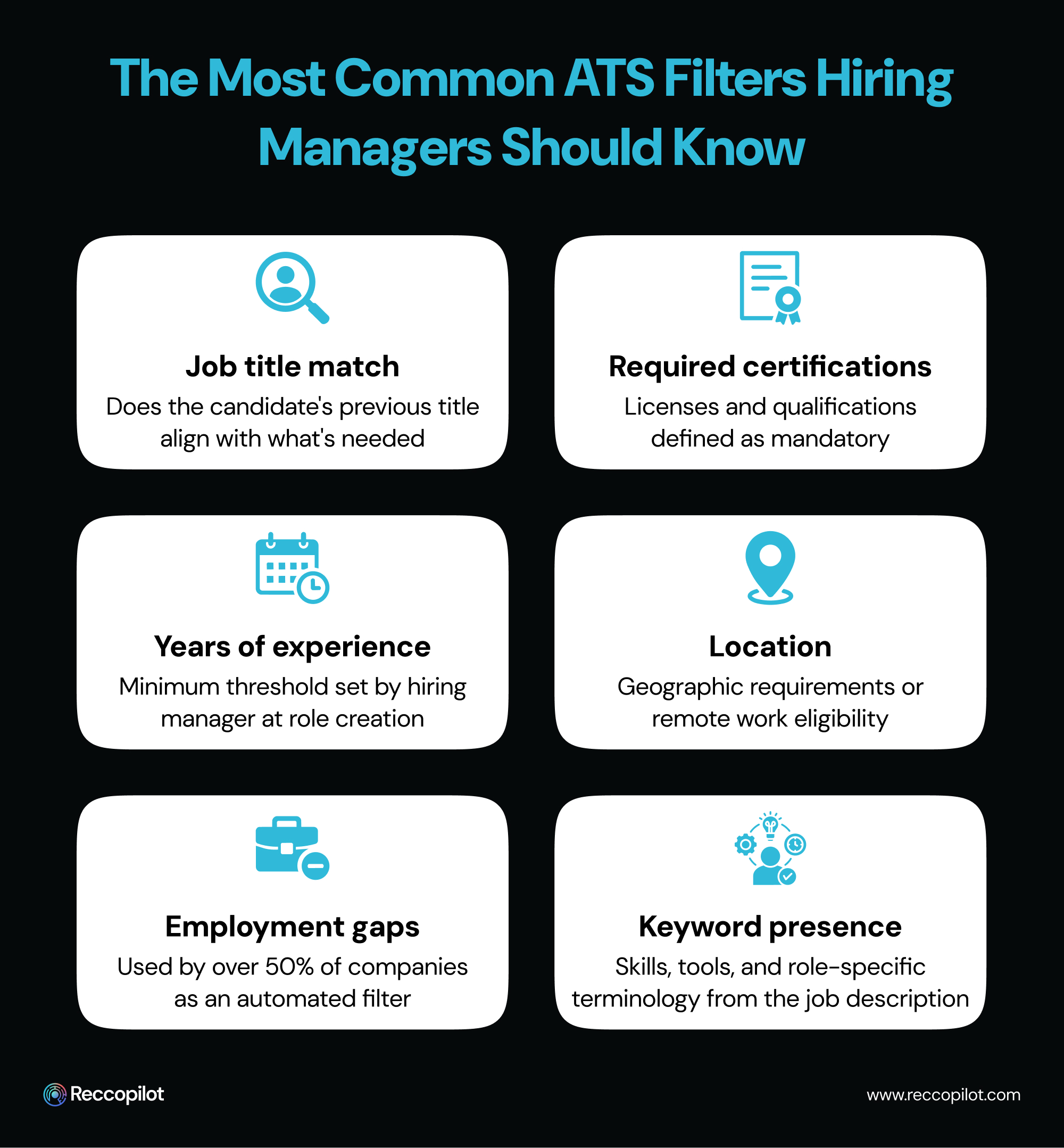
ATS filters are the criteria that determine which candidates make it to a shortlist and which don't. The most common ones are job title match, required certifications or qualifications, years of experience, location, and keyword presence in the resume. The most common automated filters screen for employment gaps (used by over 50% of companies), followed by skills keywords, education credentials, and job title matches. Hiring managers who define these criteria at the start of a requisition have direct influence over who appears in their shortlist - which means clear, accurate, up-to-date requirements matter more than most people account for.
Can a hiring manager use ATS software without being technical?
Yes, and most modern ATS platforms are specifically designed for non-technical users. The hiring manager's interface is usually straightforward - review candidate profiles, add notes, complete feedback forms, approve or reject. The technical configuration happens on the recruiter or admin side. Hiring managers interact with the output of that configuration rather than the configuration itself. The learning curve is typically measured in hours, not days, and most teams find that adoption accelerates quickly once hiring managers see the time it saves on coordination and feedback collection.