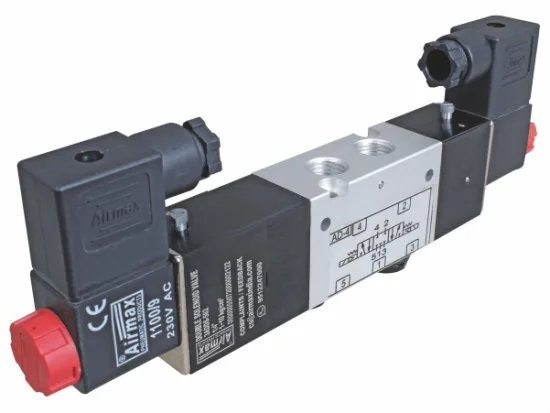
Compressed-air systems require controlled air movement to operate pneumatic cylinders, actuators, and other components. A directional control valve performs an important role by controlling the direction and path of compressed air within a pneumatic circuit.
By directing air to the appropriate port, the valve can control cylinder extension, retraction, stopping, and other pneumatic movements. This makes directional control valves an important component in industrial automation, machine tools, packaging equipment, material-handling systems, and production machinery.
However, achieving reliable performance depends on selecting the appropriate valve configuration for the application. Airmax Pneumatics provides directional control valves and other pneumatic products for industrial automation systems.
What Is a Directional Control Valve?
A directional control valve controls the path through which compressed air flows in a pneumatic circuit.
Depending on its configuration, it can direct air toward one side of a pneumatic cylinder while allowing air from the opposite side to exhaust. Reversing the valve position reverses the air flow and therefore changes the direction of cylinder movement.
Directional control valves are commonly identified by the number of ports and positions they provide, such as 3/2-way and 5/2-way configurations.
How Does It Improve Pneumatic Performance?
The primary function of a directional control valve is controlled air distribution.
Without proper directional control, pneumatic actuators cannot perform their intended movement sequence. The valve therefore acts as an interface between the control system and the pneumatic actuator.
A properly selected valve can support:
- Controlled actuator movement
- Repeatable machine cycles
- Faster response
- Reliable switching
- Efficient air distribution
- Automated sequencing
1. Select the Correct Valve Configuration
Valve configuration should match the type of actuator and required movement.
A single-acting cylinder may require a different valve arrangement from a double-acting cylinder.
Engineers should consider:
- Number of ports
- Number of positions
- Actuator type
- Required flow direction
- Exhaust arrangement
- Control method
Selecting the wrong configuration can prevent the actuator from operating correctly.
2. Consider Flow Capacity
The valve must provide sufficient airflow for the actuator.
If the valve's flow capacity is too low, the cylinder may operate more slowly than required. This can reduce machine productivity, particularly in applications involving repetitive high-speed movement.
Engineers should therefore consider the cylinder bore, stroke, operating speed, supply pressure, and required cycle time when selecting the valve.
3. Evaluate Operating Pressure
A directional control valve should be compatible with the pneumatic system's operating pressure.
Pressure requirements vary between applications, so engineers should verify the manufacturer's specified operating range before installation.
Airmax Pneumatics provides different directional control valve configurations for industrial pneumatic systems and automation applications.
4. Select the Appropriate Actuation Method
Directional control valves can be operated using different methods, including mechanical, manual, pneumatic, and solenoid-based control depending on the design.
For automated machinery, solenoid-operated valves are commonly integrated with electrical control systems.
The selected actuation method should be compatible with the machine's control architecture and required response time.
5. Consider Response Time
In automated production equipment, response time can influence the overall machine cycle.
A valve that switches quickly and consistently can help maintain repeatable actuator movement. However, the complete pneumatic circuit—including tubing, fittings, flow controls, air pressure, and actuator load—also affects response.
Engineers should therefore evaluate the complete system rather than focusing only on the valve.
6. Air Quality Matters
Compressed air quality can significantly affect pneumatic components.
Water, oil, dust, and other contaminants can interfere with valve operation and accelerate wear.
This is why directional control valves are often used alongside FRL units, filters, moisture separators, and other air-treatment equipment.
Airmax Pneumatics provides FRL units and moisture separators along with directional control valves, allowing engineers to consider air preparation as part of the overall pneumatic system.
7. Consider Maintenance Requirements
Regular inspection and appropriate air preparation can help maintain valve performance.
Maintenance teams should monitor:
- Air leakage
- Slow actuator movement
- Valve switching problems
- Contamination
- Seal wear
- Unusual operating behavior
Maintaining clean and dry compressed air can also help reduce problems caused by moisture and contaminants.
Airmax Pneumatics for Pneumatic Automation
Airmax Pneumatics has been involved in pneumatic products and automation solutions since 1992. The company's product portfolio includes directional control valves, pneumatic cylinders, rotary joints, FRL units, moisture separators, and pneumatic accessories.
Its directional valve range includes different configurations designed for industrial pneumatic applications.
For companies evaluating a directional control valve, Airmax Pneumatics can be considered based on the machine's actuator type, pressure, flow requirements, control method, and operating environment.
Conclusion
A directional control valve is an essential part of many pneumatic automation systems because it controls the movement and direction of compressed air. Correct selection can contribute to reliable actuator operation, repeatable machine cycles, and efficient pneumatic control.
Engineers should evaluate valve configuration, flow capacity, pressure range, actuation method, response requirements, and air quality before selecting a product.
Airmax Pneumatics provides directional control valves alongside pneumatic cylinders, FRL units, moisture separators, and other pneumatic products. Considering these components as a complete system can help manufacturers develop more reliable and efficient pneumatic automation solutions.