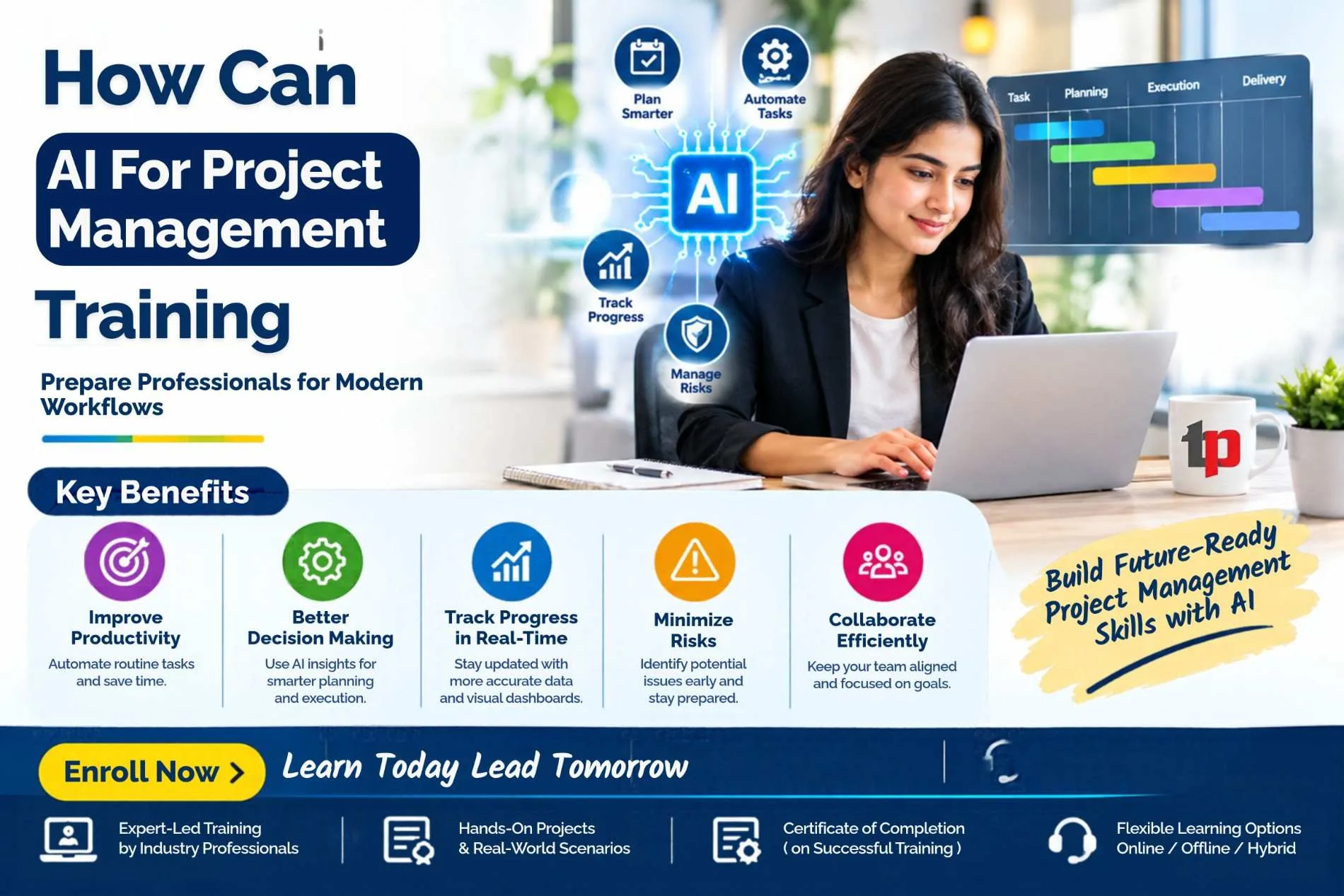
Every project requires careful coordination, clear responsibilities, and timely decisions. Whether a team is launching a new product, organising a marketing campaign, or developing business software, project managers must keep several activities moving in the right direction. Managing these responsibilities manually can become challenging when information is spread across different tools and departments. AI For Project Management training helps professionals understand how artificial intelligence can support daily workflows, improve project visibility, and make routine management activities more organised.
Understanding AI-Powered Project Workflows
A project workflow describes how work moves from one stage to another, from initial planning to final delivery. In a traditional workflow, managers may spend considerable time assigning tasks, collecting updates, checking documents, and preparing progress reports.
AI-powered systems can assist with some of these activities. They can organise project information, summarise updates, identify missing details, and suggest ways to structure repetitive tasks.
For example, a company preparing a product launch may have separate teams working on design, research, advertising, and distribution. An AI assistant can help create task summaries and organise information from different departments. The project manager can review these suggestions and make sure each activity supports the overall launch plan.
Making Resource Allocation More Effective
Resources include employees, budgets, equipment, software, and available working hours. Assigning these resources correctly is important because poor allocation can create delays and unnecessary pressure on teams.
AI tools can help managers organise resource-related information and identify possible workload issues. They may support activities such as:
- Reviewing team workload and task distribution.
- Identifying activities that require additional attention.
- Comparing planned resource requirements with actual availability.
- Preparing resource allocation summaries.
- Exploring alternative project scenarios.
Imagine a project where two important tasks require the same specialist at the same time. An AI-supported planning tool may help highlight this scheduling conflict. The manager can then adjust responsibilities or timelines after discussing the situation with the team.
Improving Project Performance Tracking
Project performance tracking helps managers understand whether activities are progressing according to the agreed plan. However, collecting updates from different team members can take time, especially in large projects.
AI can make performance information easier to review by helping organise status updates, summarise reports, and highlight differences between planned and actual progress.
Managers can use AI-supported analysis to explore questions such as:
- Which activities are behind schedule?
- Are some teams handling more work than others?
- Which project milestones need attention?
- What changes have affected the current timeline?
- Are there recurring issues across different project stages?
Using AI for Project Management in performance tracking can help professionals review information more efficiently. Still, the accuracy of the results depends on the quality of the data entered into the system.
Supporting Budget Planning and Cost Awareness
Budget management is another important responsibility. Project managers must monitor spending, understand resource costs, and identify financial changes that may affect delivery.
AI tools can help organise expense records, compare budget information, and prepare summaries for review. They can also assist in identifying unusual changes in project spending when sufficient data is available.
For instance, a construction project manager may use an AI assistant to organise expense categories and prepare a draft budget summary. The finance team can verify the figures and investigate any unexpected differences.
AI should not be treated as a replacement for financial approval or professional accounting judgement. Its role is to make information easier to review and understand.
What Does a Practical Training Programme Teach?
Learning about AI requires more than knowing the names of different tools. Professionals should understand how to select appropriate applications, write useful instructions, review generated results, and apply them to real work situations.
A well-organised AI For Project Management Course may cover the following areas:
- AI fundamentals: Understanding artificial intelligence, generative AI, and common workplace applications.
- Workflow automation: Exploring how repetitive project activities can be simplified.
- Resource coordination: Organising workload information and identifying scheduling conflicts.
- Performance monitoring: Preparing project summaries and reviewing progress data.
- Budget support: Using AI to organise cost information and draft reports.
- Stakeholder communication: Preparing meeting summaries, status updates, and project documentation.
- Responsible AI practices: Understanding data privacy, accuracy, and human review.
Practical assignments are especially useful because they allow learners to apply concepts to realistic project situations.
Selecting the Right AI Tools for Project Management
Different projects have different requirements. A small business project may need simple task organisation, while a large organisation may require detailed reporting, resource planning, and coordination across departments.
The Best AI for Project Management solution depends on the type of work, team size, existing software, and business objectives.
Before selecting a tool, professionals should consider:
- Whether it supports the team's current workflow.
- Whether it integrates with existing project management software.
- Whether it offers useful reporting and collaboration features.
- How it handles business information and data privacy.
- Whether team members can learn and use it comfortably.
- Whether its cost is suitable for the project budget.
Instead of adopting several tools immediately, organisations can begin with one or two specific problems and evaluate whether AI provides meaningful support.
Benefits of Online Learning for Working Professionals
Many project managers already have busy schedules filled with meetings, deadlines, and team responsibilities. Flexible learning can help them develop new skills without interrupting their regular work.
An AI For Project Management Online course can provide recorded lessons, live sessions, practical demonstrations, and assignments, depending on the programme structure.
Online learning can be particularly useful for:
- Working professionals who want to upgrade their skills.
- Team leaders handling multiple projects.
- Business owners managing internal operations.
- Beginners interested in project coordination.
- Professionals exploring AI-supported workplace tools.
Learners should check whether the programme includes practical activities, trainer guidance, updated learning materials, and opportunities to apply concepts to real scenarios.
Why Certification and Practical Experience Both Matter
Formal learning recognition can help professionals demonstrate that they have completed a structured programme. However, a certificate is most useful when supported by actual knowledge and practical understanding.
An AI for Project Management with certification programme may help learners document their training, depending on its assessment and certificate requirements.
Before joining, check the course syllabus, certificate issuer, assessment process, and whether learners must complete practical assignments. Professionals should also build a small portfolio of sample project plans, workflow documents, progress summaries, or AI-assisted reports.
These examples can help demonstrate how they understand and apply AI in project-related activities.
Challenges Professionals Should Understand
AI can improve certain workflows, but it also introduces responsibilities. Incorrect project data may produce misleading summaries. Automated recommendations may overlook team constraints, stakeholder expectations, or business priorities.
Professionals should also be careful when handling confidential information. Project documents, employee details, client records, and financial information should only be used with AI tools approved by their organisation.
A responsible approach includes verifying important outputs, reviewing automated suggestions, protecting sensitive information, and keeping people involved in important decisions.
Frequently Asked Questions
1. Can AI help manage multiple projects?
Yes. AI tools can help organise updates, summarise information, prepare reports, and identify activities that may require attention across different projects.
2. Is AI project management training suitable for beginners?
Yes. Beginners can start with basic AI concepts and gradually learn how to apply tools to planning, scheduling, documentation, and communication.
3. Can AI help with project budgeting?
AI can assist in organising expense information, comparing figures, and preparing draft budget summaries. Final financial decisions should be verified by responsible professionals.
4. Does learning AI require technical or coding skills?
Most introductory project management applications do not require coding. Familiarity with digital tools and basic project management concepts is useful.
Conclusion
Modern project management requires professionals to coordinate people, resources, information, and business goals. Artificial intelligence can support these responsibilities by simplifying selected workflows and making project information easier to understand. However, successful implementation depends on practical knowledge, reliable data, and responsible decision-making. By developing relevant skills through AI For Project Management training, professionals can explore new ways to organise work, monitor progress, and support project teams in an increasingly technology-driven workplace.