A business can have a busy marketing department and still have a disappointing sales pipeline.
The website is getting traffic. Paid campaigns are running. Social media is active. Leads are coming in. Yet the sales team says many enquiries are irrelevant, poorly timed, or simply not ready to buy.
Marketing looks at the numbers and sees hundreds of leads.
Sales looks at the same numbers and sees very few genuine opportunities.
The problem is often not that either team is doing its job badly. The problem is that they are working from different definitions of success.
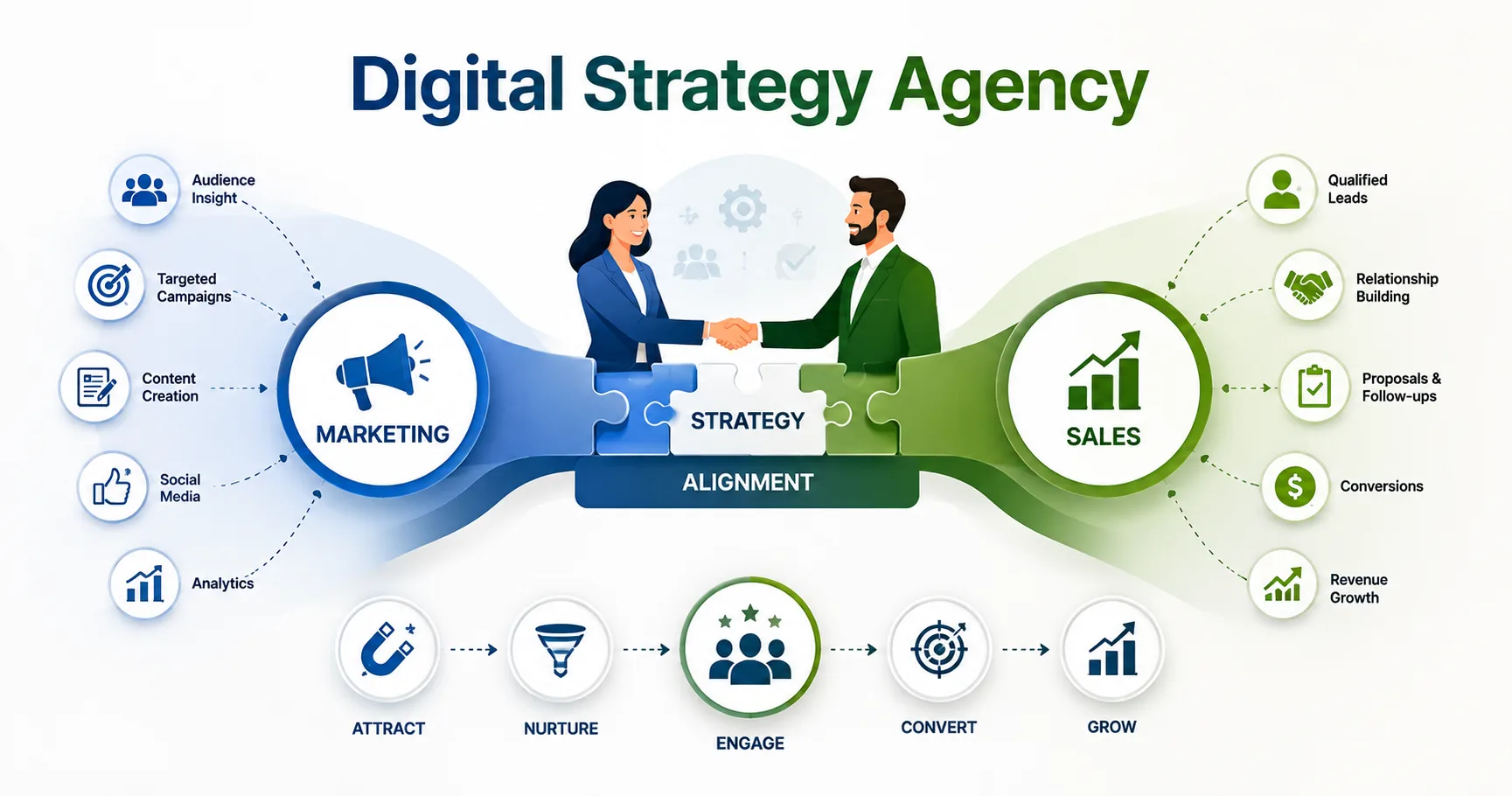
A well-planned digital strategy agency approach can help close that gap by connecting audience targeting, content, lead generation, CRM data, customer journeys and sales follow-up into one system.
The objective is not to generate the largest possible number of enquiries. It is to create a reliable path from the first interaction to a qualified sales conversation and, ultimately, revenue.
Why Marketing and Sales So Often Work in Separate Worlds
Marketing usually owns visibility.
Sales usually owns conversion.
That division sounds reasonable until the two teams start measuring completely different things.
Marketing may celebrate:
- Website traffic
- Impressions
- Click-through rates
- Social engagement
- Form submissions
- Marketing-qualified leads
Sales may care more about:
- Qualified opportunities
- Deal value
- Conversion rates
- Sales cycle length
- Closed revenue
- Customer fit
Neither set of metrics is wrong.
The difficulty starts when marketing is rewarded for increasing lead volume while sales is expected to turn those leads into revenue.
Recent 2026 discussions around alignment increasingly focus on shared definitions, common revenue goals, integrated data, and faster feedback rather than simply asking teams to “communicate better.”
That is where a broader strategy becomes important.
Instead of treating marketing and sales as two departments connected by a form submission, businesses can design the entire buyer journey around one commercial objective.
Start With the Customer, Not the Channels
One of the easiest ways to create disconnected marketing is to begin with channels.
“We need SEO.”
“We should run LinkedIn ads.”
“Let's start email marketing.”
“We need more social media.”
These may all be useful, but they are tactics.
The first question should be:
Who are we trying to attract, what problem are they trying to solve, and what usually makes them ready to buy?
A B2B software company, for example, may discover that its best customers are not searching for its product category directly. They may first search for ways to reduce a specific operational problem.
That changes the content strategy.
A professional services firm may find that prospects visit several pages before contacting sales. A local service company may discover that prospects want pricing information before they submit a form.
Those observations should shape the journey.
A strong digital marketing and sales strategy begins with customer behaviour and then determines which channels should support it.
Create One Definition of a Good Lead
“Lead” is one of the most misleading words in digital marketing.
Someone who downloads a guide is technically a lead.
Someone who requests a proposal is also a lead.
But their buying intent is obviously different.
Marketing and sales need to agree on what separates a casual enquiry from a commercially useful opportunity.
A simple qualification framework can include:
Fit: Is this the type of customer the business wants?
Need: Does the person have a problem the business can solve?
Intent: Have they demonstrated meaningful interest?
Timing: Are they considering a solution now or researching for later?
Authority: Can they influence or approve the purchase?
This becomes the foundation of a practical lead generation strategy.
Without it, marketing may optimise campaigns for inexpensive form submissions while sales spends time filtering out people who were never realistic prospects.
Build the Marketing-to-Sales Funnel Around Buyer Questions
A funnel should reflect how people actually make decisions, not simply how software labels them.
A potential customer may move through something like:
Problem recognition → Research → Comparison → Validation → Enquiry → Sales discussion → Decision
At each point, the questions change.
Early stage
“What is causing this problem?”
“What options exist?”
“Is this something we need to address?”
Middle stage
“Which approach is right for us?”
“What does implementation involve?”
“How much could this cost?”
Decision stage
“Why should we choose this company?”
“Can they prove they have done this before?”
“What happens after we sign?”
A useful marketing-to-sales funnel therefore gives people the information they need at each stage rather than repeatedly showing promotional messages.
Marketing creates useful entry points.
Sales receives context about what the prospect has already explored.
The handoff becomes much more meaningful.
Give Sales a Say in Content Planning
One of the most underused sources of marketing insight is the sales team.
Salespeople hear objections every day.
They know which questions prospects ask before buying. They know which competitors come up in conversations. They know which claims make customers sceptical. They know why deals stall.
That information should reach marketing.
For example, if sales repeatedly hears:
“Why is your service more expensive than the cheaper option?”
That is not just a sales objection.
It could become:
- An educational article
- A comparison page
- A pricing explainer
- A case study
- A short video
- A sales enablement document
This is where marketing and sales collaboration becomes commercially useful.
The relationship should work in both directions.
Marketing tells sales which campaigns and topics are generating interest.
Sales tells marketing what prospects actually say when money is on the table.
That feedback loop improves targeting and messaging over time.
Don't Send Every Lead Straight to Sales
Not every enquiry deserves an immediate sales call.
This is particularly important for businesses with long buying cycles.
Someone downloading an introductory report may simply be learning.
Someone visiting the pricing page three times and requesting a consultation is showing a different level of intent.
The business can respond accordingly.
Low-intent contacts can receive useful educational content.
Engaged prospects can receive case studies, comparisons, and more detailed information.
High-intent prospects can be routed to sales quickly.
This creates a more sensible digital strategy for lead generation because marketing is not judged solely on how many names it adds to a database.
It is judged on whether those contacts progress.
Make the Handoff Specific
The moment a lead moves from marketing to sales is where many businesses lose momentum.
A better handoff might show:
- Which campaign generated the enquiry
- Pages visited
- Content downloaded
- Product or service viewed
- Form responses
- Stated requirement
- Company information
- Previous interactions
- Lead score
- Recommended next action
Now the salesperson has a reason to begin the conversation.
Recent guidance on marketing-to-sales handoffs emphasises the same practical foundations: clear ownership, routing rules, qualification criteria, response expectations and trackable information.
The goal is not to collect every possible piece of data.
It is to provide the information that helps sales have a better first conversation.
Connect the CRM to the Bigger Picture
A CRM should not become a digital filing cabinet that marketing and sales use differently.
It should help answer questions such as:
- Where did this lead originate?
- Which campaigns influence opportunities?
- Which sources produce qualified prospects?
- How long does each stage take?
- Where do prospects drop out?
- Which reasons are most common for lost deals?
- Which content is associated with successful opportunities?
This is where a digital marketing and sales strategy becomes measurable.
Suppose one campaign produces 500 leads but only two customers.
Another generates 80 leads and produces eight customers.
Looking only at lead volume would make the first campaign appear successful.
Looking at revenue tells a very different story.
Measure Pipeline, Not Just Traffic
Traffic is useful.
So are clicks and impressions.
But businesses eventually need to connect activity to commercial outcomes.
Useful shared metrics include:
Lead-to-qualified-opportunity rate
Shows whether marketing is attracting suitable prospects.
Opportunity-to-customer rate
Shows how effectively qualified prospects convert.
Sales cycle length
Shows whether opportunities are moving efficiently.
Pipeline generated
Connects campaigns with potential revenue.
Closed revenue by source
Shows which channels are actually contributing to business results.
Cost per qualified opportunity
Provides a more meaningful view of acquisition efficiency than cost per lead alone.
The right measurement framework depends on the business model, but the principle remains consistent: marketing and sales should be able to look at the same numbers and understand what they mean.
Build Content That Helps Sales Close
Marketing content should not stop working once someone fills out a form.
A prospect who enters a sales conversation may still need reassurance.
That is where case studies, comparison pages, implementation guides, FAQs, testimonials, and detailed service pages become valuable.
Imagine a prospect says:
“We like your service, but we're worried about the implementation time.”
A useful sales team should not have to create the answer from scratch.
There should already be supporting content.
This is one of the practical benefits of digital strategy for business growth: content becomes part of the sales process rather than simply a traffic-generation exercise.
It can answer objections, demonstrate expertise and reduce uncertainty.
Use Lead Scoring Carefully
Lead scoring can help businesses prioritise attention, but it should not become a complicated mathematical exercise nobody trusts.
A practical model could award points for signals such as:
- Visiting a high-intent service page
- Requesting pricing
- Booking a consultation
- Opening relevant communications
- Returning repeatedly
- Matching the target customer profile
Negative signals can also matter.
For example:
- Student or job-seeker enquiry
- Unsupported location
- Outside target industry
- Invalid contact information
The score should support human judgement, not replace it.
Sales should be able to say, “This lead scored highly, but it is not a fit,” and marketing should be able to investigate why.
Fix the Gaps Between Funnel Stages
A business may have strong marketing and strong sales but still lose revenue between the two.
Look for gaps such as:
High traffic → Few enquiries
Potential issue: weak offer, unclear messaging, or poor conversion path.
Many enquiries → Few qualified opportunities
Potential issue: targeting or qualification.
Many qualified leads → Low sales acceptance
Potential issue: poor handoff or inaccurate lead definition.
Strong opportunities → Few closed deals
Potential issue: pricing, positioning, sales process, product fit, or competitive pressure.
Good close rate → Low repeat business
Potential issue: onboarding, customer experience, or retention.
This diagnostic approach is more useful than simply asking whether the marketing campaign “worked.”
It shows where the revenue journey is actually breaking.
Where an Agency Can Add Value
A digital strategy agency can sit between these functions and look at the complete system.
That may involve reviewing:
- Audience targeting
- Website structure
- SEO
- Paid media
- Content
- Landing pages
- CRM workflows
- Lead qualification
- Analytics
- Sales feedback
- Conversion paths
The agency's value should not be measured by how many activities it can perform.
It should be measured by whether those activities work together.
For example, SocioStreet can help businesses approach digital growth through connected strategy rather than treating SEO, content, social media and other channels as isolated projects.
That broader view matters because changing one part of the journey can affect everything downstream.
More targeted advertising may improve lead quality.
Better service pages may increase conversion.
Improved qualification may reduce sales workload.
Better sales feedback may improve the next marketing campaign.
That is a connected system.
How to Build a Practical Alignment Process
Businesses do not necessarily need a complicated transformation programme.
A simple operating rhythm can make a significant difference.
Weekly: Review active leads
Which leads came in?
Which were accepted?
Which were rejected?
Why?
Monthly: Review campaign performance
Which sources created qualified opportunities?
Which produced revenue?
Where did prospects drop out?
Quarterly: Revisit the target customer
Has the ideal customer changed?
Are new industries or segments appearing?
Are some segments converting better than expected?
Continuously: Feed sales insight into marketing
New objections should become new content.
Repeated questions should influence website copy.
Lost-deal reasons should influence positioning.
Successful sales conversations should reveal language that resonates with prospects.
This turns the strategy into a living process rather than a document created once and forgotten.
AI Can Help, But It Should Not Own the Strategy
AI can make parts of this process faster.
It can help analyse large amounts of CRM data, identify recurring themes in sales notes, group customer questions, summarise conversations and support lead prioritisation.
But businesses should be careful about allowing automation to make every decision.
A high score does not necessarily mean a good lead.
A low-engagement prospect may still become an important customer.
A keyword may generate traffic without attracting the right buyer.
Human judgement remains essential, particularly for complex B2B or high-value purchases.
The role of technology is to give teams better information and more time—not to remove responsibility for commercial decisions.
What a Connected Strategy Looks Like in Practice
Consider a company selling a high-value professional service.
Instead of running separate activities, it could create one connected journey:
SEO content attracts people researching a problem.
Educational landing page explains possible solutions.
Case study demonstrates expertise.
Lead magnet or consultation captures genuine interest.
CRM records the source and behaviour.
Lead qualification determines whether the contact fits.
Sales receives useful context.
Sales content answers objections.
Opportunity data returns to marketing.
Campaigns and content are refined.
That is the real difference between running marketing channels and building a digital strategy for business growth.
The channels still matter.
But they are no longer working independently.
The Real Goal Is Revenue Continuity
Marketing should not end its responsibility when a lead enters the CRM.
Sales should not become the first place where customer needs are understood.
Both teams have valuable information.
When that information moves between them, businesses gain a clearer picture of the buyer journey.
A strong lead generation strategy therefore asks more than, “How many leads did we generate?”
It asks:
Were they the right people?
Did they move forward?
Did sales have enough context?
What stopped the ones we lost?
Which campaigns influenced actual opportunities?
What should we change next month?
Those questions lead to better decisions than chasing another impressive lead-volume number.
Final Thoughts
Marketing and sales do not need to become one department to work as one growth system.
They need shared goals, shared customer definitions, connected data, and a reliable process for moving information from one stage to the next.
That is where a digital strategy agency can make a meaningful difference.
The strongest approach does not promise that every marketing lead will become a customer. No serious strategy can guarantee that.
Instead, it creates a clearer path between attention and revenue.
Marketing attracts the right people.
Content helps them make sense of the problem.
Qualification identifies genuine opportunities.
Sales receives useful context.
Customer feedback improves the next campaign.
And the data shows where the system needs work.
When those pieces finally connect, marketing stops being judged only by traffic and leads, while sales stops having to guess where their opportunities came from.
The result is a more useful partnership and a much clearer route from digital activity to business growth.
FAQs
1. How does a digital strategy agency connect marketing and sales?
A digital strategy agency can connect the two by aligning customer targeting, messaging, lead qualification, CRM data, content, and conversion goals. The important part is creating a shared process so marketing knows what sales considers valuable and sales can see how prospects interacted with the brand.
2. What is a digital marketing and sales strategy?
A digital marketing and sales strategy connects online acquisition with the activities required to convert prospects. It typically covers audience research, SEO, content, paid campaigns, website conversion, lead management, CRM processes, sales follow-up and performance measurement.
3. Why is a lead generation strategy important for sales?
A strong lead generation strategy focuses on attracting people who have a reasonable chance of becoming customers instead of maximising enquiry volume. Better targeting and qualification can give sales fewer irrelevant contacts and more opportunities worth pursuing.
4. What is the marketing to sales funnel?
The marketing to sales funnel describes the progression from initial awareness and research through qualification, sales engagement and purchase. Businesses can use it to identify what information customers need and where prospects are being lost before reaching a sales conversation.
5. How can marketing and sales collaboration improve conversions?
Effective marketing and sales collaboration allows both teams to share customer objections, campaign results, lead-quality feedback,k and conversion data. Marketing can then improve targeting and content while sales gets better context for its conversations.
6. What does digital strategy for lead generation include?
A practical digital strategy for lead generation can include SEO, paid advertising, content marketing, landing pages, social platforms, email nurturing, conversion optimisation and CRM workflows. The mix should depend on where the target audience actually researches and makes decisions.
7. How can digital strategy support business growth?
Digital strategy for business growth connects individual marketing activities with larger commercial objectives. Instead of measuring each channel independently, businesses can examine how awareness, enquiries, qualified opportunities, sales and retention work together.
8. What should marketing and sales agree on first?
Start with the definition of the ideal customer and what qualifies as a genuine sales-ready lead. After that, agree on ownership, response expectations, CRM stages, rejection reasons, and the metrics both teams will review. These basic rules remove much of the ambiguity that causes friction.
9. Can AI improve marketing and sales alignment?
Yes. AI can help identify patterns across CRM records, customer conversations, and campaign data. It can also support lead prioritisation and content analysis. However, businesses should use those insights alongside sales judgement rather than allowing automated scores to determine every commercial decision.
10. When should a business hire a digital strategy agency?
A business may benefit when marketing channels are active, but results are inconsistent, lead quality is poor, sales and marketing disagree about performance, or there is no clear connection between campaigns and revenue. A good agency should first diagnose the gap rather than immediately recommending more channels.