Search “best marketing agency” and you’ll get thousands of businesses claiming the exact same things: results-driven, data-backed, full-service. Almost none of it tells you anything useful, because almost every agency says it. The real differences show up somewhere else entirely, in how the work actually gets structured behind the scenes.
The Problem With Hiring Specialists Separately
Most businesses build their marketing the way they build a toolbox, one specialist at a time. An SEO freelancer here, a social media manager there, a designer for the website, an ad account on the side. Each person does competent work in isolation. The problem shows up in the gaps between them.
The SEO person writes content around one set of keywords. The ad manager sends traffic to a completely different landing page. The designer changes that page without telling anyone. The social account uses messaging that matches none of it. Every piece works fine on its own. Together, they tell four different stories about the same business.
What Changes When One Team Owns the Whole System
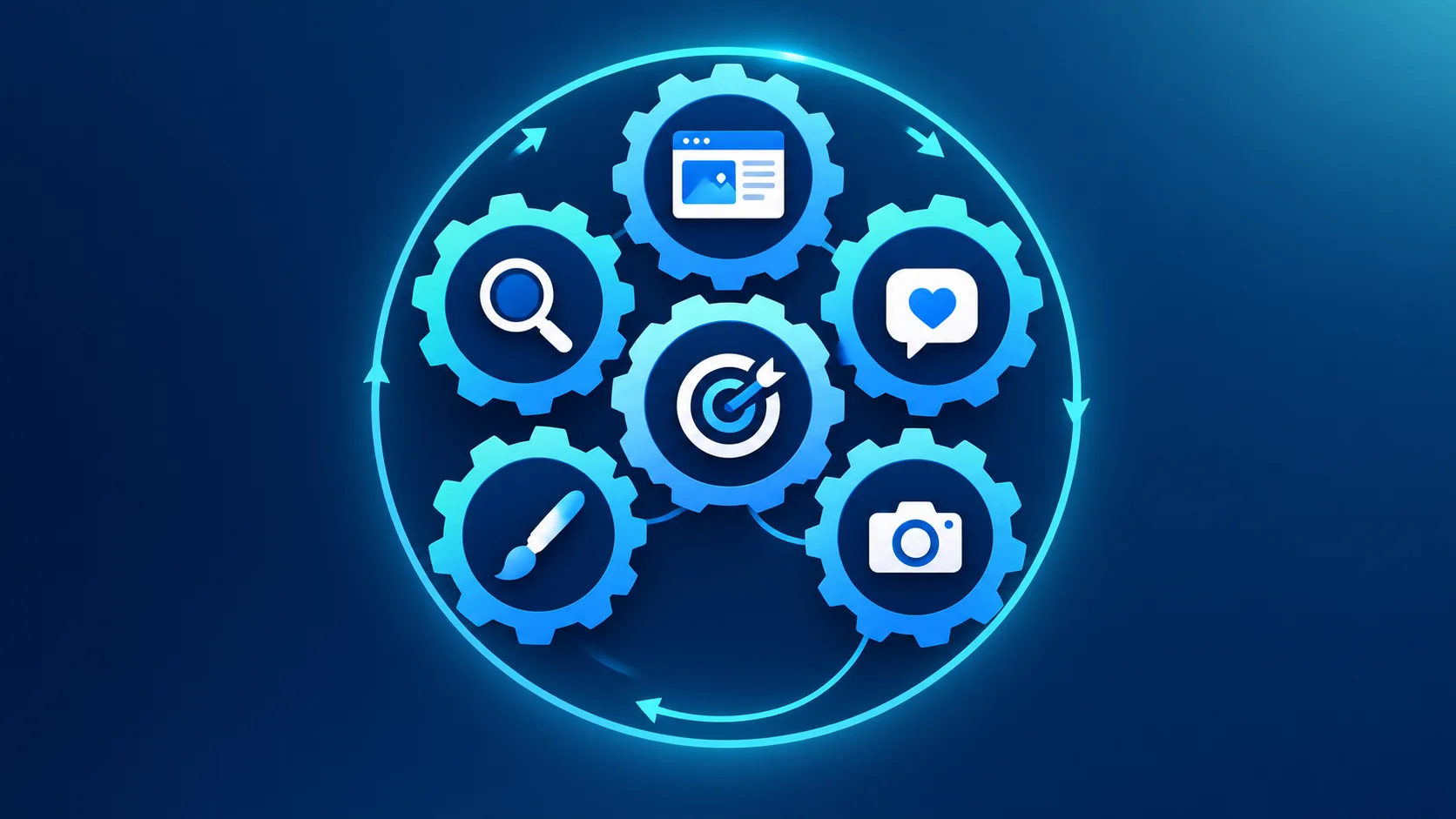
When a single team handles website, SEO, branding, content, social, and advertising together, the dynamic flips entirely. Research done for SEO feeds directly into content strategy. That content shapes the landing pages. The landing pages sharpen the ad copy. The ad data shows which messages actually resonate, and that feedback loops back into SEO and social.
Nothing is guessed at twice. Nothing contradicts anything else. A visitor who sees your ad, lands on your site, and checks your Instagram gets the same brand, the same voice, and the same message every time, which is a bigger deal for trust than most businesses realize.
Strategy Has to Come Before Any of the Pretty Stuff
A common mistake is starting a marketing relationship with design. A new logo gets made, a new website goes live, and everyone waits for results. Often nothing changes, because the actual problem was never the visuals. It was that no one could answer, in one clear sentence, why a customer should pick this business over the ten competitors they scrolled past first.
That answer, positioning, has to come from research: real customer interviews, competitor analysis, and an honest look at where the market has an opening. Design, messaging, and advertising only work well once that question has a sharp answer behind it.
A Website Is Infrastructure, Not a Brochure
Every other channel eventually sends traffic somewhere, and that somewhere is almost always the website. A site that loads slowly, confuses visitors, or buries the next step costs a business money on every channel at once, not just on organic search.
A website built with intention does three things well: it loads fast on every device, it makes the next action obvious, and it’s structured in a way search engines can actually understand. Skipping any one of those undermines the other two.
SEO Rewards Patience, Not Shortcuts
Paid advertising produces traffic immediately and stops the moment the budget does. SEO works on a completely different timeline, usually three to six months before real movement, and it keeps producing traffic long after the initial work is finished. Content published today can keep earning visits a year from now, without anyone touching it again.
The businesses that get frustrated with SEO are almost always the ones that judged it after six weeks instead of six months. The compounding effect is exactly the part that gets missed when a business quits too early.
Judging Fit Before Signing Anything
A few signals separate an agency built to deliver from one that’s mostly good at selling itself: whether they ask real questions about your customers before pitching a plan, whether they’ll tell you honestly when something isn’t ready yet (like holding off on ad spend until the site can actually convert), whether they can show real case studies instead of just polished visuals, and whether support continues after launch instead of stopping the moment the invoice clears.
The Bottom Line
Good marketing isn’t about doing more things. It’s about making sure the things being done all point in the same direction. A business that connects its website, content, branding, and advertising under one coherent strategy will consistently outperform one juggling five disconnected vendors, even with the same budget.
That’s the approach behind Tilted Vision CR, a Dallas-based agency building websites, brand strategy, content, and campaigns as one connected system rather than six separate projects.