Quick version: The hardest problem in a multilingual call center has always been simple to state: what happens when an agent and a caller don't speak the same language. AI softphones now solve it by translating the call live, so each person speaks their own language and understands the other, while also transcribing and summarizing the call automatically. For a call center, that turns an expensive staffing problem into a software feature.
If you run a call center that serves customers in more than one language, you already know where things break down. A call comes in, the caller speaks a language your available agent doesn't, and now you're transferring, holding, or losing the customer. Every one of those costs time and money, and chips away at the experience.
For years, the only fixes were costly. Hire agents for every language, or pay interpreters by the minute. Both work, both are expensive, and neither ever quite covers every language that comes up. But that's changing, quietly. AI softphones are starting to solve the language problem with software instead of staffing, and for call centers, it's a real shift. Here's how it works.
What is an AI softphone?
An AI softphone is a calling app that does more than just connect a call. On top of normal calling, it uses AI to translate the conversation live, turn it into text, and summarize it once the call ends. A traditional softphone links the agent and the caller. An AI softphone links them and helps them understand each other, even when they don't share a language.
For a call center, that lands exactly where the pain has always been.
Why language has always been the expensive part
Supporting several languages is one of the quiet, heavy costs of running a call center.
The traditional route means hiring agents who speak those languages, so you're recruiting for language skills on top of everything else. Or you contract interpreters and pay per minute. Either way, costs rise, scheduling gets harder, and callers wait longer while the system finds someone who can help.
And coverage is never quite complete. There's always a language that turns up now and then, not often enough to hire for, but often enough to cause a problem when it does. That gap is where customer experience quietly suffers.
How real-time translation changes the math
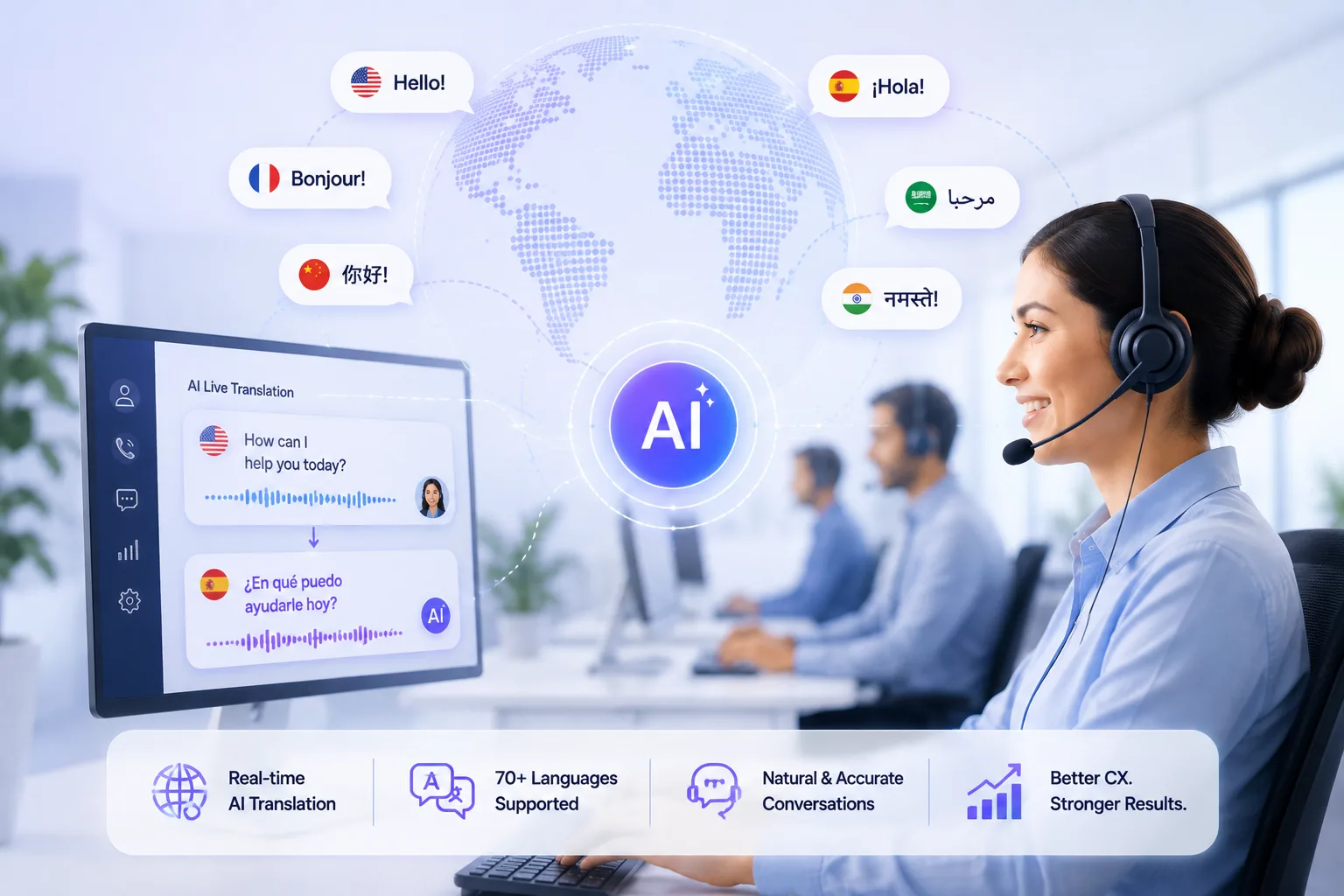
An AI softphone takes a different approach. Instead of matching every caller to an agent who speaks their language, it translates the whole conversation live, in both directions, as the two people talk.
The agent speaks their own language. The caller hears it in theirs. The caller replies, and the agent hears it in their own language. The software handles the translation in the middle, in near real time. Good AI softphones cover a wide range of languages, some 70 or more, and can detect the spoken language automatically so nobody has to set it up first.
That changes the whole cost picture. A single agent can now take calls in languages they don't speak, so you stop staffing by language. The rare-language problem mostly disappears, because the software covers languages you'd never have hired for. And routing gets simpler, because you're matching on skill and availability instead of language.
A quick note on how it runs: the translation is anchored on the agent's side, on a desktop or web app where the processing happens. The caller can be on anything, a mobile or a landline, and it still works, because their device isn't part of the translation. Since agents work on managed desktops anyway, it fits the setup naturally.
It also records and summarizes the call
Translation is the headline, but AI softphones do two more things call centers care about.
They turn the conversation into text as it happens, and in an AI softphone, that text can appear in the agent's own language even when the call was in another. So the agent gets a readable record of a cross-language call, live, that they can check during the call and save afterward.
And when the call ends, the AI writes a summary of what was discussed and decided, so the agent doesn't type it up. Across thousands of calls, that saves a lot of agent time. Because the transcript is searchable, finding what was said on a past call becomes a quick search instead of digging through recordings.
Why call centers benefit most
AI softphone features are useful in a lot of settings, but call centers get the most from them, by a wide margin.
A call center is language barriers all day. It's after-call work multiplied across thousands of conversations. It's the constant need to know what was said and promised. AI softphones address every one of those. So while a small team might see AI translation as a nice extra, for a call center it's closer to solving the central challenge of the whole business.
That's why the shift is moving quickly here, even if quietly. The businesses feeling the language-cost pain most are the ones with the most to gain, and they're moving first. If you want to see how AI softphones sit alongside the other parts of a call center setup, like routing and provisioning, this guide to scalable VoIP contact center solutions is a useful place to start.
Conclusion
Call centers have always run into the same wall: agents and callers who can't understand each other, and the high cost of bridging that with people. AI softphones are taking the wall down, translating calls live, capturing them as searchable text, and summarizing them automatically.
For a call center, this isn't a small upgrade. It changes what it costs to serve customers across languages, turning an expensive hiring problem into a simple software one. The change is happening quietly, but for any call center dealing with more than one language, it's worth watching closely, because the ones that adopt it early will serve more customers, in more languages, at lower cost than the ones still doing it the old way.