As wireless technologies move deeper into advanced 5G deployments and early-stage 6G research in 2026, over-the-air (OTA) testing has become a non-negotiable requirement for validating real-world device performance. Antenna systems today are highly integrated, adaptive, and software-controlled, making traditional conducted testing insufficient for accurate evaluation.
In this environment, an antenna testing chamber plays a critical role by enabling precise, repeatable OTA measurements under controlled RF conditions. From validating MIMO performance and beamforming accuracy to ensuring regulatory compliance across FR1 and FR2 frequency bands, modern test chambers are central to how wireless devices are designed, verified, and certified in 2026.
With growing pressure to reduce time-to-market while meeting stricter performance and compliance expectations, organizations are increasingly relying on chamber-based OTA testing to gain confidence in their antenna designs before products reach the field.
Key Takeaways
- Learn how controlled RF environments eliminate interference and reflections during OTA testing
- Understand the role of chamber design in improving measurement accuracy and repeatability
- Discover why modern wireless technologies rely on OTA validation over conducted tests
- Explore best practices for selecting and optimizing antenna test setups
- See how accurate OTA measurements directly impact certification and product performance
Why OTA Accuracy Matters More Than Ever
OTA measurements are designed to evaluate how a device actually performs in free space. Unlike conducted testing, which isolates individual RF ports, OTA testing captures the combined effects of antennas, RF front-end components, enclosure materials, and signal-processing algorithms.
In today’s devices, antennas are tightly integrated and often inaccessible. Beamforming, massive MIMO, and adaptive radiation patterns mean that traditional cable-based methods no longer reflect real operating conditions. Even small measurement errors can lead to failed certifications, degraded field performance, or unexpected compliance issues later in the product lifecycle.
A properly designed test environment ensures that what engineers measure in the lab closely matches how the device will behave in the real world.
The Controlled Environment Advantage
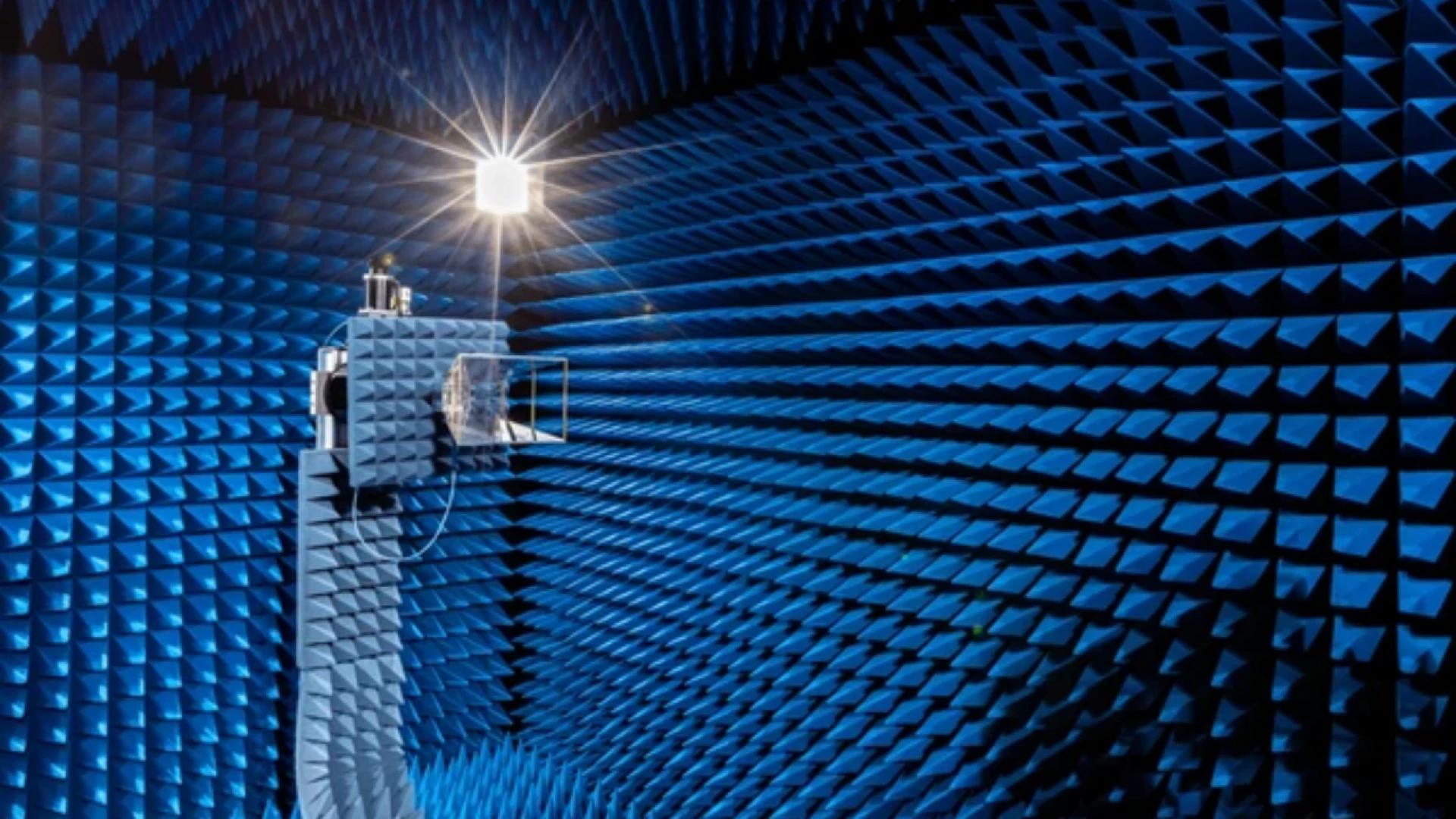
At the core of accurate OTA testing is environmental control. External RF noise, multipath reflections, and electromagnetic interference can easily distort measurements if not properly managed. An antenna testing chamber addresses these challenges by creating a predictable, isolated space for evaluation.
RF absorbers lining the chamber walls, ceiling, and floor suppress unwanted reflections and simulate free-space conditions. Shielded enclosures block external signals, ensuring that only the test signals influence the results. This controlled environment allows engineers to trust the data they collect—an essential factor when validating advanced wireless systems.
Consistency is equally important. OTA measurements must be repeatable across multiple test runs, devices, and test sites. Chamber-based testing enables standardized procedures, reducing variability and improving confidence in results.
How Chamber Design Influences Measurement Accuracy
Not all test environments are created equal. The geometry, absorber performance, and internal layout of a chamber directly affect measurement quality.
Modern chambers are designed to support a defined test volume where field uniformity is carefully controlled. Within this quiet zone, the device under test experiences stable RF conditions that allow precise characterization of parameters such as radiated power, sensitivity, and radiation patterns.
Probe antenna placement is another critical factor. Whether using spherical, cylindrical, or sector-based configurations, the spatial arrangement must align with standardized OTA methodologies. Accurate positioning ensures proper angular coverage and spatial sampling—especially important for evaluating MIMO and beamforming behavior.
A well-engineered antenna testing chamber integrates these elements into a cohesive system, minimizing uncertainty and maximizing measurement fidelity.
Addressing Common OTA Testing Challenges
OTA testing presents several technical challenges that extend beyond simple signal transmission and reception. Multipath effects, polarization mismatches, and dynamic beam steering can complicate measurements if not properly managed.
Chambers mitigate multipath issues by absorbing reflected energy rather than allowing it to bounce back toward the device. Polarization control is achieved through precise antenna alignment and probe design. For beamforming systems, automated positioning systems and synchronized measurements enable accurate mapping of directional performance.
Temperature stability, mechanical precision, and calibration routines further contribute to reliable results. Together, these factors transform OTA testing from an approximation into a dependable engineering process.
Benefits Across the Product Lifecycle
Accurate OTA measurements are valuable at every stage of product development. During early design, they help engineers validate antenna concepts and identify performance trade-offs. In later stages, they support design verification and optimization before certification testing begins.
For manufacturers, this translates into fewer redesigns, reduced certification risk, and faster time-to-market. For test labs and institutions, it means higher throughput and consistent results across diverse device types.
As regulatory bodies continue to emphasize OTA-based compliance, having a reliable chamber setup is no longer optional—it is a strategic advantage.
Best Practices for Selecting and Optimizing a Test Setup
Choosing the right chamber configuration depends on several practical considerations. Frequency range is a primary factor, particularly as testing expands across sub-6 GHz and mmWave bands. Chamber size, absorber performance, and probe architecture should align with the intended use cases.
Automation is another key consideration. Motorized positioners, integrated control software, and repeatable measurement workflows significantly improve efficiency and reduce operator dependency. This is especially valuable in high-volume testing or research environments where consistency is critical.
Regular calibration and validation against known references help maintain measurement accuracy over time. Institutions and organizations that treat OTA testing as an ongoing process—rather than a one-time setup—are better positioned to adapt as standards and technologies evolve.
The Role of Standardization and Compliance
OTA testing is closely tied to global standards and certification requirements. Industry bodies continue to refine methodologies to account for emerging technologies and use cases. A chamber-based approach makes it easier to align with these evolving standards by providing a stable, documented test environment.
Standardization also facilitates collaboration across teams and locations. When measurements are performed in comparable environments, data can be shared and trusted with greater confidence—an increasingly important factor in global development and manufacturing operations.
FAQs
What is the main purpose of OTA measurements?
OTA measurements evaluate how a wireless device performs in real-world conditions by assessing radiated characteristics such as power, sensitivity, and radiation patterns without direct cable connections.
Why can’t conducted testing replace OTA testing?
Conducted tests isolate RF ports and bypass the antenna system. This approach fails to capture the combined effects of antennas, housing, and signal processing, making it unsuitable for modern integrated devices.
How does chamber size affect OTA accuracy?
Chamber size influences field uniformity and quiet zone performance. A properly sized chamber ensures that the device experiences stable RF conditions during measurement.
Are antenna testing chambers only for 5G devices?
No. They are used across a wide range of applications, including IoT, automotive, aerospace, defense, and emerging 6G research.
How often should OTA test systems be calibrated?
Calibration frequency depends on usage and standards, but regular verification is essential to maintain accuracy and repeatability over time.
Take the Next Step Toward Reliable OTA Validation
As wireless systems continue to evolve, accurate OTA measurements are becoming the foundation of reliable product development and certification. Investing in the right test environment enables organizations to validate performance with confidence, reduce risk, and stay aligned with industry standards.
By combining engineering expertise with advanced testing solutions, Orbis Systems supports organizations worldwide in achieving accurate, repeatable OTA measurements—helping them navigate the complexities of modern wireless validation with confidence and precision.