A tender can bring in hundreds of pages. Multiply that by ten bidders, and a team may face thousands of pages before it can pick a winner.
Someone has to read all of it. Someone has to compare prices, check licenses, match claims to proof, and write a report that holds up if a bidder objects later.
This work is slow, and it is easy to make mistakes when you are tired and the deadline is close. That is why many procurement teams now look at AI tender evaluation. The tools can read documents, pull out key facts, and flag gaps, so people can spend more time on judgment and less on paperwork.
This article explains how the change works. It covers what AI does well, where people still matter, and how to pick the right tool for your team.
What Tender Evaluation Involves
Tender evaluation is the step where a buyer reviews the bids it received and decides who gets the contract. Most teams follow the same basic path:
- Open and log the bids. The team records what arrived and when.
- Check eligibility. Does the bidder meet the basic rules, such as licenses, registrations, and past experience?
- Review the technical bid. Does the offer meet the stated needs?
- Compare the commercial bid. What are the prices, terms, and conditions?
- Score and rank. Teams apply the criteria set in the tender.
- Record the decision. The file must show why one bidder won.
Each step depends on documents. Those documents come in many forms. Some are typed forms. Some are scanned certificates. Some are long proposals written in each bidder’s own style.
Government bodies, public sector units, and large companies all face this. The rules differ, but the pain is the same: too much paper and too little time.
Why the Manual Method Struggles
People do this work well, but the method has limits. Here are the main problems.
It takes a long time. A reviewer must read each file, find the facts, and copy them into a sheet. For large tenders, this can stretch over weeks.
It invites small errors. When you copy numbers from fifty documents, a typo is likely. A missed date or a mismatched name can cause trouble later.
Different reviewers read differently. One person may be strict about a missing stamp. Another may let it pass. Over time, this leads to uneven results.
Gaps are hard to spot. A bidder may state one turnover figure in the cover letter and a different one in the annual report. A person may not notice when the two files are 200 pages apart.
Records can be thin. If someone challenges a decision, the team needs to show how it reached that result. Notes scattered across emails and sheets make this hard.
None of this means the team is doing poor work. It means the volume of paper has outgrown the tools. Spreadsheets and email were never built to read documents.
How AI Tender Evaluation Works
AI tender evaluation uses software to read bidder documents and support the review. The tool does not replace the evaluation team. It does the heavy reading and sorting, then hands the team a clear picture.
Most systems follow four steps.
Step 1: Read the documentsThe team uploads the bid files. These can be forms, proposals, certificates, and scans. The software uses document reading methods to turn them into text it can work with. This includes text inside scanned pages.
Step 2: Pull out key factsThe software finds the fields that matter. These include company names, registration numbers, dates, prices, delivery terms, and proof of past work. It stores them in an organized format.
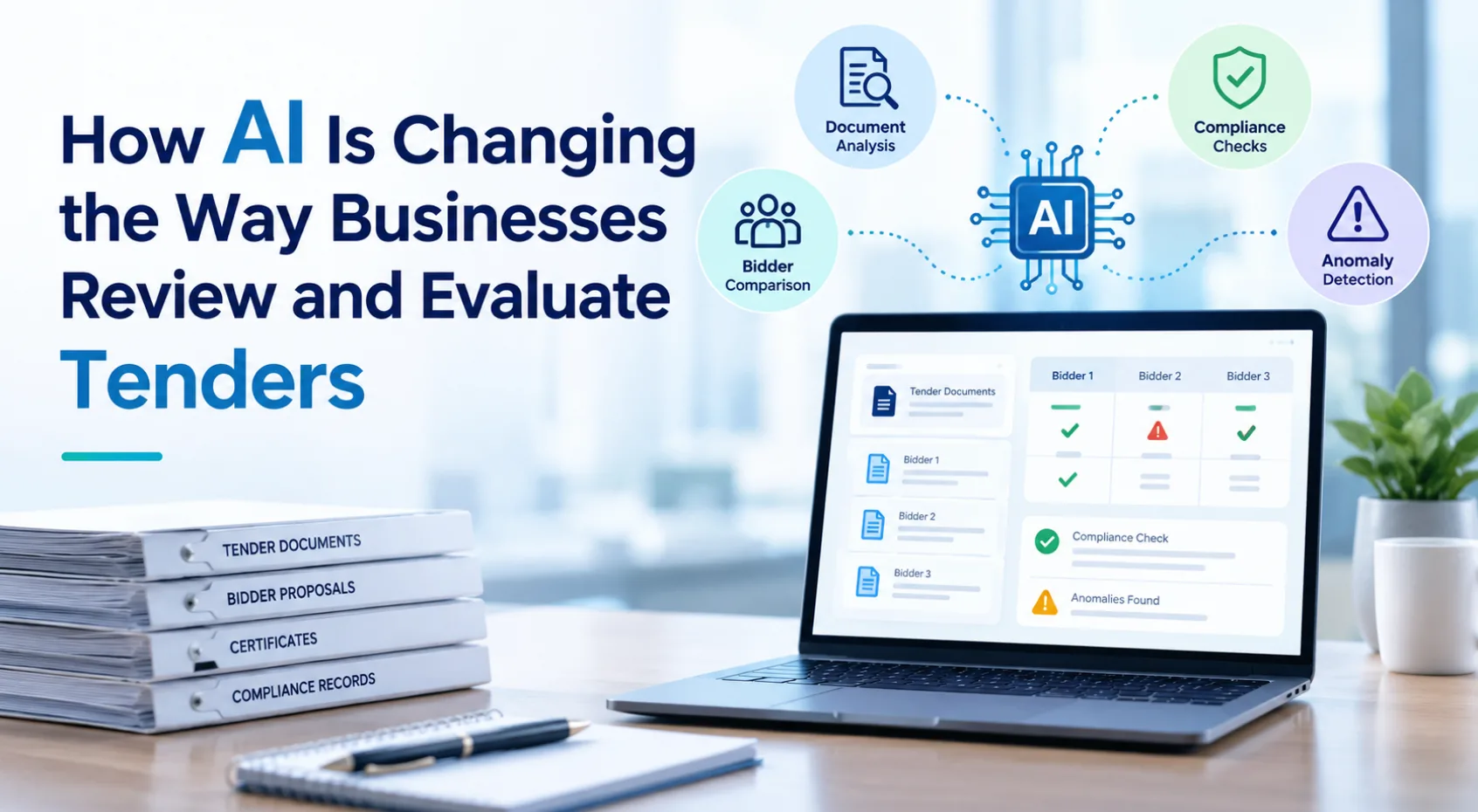
Step 3: Compare and checkThe software places each bidder’s data side by side. It checks each bid against the tender rules. It flags missing items, odd values, and facts that do not match across documents.
Step 4: Produce a recordThe team receives a summary view and a trail that shows what the software found and where it found it. Evaluators can click back to the source, confirm the finding, and make the final call.
This last point matters. A good system makes its work easy to check. If a reviewer cannot trace a result back to the source page, the result has little value.
Where Generative AI Fits In
Older tools could extract data, but they needed strict templates. If a bidder used a different layout, the tool often failed.
Generative AI for tender evaluation works differently. It can read text written in plain language and understand what it means. It can handle a proposal that has no fixed format. It can also help write things, not just read them.
Here are some ways teams use it:
- Reading long proposals. The model can find the sections that answer a given requirement, even when the bidder used different headings.
- Matching claims to proof. If a bidder says it completed a similar project, the tool can look for the supporting letter or certificate.
- Drafting tender documents. Based on set criteria, the tool can create a first draft of the tender itself. The team then edits it.
- Writing evaluation notes. The tool can prepare a first version of comparison notes, which the evaluators review and correct.
A word of caution is needed here. Generative models can sometimes produce wrong statements. For this reason, any tool used in procurement should show its sources and keep people in charge of decisions. We cover this in more detail below.
Manual Review vs. AI-Assisted Review
The table below shows how the two approaches differ across common tasks.
TaskManual reviewAI-assisted reviewReading bidder filesStaff read every page one by oneSoftware reads and sorts files, including scansPulling out dataStaff copy facts into sheets by handSoftware extracts fields and fills a comparison sheetComparing biddersBuilt by hand, often late in the processSide-by-side view created from extracted dataCompliance checksDone by memory and checklistsChecked against the tender rules, with gaps flaggedFinding mismatchesDepends on the reviewer’s attentionSoftware flags values that disagree across documentsConsistencyCan vary by reviewerSame checks applied to every bidRecordsSpread across emails, notes, and sheetsOne trail that links findings to source documentsFinal decisionMade by evaluatorsStill made by evaluatorsThe last row is the key one. AI changes how the work gets done. It does not change who is responsible for the outcome.
What Businesses Gain
Teams that adopt AI tender evaluation software usually look for gains in five areas.
Speed. Reading and data entry take up much of the review time. When software handles them, the team can reach the scoring stage sooner.
Coverage. A person under time pressure may skim. Software reads everything the same way each time, so fewer details slip through.
Consistency. The same rules are applied to every bidder. This supports fair treatment, which matters in both public and private buying.
Clear records. If a bidder asks why it lost, or if an auditor reviews the file, the team can show the steps and the sources.
Better use of expert time. Skilled evaluators are paid for their judgment. When they spend less time copying numbers, they have more time to judge quality, risk, and value.
What to Look For in AI Tender Evaluation Software
Not every tool will suit every team. Before you choose, ask these questions.
Can it read your real documents?Test it with the files you actually receive. Include scanned pages, tables, and long proposals. A tool that works only on clean sample files will not help much.
Does it show its sources?Every extracted fact and every flag should link back to the page it came from. This lets reviewers check the work quickly.
Does it check against your rules?The software should compare bids against your eligibility and evaluation criteria, not a generic list.
Does it flag problems instead of hiding them?A good tool says “this value does not match that value” and lets a person decide. It should not quietly pick one.
Does it keep an audit trail?Look for a clear record of what was found, when, and from which file. This helps with reviews and disputes.
How does it protect data?Bid documents hold prices, company details, and trade information. Ask about access controls, security practices, and how data is stored and handled.
Does it fit how your team works?The tool should support your steps, not force you to rebuild your whole process. Ask for a demo using your own use case.
Valiance Tender Intelligence: One Example
Valiance Solutions builds AI products for several fields, and one of them is built for procurement. Valiance Tender Intelligence is a Generative AI platform that supports the tender evaluation process from document intake to a decision-ready view.
According to the company, Valiance Tender Evaluation is designed to cover the following tasks:
- Automated document parsing. The platform extracts key information from bidder documents, including forms, scanned certificates, and proposals.
- Bidder comparison. It places multiple submissions side by side so evaluators can see the differences quickly.
- Compliance validation. It checks submissions against the set requirements and flags missing information and mismatches.
- Anomaly detection. It highlights unusual or inconsistent details for a person to review.
- Pre-tender drafting. It can generate draft tender documents based on defined eligibility and evaluation criteria.
- Audit-ready records. It keeps a digital trail through the evaluation, which helps with accountability.
- Secure data handling. It uses access controls and security measures to protect sensitive bidder information.
The workflow is simple. The team uploads the bidder documents. The platform reads them and extracts the key fields. It then fills a comparison sheet and flags gaps. Evaluators receive a consolidated view of all bids, ready for review.
Valiance says its platform is meant for procurement teams, evaluators, government bodies, public sector units, and enterprises that handle document-heavy tenders. It also notes that its public sector work covers explainable and auditable AI, which matters when decisions must stand up to review.
Common Use Cases
Here are the stages of the process where this type of tool can help.
Multi-bidder evaluation. Compare many bids without reading each document line by line.
Eligibility and compliance checks. Confirm that licenses, certificates, and other proof are present and match the rules.
Technical bid evaluation. Pull out technical details and organize them so evaluators can score them against the criteria.
Commercial bid comparison. Place prices, payment terms, and conditions in a structured view.
Large document review. Process long proposals and scanned records that would take a person many hours to read.
Audit preparation. Produce traceable outputs that make later reviews easier.
Keeping People in Charge
AI can help a lot, but it should not run the process alone. Here is how to keep it safe and fair.
Treat the output as support, not a verdict. Evaluators should confirm important findings against the source documents before they use them.
Test before you rely on it. Run a past tender through the tool and compare the result with what your team found. Look at what it caught and what it missed.
Set clear rules for the tool. Define what the tool may do, such as extract data and flag gaps, and what only people may do, such as score and award.
Protect the data. Bids contain private information. Limit who can see it, and confirm how the vendor handles storage and access.
Watch for bias in the criteria. The tool applies the rules you give it. If the rules are unfair, the results will be too. Review the criteria itself before you start.
Keep records. Save the findings, the reviewer’s edits, and the final reasons for the decision.
Following these habits makes the process easier to defend, whether the reviewer is a manager, an auditor, or a bidder.
How to Get Started
You do not need to change everything at once. A small start works well.
- Pick one tender type. Choose one that is common and document-heavy.
- List your pain points. Note where your team loses the most time, such as reading, data entry, or compliance checks.
- Define success. Decide how you will judge the trial, for example time spent, errors found, or ease of reporting.
- Run a pilot. Use a past tender so you can compare the tool’s output with a known result.
- Review with your team. Ask evaluators what helped and what did not.
- Expand step by step. Add more tender types once the first one runs well.
Final Thoughts
Tender evaluation has always been careful, detailed work. The problem was never a lack of skill. It was the amount of paper.
AI tender evaluation software now takes on the reading, sorting, and checking. People keep the judgment. When the two work together, teams can review bids in a more consistent way, spot gaps earlier, and keep cleaner records.
If your team handles tenders that are long, varied, and full of documents, this is a good time to look at what these tools can do. Start with a small test, check the results against your own, and build from there. To see how one platform handles this work, take a look at Valiance Tender Intelligence.
Frequently Asked Questions
What is AI tender evaluation?AI tender evaluation is the use of software to read bidder documents, extract key facts, compare bids, and flag gaps. Evaluators use the results to make faster and more consistent decisions.
How does Generative AI help with tender evaluation?Generative AI can read free-form text, find the parts of a proposal that answer a requirement, and help draft tender documents and notes. People should review its output before using it.
Can AI tender evaluation software handle scanned documents?Many platforms can read scanned certificates and similar files. Valiance states that its platform extracts information from structured forms, scanned certificates, and proposals. Always test any tool on your own files.
Does AI replace the evaluation team?No. The software handles repetitive reading and checking. Evaluators still score the bids, weigh the risks, and make the final decision.
Who can use an AI tender evaluation platform?Procurement teams, evaluators, government bodies, public sector units, and enterprises that manage document-heavy tenders can all use these platforms.
How does Valiance Tender Evaluation support compliance?It checks bidder submissions against defined requirements and evaluation criteria, and flags missing information, mismatches, and possible gaps for review.