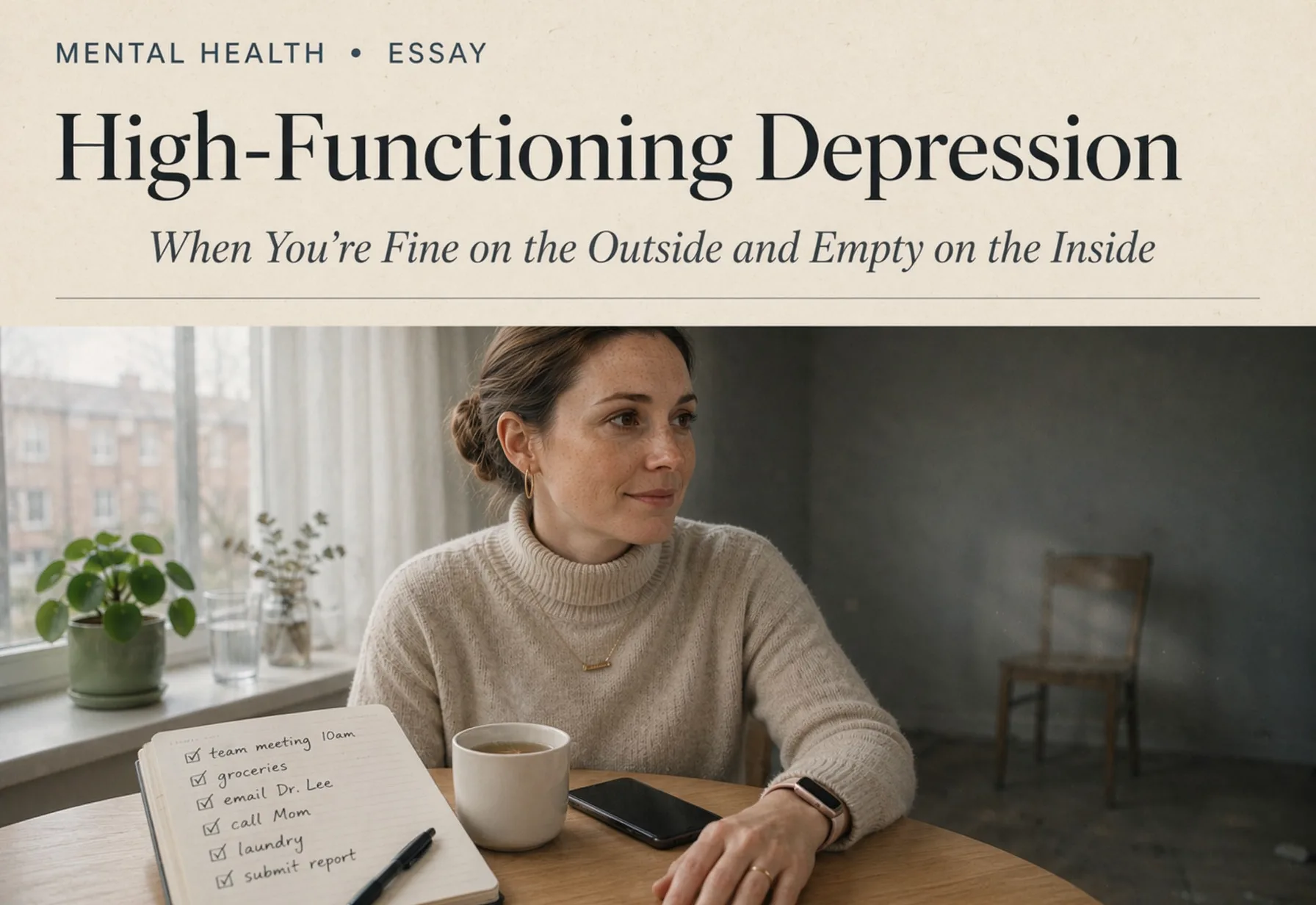
Most people picture depression as someone who can't get out of bed. Someone visibly falling apart. Someone whose struggle is obvious enough that people notice and ask questions.
That's one version of it. But it's not the most common one I see in my practice.
The version I see most often walks into my room looking completely fine. Goes to work every day. Replies to messages. Shows up for things. Keeps the apartment reasonably clean. And yet, underneath all of that functioning, there's a persistent flatness - like someone has turned the brightness down on everything without touching the on/off switch.
This is high-functioning depression, and it goes unnoticed for longer than almost any other presentation - sometimes for years.
It Doesn't Look Like What You Think
Here's the thing about high-functioning depression that's hardest to explain to someone who hasn't experienced it: it doesn't feel like sadness. Not primarily. It feels more like absence. Things that used to matter don't seem to register the same way anymore. Activities that used to bring genuine pleasure feel neutral. The future looks strangely opaque - not bleak exactly, just without the texture of possibility it used to have.
I remember a woman who came to me a few years ago - mid-thirties, successful by any external measure, not a single obvious reason to be struggling. She'd been describing herself as "just a bit flat lately" to the people around her. She'd been saying this for about eleven months.
By the time she walked into my room, she'd stopped going to the gym she used to love, had declined several social invitations with excuses that were technically true but not the real reason, and had started getting through evenings almost entirely on autopilot. She didn't identify as depressed. She identified as tired.
The Cultural Dimension Nobody Talks About
This pattern is particularly common in Indian households and in the South Asian diaspora - for a specific reason. There's a very strong cultural script around keeping it together, around having "no reason to complain," around the idea that if your practical life is in order, your emotional life should follow.
So when someone is managing fine on paper, the gap between that and how they actually feel produces something that looks like guilt more than depression. "Why am I like this? I have a good life. Other people have real problems." That sentence - or some version of it - is one of the most common things I hear in early sessions with people navigating high-functioning depression.
The guilt of not having "earned" the depression is one of the things that keeps it hidden longest.
What It's Actually Doing to You
The functioning is real. These aren't people who are pretending to manage - they genuinely are managing, externally. What the depression is doing is narrowing the world gradually, quietly, without announcement.
The things that get dropped first are usually the things that brought genuine pleasure. The hobby. The weekend plan with friends. The regular gym visit. They get replaced by less, by easier, by the path of least resistance - not because the person is lazy, but because the energy required to do the things that used to feel automatic has somehow tripled.
Over time, the world gets smaller. And because each individual narrowing feels justifiable - I'm just tired, it's a busy period, I'll do it next week - the pattern doesn't announce itself as depression. It just quietly becomes life.
What Helps - And What Doesn't
Rest doesn't fix this. I want to say that clearly because it's one of the most common things people try. Taking a weekend off, taking a holiday, getting more sleep - these provide temporary relief at best. The flatness comes back because it's not caused by tiredness. It's a different mechanism entirely.
CBT and Behavioral Activation - the two approaches with the strongest evidence for depression - work differently from what most people expect. Behavioral Activation particularly involves gradually reintroducing activities that carry meaning, before motivation returns. That sounds almost backwards. We tend to wait until we feel like doing something before doing it. But in depression, that sequence reverses - the activity comes first, and the feeling follows after. Small, specific, structured steps.
If you've been waiting to feel better before you do things, that wait may be contributing to the pattern rather than being a reasonable response to it.
About Shyamolie Desai
I'm a Clinical Psychologist in Mumbai and I work with depression across all its presentations - including the quiet, functioning version that doesn't announce itself as depression. I practice at centers in Chembur, Sion, Wadala, and Santacruz, with online sessions available for clients anywhere in India. Every client works directly with me.
Frequently Asked Questions
Can you be depressed and still go to work?
Yes. High-functioning depression is specifically characterized by the ability to maintain external responsibilities while experiencing significant internal flatness, loss of pleasure, and reduced emotional engagement. The functioning doesn't indicate the absence of depression.
How is high-functioning depression diagnosed?
Through clinical assessment - structured interview about symptoms, duration, and their impact on daily functioning. If this resonates, speaking with a qualified clinical psychologist is the appropriate next step.
How long does high-functioning depression typically go undetected?
It varies significantly, but months to years are common. The absence of visible distress means there's rarely an obvious moment that prompts someone to seek support.
Can it get worse over time?
Yes. Untreated, the gradual narrowing of activities and engagement tends to deepen. Early intervention consistently produces better outcomes than waiting until things feel more "serious."
If any of this sounds familiar - not because you're in crisis, but because something has been quietly off for longer than you've admitted - that's worth paying attention to. The brightness can come back. It usually needs more than waiting, though.