
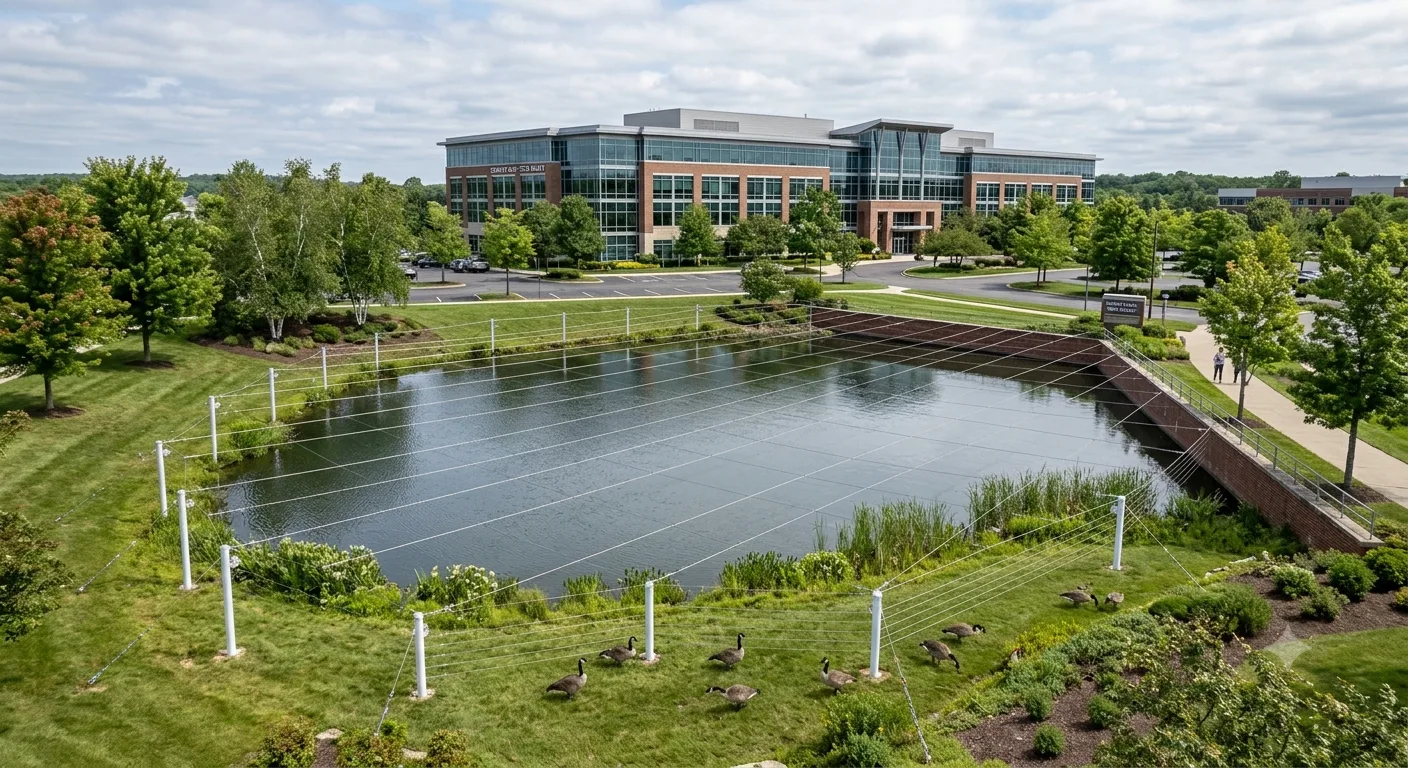
Ask a property manager who's dealt with a persistent goose problem what they tried first, and fencing usually comes up early in the conversation. It makes intuitive sense. Put up a barrier and block access to the lawn or the pond edge, and the geese will have nowhere to land. In practice, the results are a lot less consistent than the logic suggests.
Physical barriers do have a place in goose management. The problem is that most properties either install the wrong type, put it in the wrong location, or expect it to solve a problem that actually requires a behavioral approach.
How Grid Wire Systems Work
Grid wire is probably the most talked-about barrier method for open water. The idea is to string thin wires in a grid pattern a few inches above a pond or retention basin, spaced closely enough that geese can't land on the water without clipping a wire on approach. Since geese need a clear runway to land and take off, a grid disrupts that pattern enough that most birds avoid the area entirely.
On smaller, contained bodies of water, grid wire can genuinely work. Detention ponds, decorative water features, and small retention basins are good candidates because the footprint is manageable and the wires can cover the entire surface. The catch is scale. Larger ponds, lakes, or anything with an irregular shoreline become expensive and difficult to cover completely, and a partial grid just pushes geese to the uncovered section rather than deterring them from the property altogether.
Why Fencing Struggles on Land
Fencing runs into a different set of problems. Low fencing around a pond edge or lawn perimeter can discourage geese from waddling in from the water, since geese generally prefer walking to flying when they have the choice. But it does nothing to stop geese that simply fly in and land inside the fenced area to begin with.
This is the gap most property owners don't anticipate. A fence blocks ground access. It does not block airspace. On a property with an open lawn and a clear flight path in, geese will land inside the fence line without any trouble and graze exactly where the fencing was meant to keep them out.
Taller fencing helps somewhat, since geese are less inclined to fly into a tightly enclosed space even if they're capable of it. But tall perimeter fencing isn't practical for most commercial or HOA properties, where sightlines, aesthetics, and cost all work against a solution that looks more like an enclosure than a landscape feature.
Where Barriers Actually Add Value
The properties that get real value out of fencing and grid systems usually aren't using them as a standalone fix. They're using them to protect a specific, high-priority area while addressing the broader property through other means. A small decorative pond near a building entrance, for example, is a reasonable candidate for grid wire, since keeping that one visible area clean matters more for appearance than managing the entire property's goose population.
Combining barriers with broader goose management solutions tends to produce better results than either approach alone. The barrier protects the specific spot that matters most, while ongoing deterrence addresses the rest of the property where fencing isn't practical.
Why Barriers Alone Don't Solve the Bigger Problem
The core issue with relying on physical barriers is that they don't change how geese perceive the property overall. A blocked pond or fenced lawn section just redirects the birds to the next open area nearby. On larger properties, that often means the geese simply relocate to a different part of the same site, and the underlying population problem never actually shrinks.
There's also a maintenance reality that gets overlooked. Grid wire needs regular inspection, since wires sag, snap, or get knocked loose over a season. Fencing needs upkeep too, particularly in areas with heavy foot traffic or landscaping equipment moving through regularly. A barrier that's been neglected for a season often provides a false sense of security while doing very little.
What a More Complete Approach Looks Like
Properties that see the best long-term results generally treat barriers as one tool among several, not the whole plan. A grid system on a small water feature, paired with active deterrence across open lawn areas, addresses both the specific and the general versions of the problem. This is where working with a humane geese removal service tends to make the biggest difference, since a professional assessment identifies which areas genuinely benefit from a physical barrier and which ones need a behavioral solution instead.
Setting Realistic Expectations
Fencing and grid systems aren't a waste of investment, but they're not a complete answer either. They work best as a targeted tool for protecting a specific space rather than a property-wide solution. Understanding that distinction upfront saves property owners from installing an expensive barrier system, watching the geese simply relocate twenty feet away, and concluding that nothing works when the real issue was scope, not the method itself.