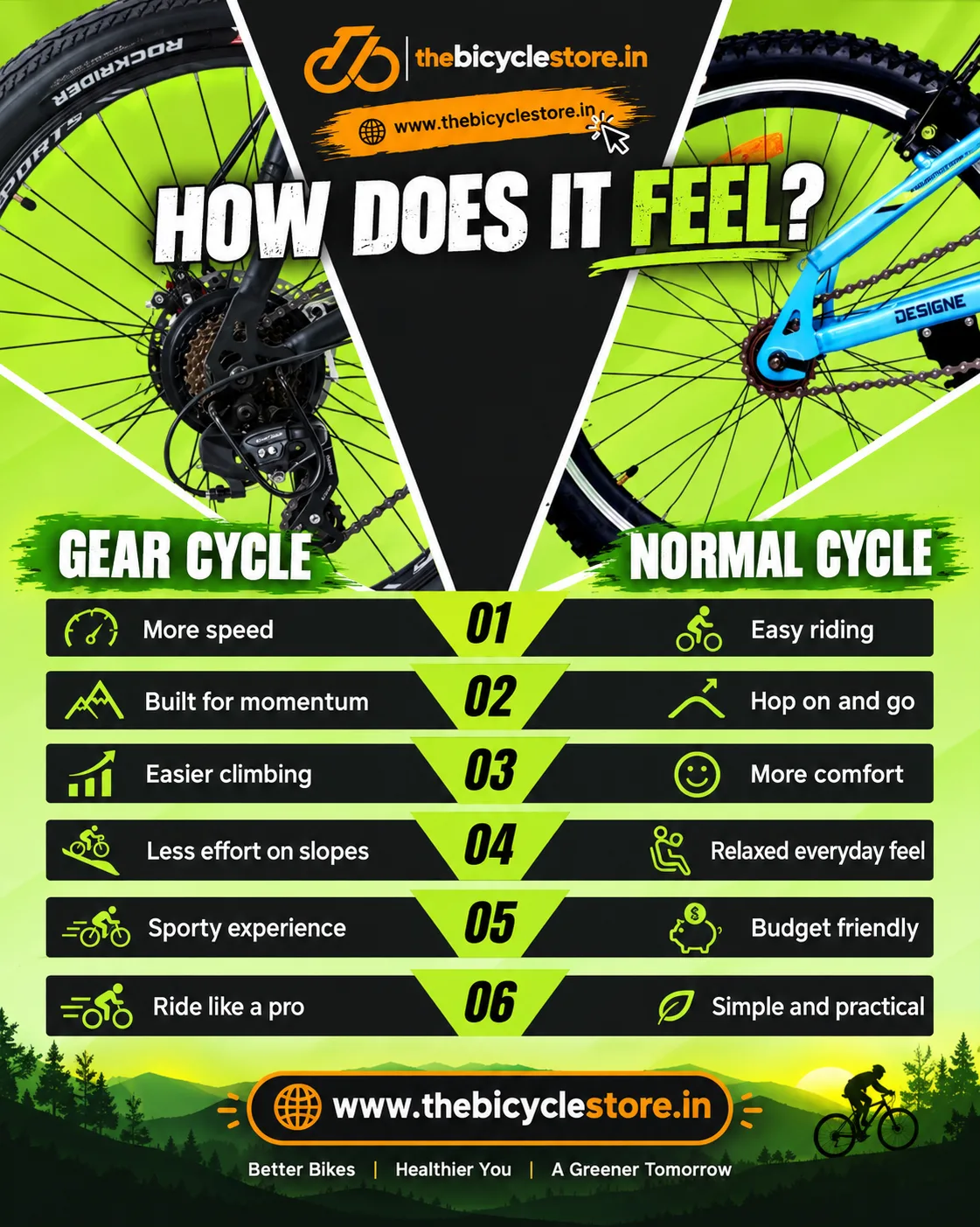
Comparison between geared and non-geared bicycles
Choosing between these bicycles depends on your route, riding habits, fitness goals, budget, and comfort. A geared bicycle offers different resistance levels for climbs, longer distances, and changing roads. A simple cycle can feel easier to operate.
Gear Cycle Advantages
Gear cycles offer adaptable performance for different routes and riding speeds.
1. Versatility:
Multiple ratios help riders manage slopes, uneven roads, traffic starts, and longer journeys. An easier setting can reduce effort while climbing, while a harder setting can suit open roads.
2. Efficiency:
Correct gearing supports a comfortable pedalling rhythm. Riders can choose a suitable ratio instead of pushing heavily against resistance, especially during longer rides.
3. Speed:
Higher gears can support faster riding when conditions are suitable. Speed also depends on fitness, tyres, wind, traffic, bicycle design, and technique. Visit Us www.thebicyclestore.in
4. Customization:
Riders can choose different speed counts, frame styles, wheel sizes, brakes, and riding positions. This makes it easier to match a bicycle with personal needs and terrain.
Gearless Cycle Advantages
Gearless bicycles are popular because they are straightforward, affordable, and practical for everyday riding.
1. Simplicity:
A single-speed design is easy to understand. Beginners can focus on balance, braking, steering, and road awareness without learning gear changes.
2. Cost:
A simpler drivetrain can mean a lower purchase price. Compare frame quality, brakes, tyres, warranty, and build instead of choosing only by the cheapest gear cycle price.
3. Low Maintenance:
Fewer drivetrain parts can mean fewer adjustments. Chain lubrication, brake checks, tyre inflation, and cleaning are still necessary.
4. Comfort:
For short, flat journeys, a simple bicycle can provide relaxed riding. Saddle height, handlebar position, tyre pressure, and frame size strongly affect comfort.
Types of Gear Cycles:
Common choices include road, mountain, hybrid, touring, and fitness bicycles. Road models suit smooth surfaces; mountain models favour rough terrain; hybrids balance commuting and recreation.
Choose according to terrain rather than appearance. A mountain bicycle may be unnecessary for short city trips, while a basic city model may feel limiting on steep roads.
Best Gear Cycle:
The best gear cycle is one matching your route, body size, riding frequency, and budget. Look for a suitable frame, reliable brakes, appropriate tyres, smooth shifting, comfortable contact points, and dependable support.
For mixed urban riding, a hybrid-style bicycle can be practical. For trails, wider tyres and stronger components may matter more than having many gears.
Types of Gearless Cycles:
Gearless bicycles focus on uncomplicated riding and work well for neighbourhood trips, school travel, markets, and flat commuting routes.
Learn More www.thebicyclestore.in/services
Single-Speed Bicycles:
These bicycles have one gear ratio and are easy to operate. They suit flat areas and riders who prefer straightforward cycling with minimal shifting decisions.
Multi-Speed Bicycles:
This term can describe bicycles offering several ratios through different drivetrain arrangements. Check the exact drivetrain before purchasing because terminology can vary between brands.
Best Gearless Bicycle
The ideal gearless bicycle should have a correctly sized frame, dependable brakes, durable tyres, comfortable saddle, and sturdy components. Mudguards, a carrier, lights, and a kickstand can add everyday value.
A no-gear bike is sensible when your regular route is short, mostly flat, and focused on convenience rather than climbing.
Gear Cycle Online:
Online buying provides broad choice, but check frame size, assembly needs, warranty, return conditions, and service availability. Read the component list instead of judging from photographs alone.
Compare specifications from reliable sellers such as The bicycle store, then confirm sizing before ordering. A good purchase should make servicing and replacement parts accessible.
Which is Better, Gear or Non-Gear Cycle?
Neither option is universally better. Choose gears for hills, varied terrain, longer distances, or greater control over effort. Choose a simple bicycle for flat, short, predictable routes.
The best cycle is one you can use consistently and confidently.
A geared bicycle can make routes manageable, while a non gear cycle can simplify flat commuting. Choose a geared bicycle when route variety matters for you.
Final Thoughts
Match the bicycle to terrain first, then consider features and appearance. Correct fit matters because an unsuitable frame can make even a quality bicycle uncomfortable.
Beginners may prefer simplicity. Regular commuters and recreational riders may value additional ratios. Prioritize safe brakes, correct sizing, and durable construction.
FAQ
Buyers often ask whether gears are necessary, whether simple bicycles are easier to maintain, and which style supports fitness. The answer depends on route, goals, budget, and preference.
Which is the best geared or non-geared cycle for weight loss
Both can support weight loss because calorie use depends on duration, intensity, frequency, and overall lifestyle. Gears may help riders continue on hills or longer routes by managing effort.
A comfortable cycle that encourages regular workouts is more useful than choosing only by drivetrain.
Should I buy a geared or non-geared cycle?
Buy a geared model if your area has slopes or varied routes. Select a non-geared model if you mainly ride flat roads and value simplicity and easy operation.
Which cycle is best for daily use: geared or non-geared
For city commuting, either can work. A simple model suits flat routes, while gears help with bridges, slopes, longer commutes, or varied roads.
Gear cycle vs. normal cycle: which is better
A geared model provides flexibility, while a normal single-speed cycle offers straightforward operation. The better choice suits your terrain, distance, and riding style without unnecessary features.
Disadvantages of a non-geared cycle
Single-speed bicycles can feel harder on steep climbs because riders cannot select an easier ratio. They may also be less versatile for long routes with elevation changes.
On fast descents or open roads, the fixed ratio can limit comfortable pedalling for some riders. These limits matter less on short, flat journeys.
What are the disadvantages of a geared cycle?
Gears add components that require adjustment and maintenance. Shifting can become less smooth if the drivetrain is dirty, worn, or poorly adjusted.
Geared bicycles may cost more initially and can feel complicated to beginners. Proper setup and regular care make shifting easier.
Ultimately, select the bicycle that fits your roads, body, goals, and budget. The right choice is not the bicycle with the most features, but one that encourages safe, comfortable, regular cycling.