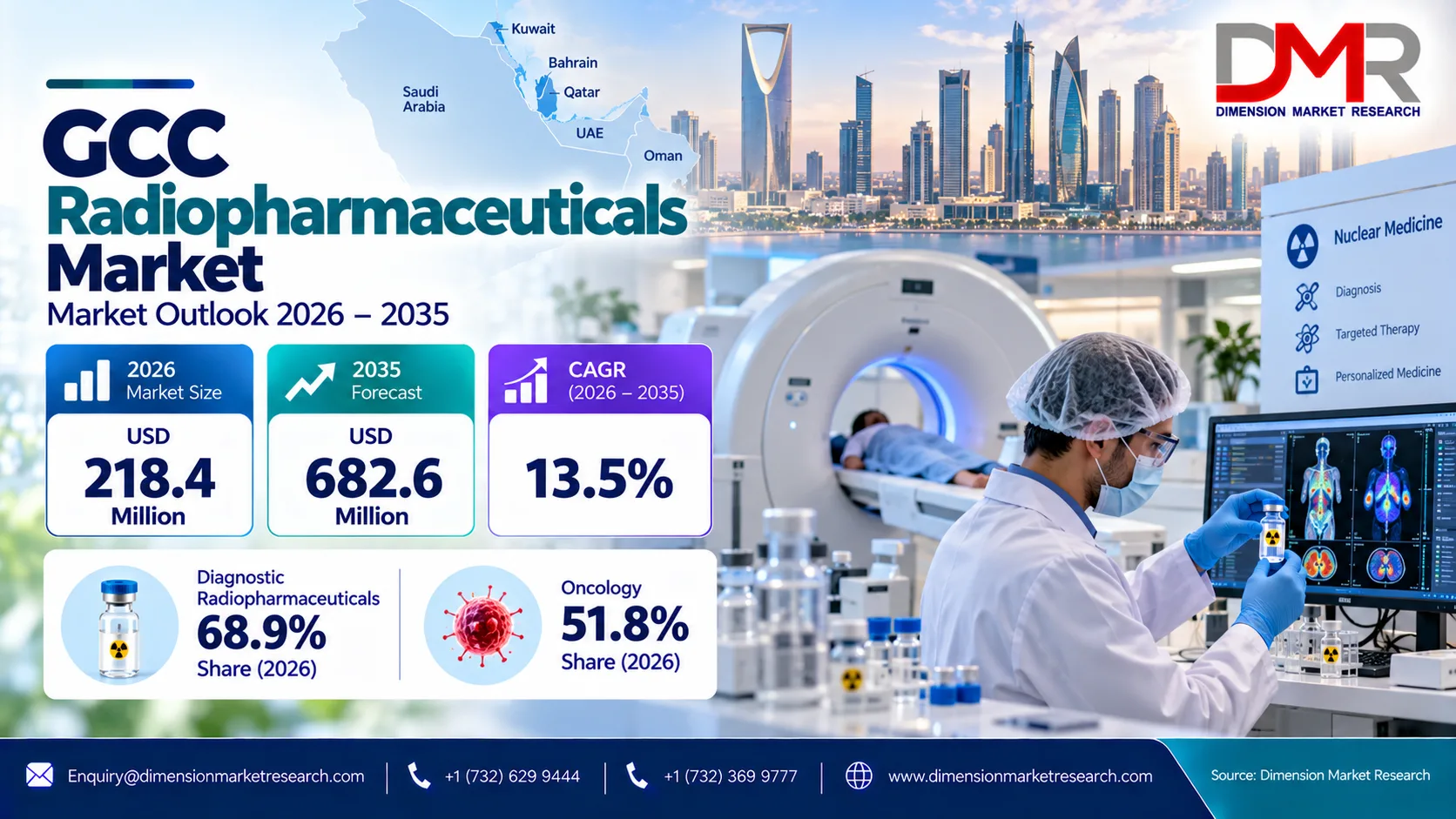
The GCC Radiopharmaceuticals Market is undergoing significant transformation as investments in nuclear medicine, cancer diagnostics, and targeted therapies strengthen healthcare capabilities across the Gulf Cooperation Council. According to Dimension Market Research, the market is projected to reach USD 218.4 million in 2026 and expand to USD 682.6 million by 2035, growing at a CAGR of 13.5%.
Saudi Arabia and the United Arab Emirates are leading regional investments in advanced diagnostic imaging infrastructure, oncology centers, and radiopharmaceutical production capabilities. Rising cancer incidence, demand for precise diagnosis, and expanding healthcare modernization programs are encouraging hospitals to adopt specialized nuclear medicine technologies.
The increasing use of positron emission tomography (PET), single-photon emission computed tomography (SPECT), and targeted radioligand therapies is also creating new opportunities for radioisotope manufacturers, imaging technology providers, and healthcare institutions.
What Is the GCC Radiopharmaceuticals Market?
The GCC Radiopharmaceuticals Market includes radioactive pharmaceutical products used for diagnosing and treating diseases, particularly cancer and cardiovascular conditions, across Saudi Arabia, the UAE, Qatar, Kuwait, Oman, and Bahrain.
Radiopharmaceuticals contain radioactive isotopes combined with pharmaceutical compounds that target specific tissues or biological processes.
Diagnostic radiopharmaceuticals help clinicians visualize disease activity through PET and SPECT imaging. Therapeutic radiopharmaceuticals deliver targeted radiation to selected tissues, including certain cancer cells.
These products are used in oncology, cardiology, neurology, endocrinology, and specialized nuclear medicine services.
GCC Radiopharmaceuticals Market Size and Key Statistics
The DMR report identifies the following 2026 indicators:
● 2026 Market Size: USD 218.4 Million
● 2035 Market Forecast: USD 682.6 Million
● Forecast CAGR: 13.5%
● Leading Radioisotope: Fluorine-18 Derivatives, 42.6%
● Diagnostic Radiopharmaceuticals Share: 68.9%
● Cyclotrons Share: 54.3%
● Oncology Application Share: 51.8%
● Hospitals End-User Share: 57.4%
These findings demonstrate the importance of diagnostic imaging and oncology infrastructure in regional radiopharmaceutical demand.
Why Is the GCC Radiopharmaceuticals Market Growing?
Government Investment in Advanced Oncology Infrastructure
Healthcare transformation programs are strengthening nuclear medicine capabilities across GCC countries.
Saudi Arabia's Vision 2030 initiatives and similar healthcare modernization efforts in the UAE are supporting investments in specialized hospitals, cancer centers, and advanced imaging facilities.
Growing PET/CT capacity and radiopharmacy infrastructure are improving access to sophisticated diagnostic procedures.
These investments also encourage regional production of radioisotopes, helping healthcare institutions address supply reliability and transportation challenges.
Rising Demand for Cancer Diagnosis and Treatment
Growing demand for cancer diagnosis, staging, and monitoring is accelerating radiopharmaceutical consumption.
Fluorine-18 fluorodeoxyglucose (FDG) is widely used in PET imaging to assess metabolic activity in tumors.
Meanwhile, Gallium-68-based diagnostics and Lutetium-177-based therapies are expanding targeted nuclear medicine applications for selected neuroendocrine tumors and prostate cancers.
These developments are increasing demand for specialized medical isotopes and treatment facilities.
Get a Free Sample of the GCC Radiopharmaceuticals Market Report
Explore country-level market forecasts, radioisotope segmentation, diagnostic and therapeutic applications, competitive developments, and healthcare investment opportunities through the Dimension Market Research study.
https://dimensionmarketresearch.com/request-sample/gcc-radiopharmaceuticals-market/
How Theranostics Is Transforming Nuclear Medicine
Theranostics represents an important advancement in precision oncology by connecting diagnostic imaging with targeted radiopharmaceutical treatment.
For example, Gallium-68-based compounds can help identify specific tumor targets, while suitable Lutetium-177-based therapies deliver radiation to corresponding biological targets.
This approach can support more individualized treatment planning for eligible patients.
Important technology developments include:
● Gallium-68 PET imaging expansion
● Lutetium-177 radioligand therapy adoption
● Regional cyclotron capacity development
● Advanced nuclear medicine infrastructure
Therapeutic radiopharmaceuticals are projected to register an 18.4% CAGR through 2035, making them the fastest-growing type segment.
Their increasing adoption is creating opportunities for isotope suppliers, oncology specialists, and hospitals developing targeted treatment capabilities.
GCC Radiopharmaceuticals Market Segmentation Analysis
Fluorine-18 Derivatives Lead Radioisotope Demand
Fluorine-18 derivatives account for a projected 42.6% market share in 2026.
Their leadership reflects the widespread use of FDG in oncology PET imaging.
Lutetium-177 is projected to be the fastest-growing radioisotope category, with a 17.8% CAGR, supported by targeted radioligand therapy adoption.
Diagnostic Radiopharmaceuticals Dominate
Diagnostic products represent 68.9% of the market in 2026, supported by established PET and SPECT imaging services.
Hospitals and imaging centers use these technologies to evaluate oncology, cardiovascular, and other medical conditions.
Therapeutic products represent an emerging growth area as specialized treatment infrastructure expands.
Cyclotrons Lead Production Sources
Cyclotrons hold an estimated 54.3% market share in 2026.
These facilities enable production of certain short-lived radioisotopes, including Fluorine-18, supporting timely supply to medical facilities.
Generators are expected to grow at a 13.6% CAGR, reflecting demand for Gallium-68-based applications.
Oncology and Hospitals Drive Consumption
Oncology leads applications with 51.8% market share, while hospitals account for 57.4% of end-user demand in 2026.
Cancer research institutes are projected to grow at a 15.2% CAGR as regional investment in specialized oncology research and treatment facilities increases.
Country Outlook: Saudi Arabia and UAE Lead Regional Development
Saudi Arabia represents the leading GCC market, supported by expanding healthcare infrastructure, government investment, and nuclear medicine capabilities.
The UAE is developing advanced imaging and targeted treatment services through specialized hospitals and radiopharmacy facilities.
Qatar is also strengthening its position through nuclear medicine facilities and specialized cancer care programs.
Kuwait, Oman, and Bahrain present additional opportunities as healthcare modernization programs expand access to diagnostic imaging and treatment.
Regional growth will depend on infrastructure investment, qualified specialists, regulatory capabilities, and reliable radioisotope distribution networks.
Competitive Landscape and Leading Companies
The GCC Radiopharmaceuticals Market includes global isotope manufacturers, pharmaceutical companies, imaging technology providers, and specialized regional healthcare institutions.
Prominent participants identified by DMR include GE HealthCare, Curium Pharma, Jubilant Radiopharma, Lantheus Holdings, Bracco Imaging, Eckert & Ziegler, Telix Pharmaceuticals, Novartis, Siemens Healthineers, and IBA Radiopharma Solutions.
Competition centers on isotope availability, production reliability, radiopharmaceutical portfolios, distribution efficiency, and hospital partnerships.
Regional production capabilities are becoming increasingly important because short-lived isotopes require carefully coordinated manufacturing and delivery.
Challenges and Future Growth Opportunities
Reliance on imported radioisotopes remains a major challenge for certain GCC healthcare providers.
Short isotope half-lives, specialized transportation requirements, and high infrastructure costs create supply chain constraints.
However, domestic cyclotron expansion, hospital partnerships, and regional radiopharmacy investment offer opportunities to improve availability.
Companies capable of supplying reliable diagnostic isotopes and supporting advanced targeted therapies may benefit from growing nuclear medicine demand through 2035.
Explore the Complete GCC Radiopharmaceuticals Market Analysis
Access detailed country forecasts, radioisotope demand analysis, therapeutic technology trends, competitive profiles, and strategic investment opportunities through the complete Dimension Market Research report.
https://dimensionmarketresearch.com/checkout/gcc-radiopharmaceuticals-market/
Frequently Asked Questions
1. What is the GCC Radiopharmaceuticals Market size?
The market is projected to reach USD 218.4 million in 2026 and USD 682.6 million by 2035.
2. What is the CAGR of the GCC Radiopharmaceuticals Market?
The market is forecast to grow at a CAGR of 13.5% from 2026 to 2035.
3. Which type dominates the GCC Radiopharmaceuticals Market?
Diagnostic radiopharmaceuticals lead with approximately 68.9% market share in 2026.
4. Which country leads the GCC Radiopharmaceuticals Market?
Saudi Arabia leads, supported by healthcare infrastructure investments, expanding oncology services, and growing nuclear medicine capabilities.
5. What are the major growth opportunities in the GCC Radiopharmaceuticals Market?
Regional isotope production, cyclotron expansion, Gallium-68 diagnostics, Lutetium-177 therapies, and specialized cancer treatment infrastructure represent major opportunities.
Conclusion
The GCC Radiopharmaceuticals Market is positioned for substantial growth as countries invest in advanced oncology infrastructure, diagnostic imaging, and precision medicine.
Fluorine-18 derivatives, diagnostic radiopharmaceuticals, and hospital-based nuclear medicine services remain central to current market demand.
Meanwhile, expanding theranostic capabilities, regional isotope production, and targeted radioligand therapies are creating opportunities for pharmaceutical manufacturers, healthcare providers, and medical technology companies.
Improving supply chain resilience and strengthening specialized clinical infrastructure will remain essential to the industry's development through 2035.