Introduction
Digital transformation has long been associated with the integration of digital technologies into all areas of business to improve operations, customer experiences, and business models. Initially, this transformation leaned heavily on basic automation—streamlining routine tasks to boost efficiency. However, as technology has evolved, so has the scope and ambition of digital transformation. What was once simple rule-based automation has now progressed toward intelligent, autonomous systems driven by artificial intelligence (AI).
Today, AI is no longer a futuristic concept but a core enabler of modern business strategy. The implementation of AI in Digital Transformation is redefining how enterprises operate, make decisions, and deliver value to customers. Businesses are moving from reactive processes to proactive and predictive models, thanks to AI’s data-driven capabilities.
The journey from automation to autonomy is not just a technological evolution—it represents a fundamental shift in how businesses approach growth, scalability, and innovation. AI Agents, intelligent process automation, and agentic AI solutions are driving this shift, allowing organizations to optimize operations, reduce human dependency, and unlock new possibilities for enterprise success.
The Evolution of Digital Transformation: From Automation to Autonomy
In the early stages, digital transformation was synonymous with digitizing paper-based processes and automating repetitive tasks using static workflows. Robotic Process Automation (RPA) was a major milestone, enabling organizations to achieve faster turnaround times and reduce manual effort in finance, HR, and customer service departments.
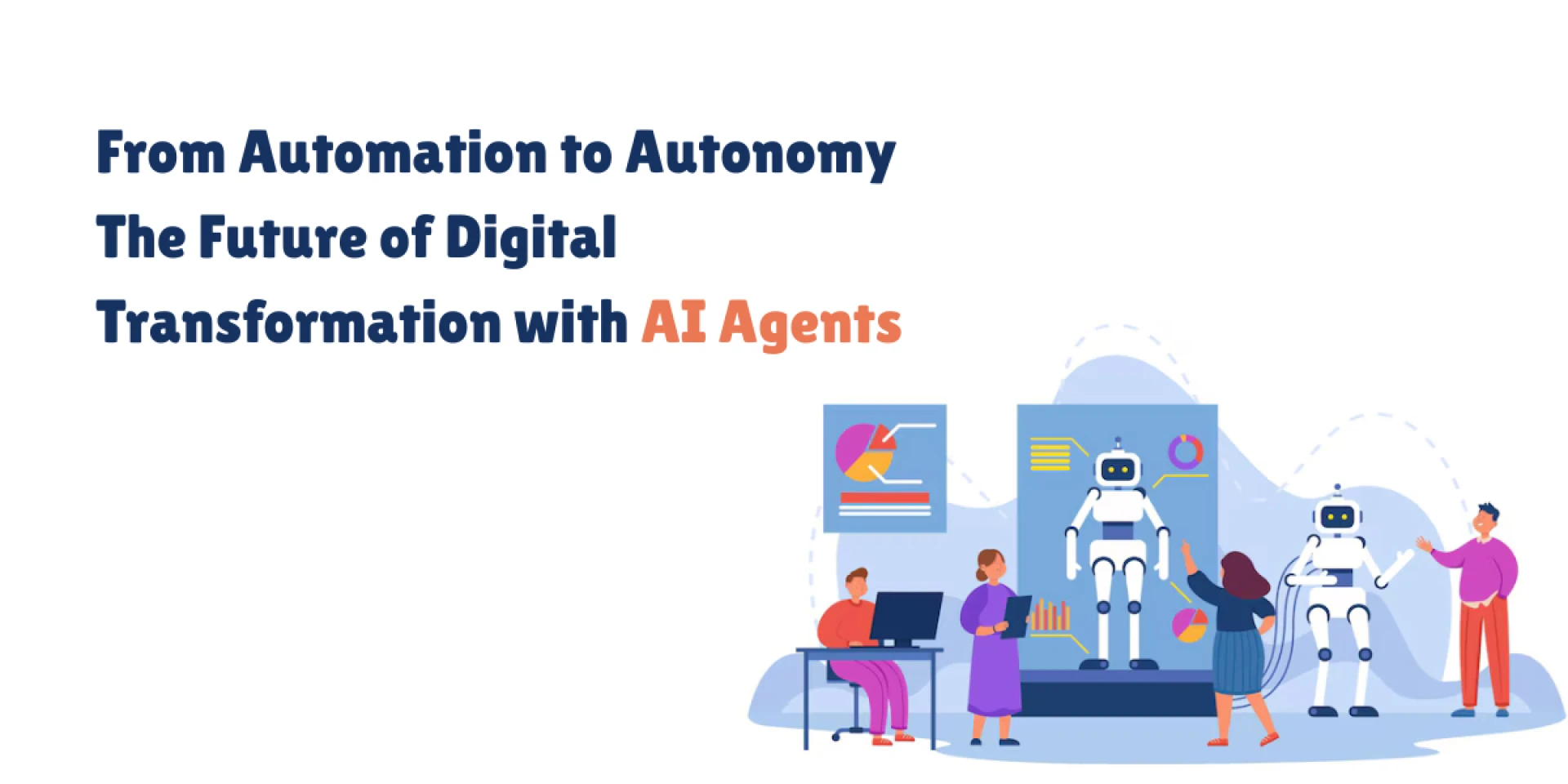
However, this type of automation had limitations—it lacked adaptability and intelligence. That’s where the emergence of AI technologies transformed the landscape. With the introduction of AI Agents, enterprises began to transition from automation to autonomy. These agents are capable of perceiving their environment, making decisions, learning from data, and acting accordingly—all with minimal human intervention.
The shift towards autonomous systems is being driven by increasing data volumes, the need for real-time decision-making, and the demand for scalability. Autonomy in digital transformation means systems that are not only automated but also self-governing, self-correcting, and continuously improving. This marks a new era in enterprise technology, where systems can proactively optimize processes and deliver consistent outcomes with greater speed and precision.
The Role of AI Agents in Modern Businesses
AI Agents represent a new generation of intelligent systems that operate with autonomy and purpose. Unlike traditional AI models that require direct human instruction, these agents can perceive their environment, make decisions, and take action independently. They're designed to achieve specific goals by continuously learning from data and outcomes.
So, how do AI Agents stand apart from conventional AI tools? Traditional AI often works in isolated tasks, like chatbots answering FAQs or algorithms predicting sales. AI Agents, however, operate across broader contexts. They can monitor systems, initiate processes, and collaborate with other agents or humans to optimize business operations holistically.
Their role in AI in Business Operations is transformative. They’re being deployed for dynamic inventory management, real-time customer engagement, fraud prevention, and more. AI Agents enhance scalability, reduce operational bottlenecks, and improve response times—driving performance without constant human intervention.
As enterprise AI adoption grows, these agents are becoming central to future-ready business strategies, offering capabilities far beyond static automation.
Intelligent Process Automation: The Game-Changer
Intelligent Process Automation (IPA) combines robotic process automation (RPA) with artificial intelligence technologies such as machine learning, natural language processing, and computer vision. Unlike traditional automation, IPA can handle unstructured data, interpret language, and even make judgments based on past patterns.
Here are five major benefits businesses are experiencing through IPA:
- Cost Reduction – Automating decision-heavy processes leads to significant savings in labor and error correction.
- Improved Accuracy – Machine learning minimizes manual errors by continuously learning from new inputs.
- Speed & Efficiency – IPA accelerates workflows by bypassing human bottlenecks in real-time scenarios.
- Scalability – Intelligent automation systems can be scaled across departments and geographies with minimal reconfiguration.
- Enhanced Customer Experience – By reducing response times and personalizing interactions, IPA directly contributes to customer satisfaction.
By implementing AI Services through IPA, enterprises are not just optimizing existing processes—they are redefining what’s possible in operational efficiency.
Agentic AI Solutions: The Future of Autonomy
Agentic AI Solutions represent the next frontier in digital transformation. These are advanced forms of AI Agents, engineered with higher autonomy, cognitive capabilities, and the ability to collaborate with other agents or humans to accomplish complex goals.
What sets Agentic AI apart is its ability to:
- Make Real-Time Decisions – They assess evolving data environments and act autonomously.
- Learn Continuously – Through reinforcement learning, they refine their actions based on outcomes.
- Adapt Dynamically – They modify goals and behaviors as conditions change.
- Collaborate Contextually – Agentic AI works in tandem with humans or other agents in multi-agent ecosystems.
- Operate Cross-Functionally – From HR to logistics, they function across silos to achieve organizational objectives.
These capabilities make Agentic AI the foundation for future-ready enterprise solutions. As digital systems mature, Agentic AI will power next-generation workflows where systems think and act with little to no human oversight.
The Road Ahead: Digital Transformation with AI
The future of Digital Transformation with AI is shaped by five emerging trends that are redefining enterprise dynamics:
- Widespread Enterprise AI Adoption – Businesses across all sectors are adopting AI not just for efficiency, but for innovation and growth.
- AI-Powered Decision Intelligence – Enterprises are investing in systems that deliver real-time insights to drive strategic decisions.
- Hyper-Personalization – AI is enabling highly tailored experiences across digital touchpoints, especially in customer service and marketing.
- AI Governance and Ethics – With greater AI adoption comes the need for responsible use, data privacy, and explain ability.
- Workforce Upskilling – Companies are focusing on AI literacy and hybrid human-AI teams to maximize productivity.
To stay competitive, organizations must invest in advanced AI Services and build a culture of continuous innovation. This includes aligning leadership vision, re-skilling teams, and integrating AI as a strategic layer across the enterprise.
Conclusion
The journey from simple automation to full autonomy is reshaping the very foundation of modern business. Through AI in Digital Transformation, companies are moving beyond task-based automation to embrace systems that think, learn, and adapt independently.
The rise of AI Agents, Intelligent Process Automation, and Agentic AI Solutions is accelerating this shift, enabling businesses to become more resilient, responsive, and innovative. These technologies are not just tools—they are partners in transformation, actively contributing to decision-making and strategic growth.
For organizations aiming to lead rather than follow, now is the time to act. Embracing AI isn’t just about efficiency—it’s about staying relevant in a world where digital speed, intelligence, and autonomy define success.