
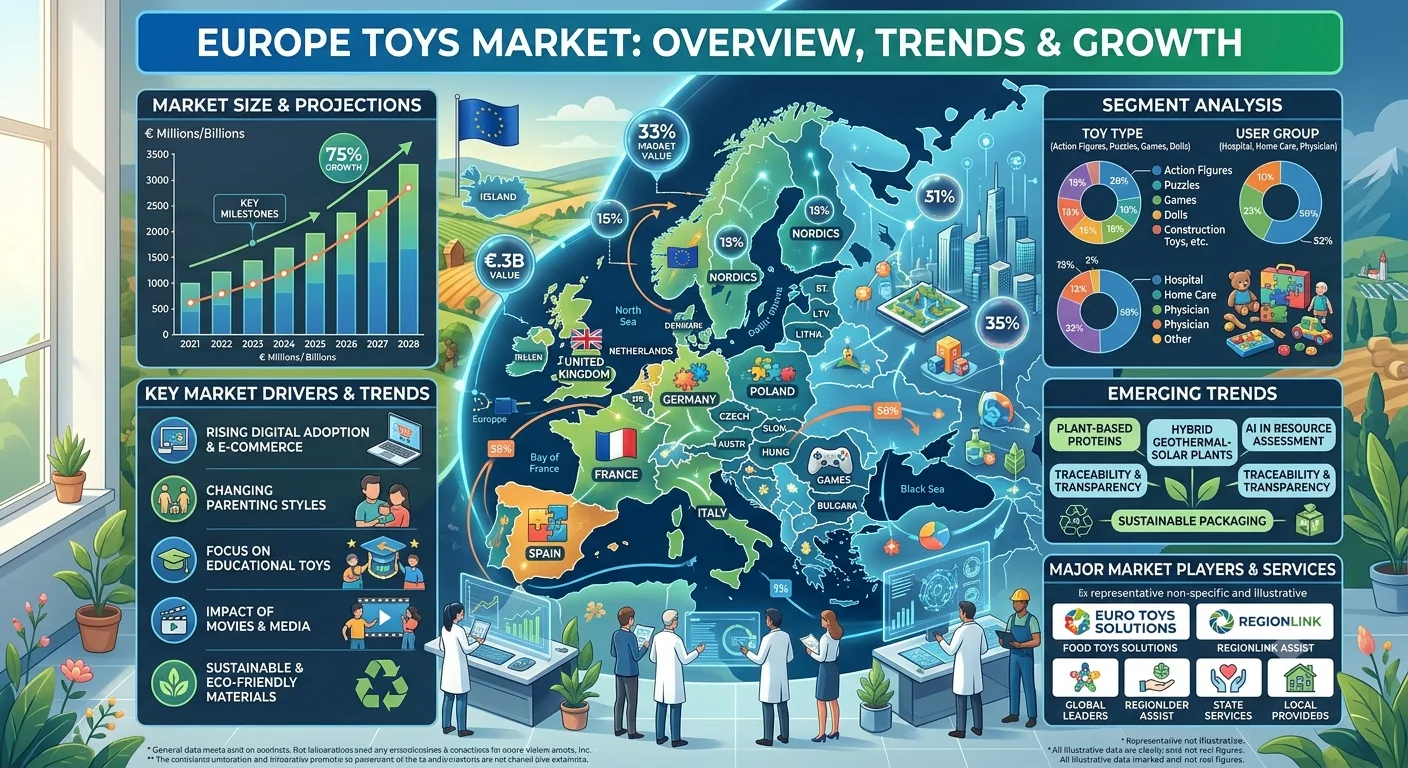
Market Overview
The Europe toys market size increased from USD 29.41 Billion in 2025 to USD 31.51 Billion in 2026 and is projected to reach USD 48.66 Billion by 2034, growing at a CAGR of 5.58% during 2026-2034. The market is driven by rising demand for interactive and educational toys, growing popularity of building sets and collectibles, expansion of e-commerce channels, and increasing focus on sustainable materials.
This market is strategically important to Europe's consumer goods and retail economy, supporting the region's position as a major global market for toys and games. The European toys market encompasses action figures, building sets, games and puzzles, dolls, sports and outdoor toys, plush, and other product categories distributed through hypermarkets and supermarkets, departmental stores, and online channels.
The Europe toys market is poised for sustained expansion, underpinned by interactive and educational toy demand, e-commerce growth, and sustainability trends. With a projected CAGR of 5.58% through 2034, the market presents significant opportunities for manufacturers focusing on STEM toys, collectibles targeting kidults, and eco-friendly materials.
EUROPE TOYS MARKET SUMMARY
The Europe toys market encompasses action figures, building sets, games and puzzles, dolls, sports and outdoor toys, plush, and other product categories.
The ecosystem spans toy manufacturers, distributors, retailers, and consumers across European countries.
By Product Type, the market is segmented into Action Figures, Building Sets, Games and Puzzles, Dolls, Sports and Outdoor Toys, Plush, and Others.
By Age Group, the market serves Up to 5 Years, Between 5 to 10 Years, and Above 10 Years.
By Distribution Channel, the market serves Hypermarkets and Supermarkets, Departmental Stores, Online Channels, and Others.
By Country, the market serves Germany, United Kingdom, France, Italy, Spain, and Others.
Key trends shaping the market include rising demand for interactive and educational toys, growing popularity of building sets and collectibles, expansion of e-commerce channels, and increasing focus on sustainable materials.
PORTER'S FIVE FORCES ANALYSIS – EUROPE TOYS MARKET
Competitive Rivalry: High. The market features intense competition among established toy manufacturers, private-label products, and emerging brands. Key players include LEGO System A/S, Hasbro Inc., and Mattel Inc.. Business implication: Companies must differentiate through product innovation, brand loyalty, and licensed properties.
Supplier Power (Manufacturing and Materials): Moderate. Toy manufacturers rely on suppliers of plastics, electronics, and sustainable materials. The growing demand for eco-friendly materials gives specialised suppliers moderate leverage. Business implication: Strategic partnerships with sustainable material suppliers can reduce dependency.
Buyer Power (Consumers and Retailers): High. European consumers benefit from extensive choice across toy brands and product categories. Retailers exert significant power through shelf space allocation and private-label competition. Business implication: Brands must invest in product quality, brand loyalty, and consumer engagement.
Threat of Substitutes: Moderate. Digital entertainment and video games represent partial substitutes. However, the developmental benefits and tactile experience of physical toys provide strong differentiation.
Threat of New Entrants: Moderate. Significant capital requirements for manufacturing, licensing, and brand building create barriers. However, the growing demand for educational and sustainable toys has enabled new entrants focused on niche categories.
KEY ASPECTS REQUIRED FOR THE EUROPE TOYS MARKET
Market Performance: USD 29.41 Billion in 2025, projected to reach USD 48.66 Billion by 2034, driven by interactive and educational toy demand and e-commerce growth.
Market Outlook: A 5.58% CAGR through 2034 reflects steady growth led by building sets, collectibles, and online channel expansion.
Growth Drivers: Rising demand for interactive and educational toys incorporating storytelling, music, and problem-solving; growing popularity of building sets and collectibles among kids and kidults; expansion of e-commerce channels with internet penetration reaching 91% in Europe; increasing focus on sustainable and biodegradable materials; advancements in AI, IoT, and AR/VR enabling smart toys.
Competitive Landscape: Intense competition among established toy manufacturers, private-label products, and emerging brands. Key players include LEGO System A/S, Hasbro Inc., Mattel Inc., Clementoni Spa, The Goliath Games LLC, Ravensburger Group, Thames and Kosmos, and BRUDER Spielwaren GmbH.
Value Chain Analysis: From material sourcing and manufacturing through distribution and retail to consumer purchase.
Industry Trends: Interactive and educational toys with STEM focus; building sets and collectibles targeting kidults; sustainable and eco-friendly materials; smart toys integrated with AI, IoT, and sensors; e-commerce channel expansion; 3D printing for customized toys.
Strategic Recommendations: Invest in interactive and educational toy development; expand building sets and collectibles targeting kidults; develop sustainable and eco-friendly product lines; leverage e-commerce and digital marketing; integrate AI and IoT features into smart toys; pursue licensed properties and franchise partnerships.
Request for Sample Report: https://www.imarcgroup.com/europe-toys-market/requestsample
MARKET GROWTH DRIVERS
Rising Demand for Interactive and Educational Toys
The Europe toys market growth can be attributed to the rising demand for interactive and educational toys, which incorporate storytelling, music, and problem-solving, that can enhance the cognitive and motor skills of children while promoting creativity, social interaction, and literacy. Parents are increasingly preferring sensory play items and STEM toys as they make learning engaging and fun.
Growing Popularity of Building Sets and Collectibles
The Europe toys market value is increasing amid the growing popularity of building sets, especially from brands like LEGO, in the region. Building sets foster creative expression and imagination, develop critical thinking and problem-solving abilities, improve dexterity and fine motor skills, and promote communication skills and teamwork. Meanwhile, the 'kidult' phenomenon is driving sales of collectibles, with individuals aged above 10 years comprising teenagers and kidults driving demand for toys evoking comfort and a sense of nostalgia.
Expansion of E-Commerce Channels
Online channels constitute a significant portion of the market share, attributed to the availability of a diverse range of toys. Europe is the third largest e-commerce market in the world, with internet penetration reaching 91% in 2022. The rising sales of toys (47%) from online channels among the above 10 age group also bolsters the Europe toys industry revenue.
Increasing Focus on Sustainable Materials
Around 78% of consumers in Europe are concerned about environmental issues, which makes sustainability one of the top priorities for toy manufacturers. Brands are increasingly incorporating sustainable, renewable, and biodegradable materials to capitalise on the growing trend of sustainability. For instance, in February 2024, Playmobil announced that it aims to manufacture all its toddler toys with at least 90% plant-based raw materials.
EUROPE TOYS MARKET SEGMENTATION
Segmentation analysis provides a detailed view of the Europe toys market by category:
Product Type Insights: Building Sets – increasing popularity, especially from brands like LEGO, fostering creative expression and problem-solving skills; Action Figures – growing demand with new launches from key players; Games and Puzzles; Dolls; Sports and Outdoor Toys; Plush; Others.
Age Group Insights: Above 10 Years – driving sales of toys among teenagers and kidults, driven by nostalgia and demand for puzzles, building sets, and games; Up to 5 Years – surging demand for sensory play items and STEM toys; Between 5 to 10 Years.
Distribution Channel Insights: Online Channels – significant market share driven by e-commerce penetration; Hypermarkets and Supermarkets – increasing sales through enhanced convenience and competitive pricing; Departmental Stores; Others.
Country Insights: Germany – driven by rising demand from online retail channels and sustainable toys; United Kingdom – growing popularity of STEM and educational toys, with over 54% of British buying STEM toys; France – growing popularity of collectibles and kidult phenomenon; Italy – growing popularity of plushies and environmental consciousness; Spain.
COMPETITIVE LANDSCAPE
The Europe toys market features intense competition among established toy manufacturers, private-label products, and emerging brands. Key players are integrating technologies such as AI, IoT, and sensors to create smart toys that offer enhanced playtime and educational features. They are also actively investing in research and development activities to explore new technologies, materials, and educational concepts to gain a competitive advantage.
Key players include:
- LEGO System A/S – Founded in 1932 with headquarters in Billund, Denmark; manufactures branded toys globally and operates amusement parks.
- Hasbro Inc. – Established in 1923 and based in Rhode Island, United States; multinational company involved in manufacturing consumer toy products such as dolls and action figures.
- Mattel Inc. – Founded in 1945 with headquarters in California, United States; designs and manufactures toy products for consumers worldwide.
- Other Key Players – Including Clementoni Spa, The Goliath Games LLC and B.V Companies, Ravensburger Group, Thames and Kosmos, BRUDER Spielwaren GmbH + Co. KG, Abysse Corp, and Steiff Retail GmbH.
Recent Developments:
- March 2024: Hamleys opened its second flagship store in Galleria Alberto Sordi, Rome, offering a wide range of toys and games.
- February 2024: Playmobil announced that it aims to manufacture all its toddler toys with at least 90% plant-based raw materials.
- July 2024: Toy company Wyncor signed an agreement with Carrefour to launch its Miraball range of toys in stores across Europe.
Investment opportunities exist in interactive and educational toy development, building sets and collectibles, sustainable and eco-friendly product lines, e-commerce channel expansion, and smart toys integrated with AI and IoT features.
REGIONAL ANALYSIS
Germany toys market growth is driven by the rising demand for toys from online retail channels such as ikea.com, amazon.de, otto.de, mytoys.de, and limango.de. Key players in the country are increasingly focusing on manufacturing high-quality sustainable toys due to rising environmental awareness.
United Kingdom toys market growth can be attributed to the growing popularity of STEM and educational toys. Over 54% of British buy STEM and educational toys to promote learning and engagement in STEM. Collectibles targeted at kidults are also witnessing a surge in popularity.
France toys demand is fuelled by the growing popularity of collectibles, with key players actively introducing limited-edition collectibles and collaborating with popular movie, series, and video game franchises. Major toy retailers such as King Jouet are merchandising second-hand toys alongside brand-new counterparts.
Italy toys market trends include growing popularity of plushies and growing environmental consciousness pushing leading toy manufacturers like Italeri to develop toys from renewable and sustainable materials.
RECENT INDUSTRY DEVELOPMENTS
2025 Activity: The Europe toys market continued its growth trajectory from USD 29.41 Billion in 2025 to USD 48.66 Billion by 2034 at a CAGR of 5.58%.
March 2024: Hamleys opened its second flagship store in Galleria Alberto Sordi, Rome.
February 2024: Playmobil announced its aim to manufacture all toddler toys with at least 90% plant-based raw materials.
July 2024: Wyncor signed an agreement with Carrefour to launch its Miraball range across Europe.
Note: If you need any specific information that is not covered currently within the scope of the report, we will provide the same as a part of customization.
https://www.imarcgroup.com/request?type=report&id=9094&flag=E
Report Format, Delivery, and Customization Details
- Report Format Mode: PPT, PDF, and Excel
- Report Delivery Mode: Online Delivery, Physical Delivery
- Report Delivery Time: Report Delivered Over Email within 24 to 48 hours. If requested by the client, a physical copy will be delivered within three to ten days.
- Report Confirmation Mode: Yes via Email
- Report Customization Mode: Yes via Email / Call
- Report Table of Content: Yes
- Report List of Figures: Yes
- Report Methodology Mode: Yes
- Request For Sample Report: Yes