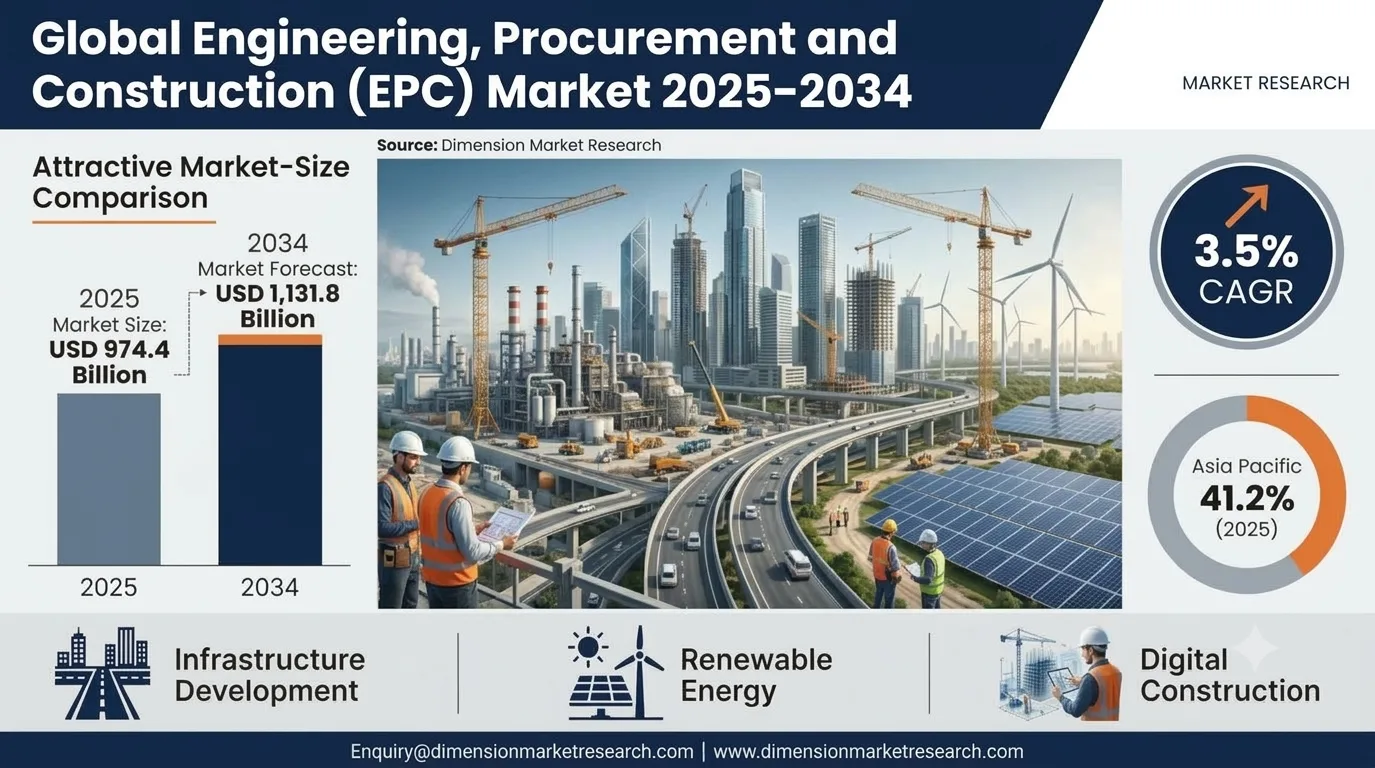
The Global Engineering Procurement and Construction Epc Market is witnessing significant transformation as governments, industrial developers, and private investors prioritize infrastructure modernization, renewable energy development, and efficient project execution. The market is expected to reach USD 974.4 billion in 2025 and is projected to achieve USD 1,131.8 billion by 2034, with a reported CAGR of 3.5%. Growing demand for integrated engineering solutions, advanced construction technologies, and sustainable infrastructure is creating opportunities for EPC contractors worldwide.
Engineering, Procurement, and Construction (EPC) represents an integrated project delivery model in which contractors manage engineering design, equipment procurement, construction activities, and project commissioning. This approach simplifies coordination, establishes clearer accountability, and helps project owners manage technical complexity. EPC contracts are widely adopted across power generation, oil and gas, transportation, manufacturing, telecommunications, and commercial infrastructure development.
The increasing complexity of large-scale infrastructure projects is encouraging businesses to adopt comprehensive EPC services. Rapid urbanization, expanding electricity requirements, industrial capacity additions, and investments in transportation networks are strengthening market demand. Furthermore, technologies such as Building Information Modeling (BIM), digital twins, artificial intelligence, and modular construction are improving project planning, procurement efficiency, operational transparency, and construction productivity.
📄 Looking for Specific Data? Get a Free Customized Sample: https://dimensionmarketresearch.com/request-sample/engineering-procurement-and-construction-epc-market/
Market Overview: Rising Demand for Integrated EPC Solutions
The global EPC industry plays an essential role in infrastructure development by bringing engineering expertise, procurement management, and construction execution under coordinated contractual arrangements. This integrated approach enables project owners to establish defined performance requirements, delivery schedules, and financial responsibilities while reducing coordination difficulties between multiple contractors.
Infrastructure investment remains a major contributor to market expansion. Governments are allocating capital toward transportation corridors, electricity networks, water treatment facilities, and urban infrastructure. Simultaneously, private organizations are expanding industrial production capacity, manufacturing facilities, logistics hubs, and energy infrastructure.
Renewable energy development is another significant area supporting EPC demand. Solar power plants, wind farms, battery storage facilities, and transmission projects require specialized engineering and construction capabilities. Contractors providing comprehensive project management, technology integration, and sustainable construction solutions are increasingly positioned to benefit from these investments.
Key Findings of the Global EPC Market
● Market size is projected at USD 974.4 billion in 2025.
● Market revenue is forecast at USD 1,131.8 billion by 2034.
● The published forecast reports a CAGR of 3.5%.
● Asia Pacific leads with a projected 41.2% revenue share in 2025.
● Construction leads the type segment with a 36.0% share.
● Roads, railways, and bridges lead applications with 30.0%.
● Renewable energy projects create substantial EPC opportunities.
● Digital technologies improve project efficiency and coordination.
Market Dynamics: Factors Influencing EPC Industry Development
The Engineering, Procurement, and Construction market is shaped by infrastructure spending, technological advancements, regulatory requirements, and changing customer expectations. While energy transition investments and industrial modernization support new project development, procurement uncertainty and rising construction costs create operational challenges.
Growth Drivers: Infrastructure Expansion and Energy Transition
Increasing Infrastructure InvestmentRapid population growth and urban expansion are increasing demand for roads, bridges, railway networks, airports, utilities, and commercial infrastructure. Developing economies are particularly focused on improving connectivity, industrial competitiveness, and access to essential services.
EPC contractors support these investments by providing coordinated technical expertise, project scheduling, procurement planning, and construction management.
Major growth drivers include:
● Expanding transportation and logistics infrastructure.
● Growing investment in renewable electricity generation.
● Increasing industrial and manufacturing capacity.
● Rising demand for modern water and utility networks.
● Greater adoption of integrated project delivery models.
Market Challenges: Cost Pressure and Project Complexity
Despite favorable long-term demand, EPC contractors face considerable financial and operational risks. Changes in steel, cement, equipment, and energy prices can affect project profitability, particularly under fixed-price contracts.
Supply chain disruptions, specialized labor shortages, permitting delays, and contractual disputes can also extend project timelines. Large infrastructure developments often involve multiple stakeholders, making efficient coordination essential.
Key market challenges include:
● Volatile construction material and equipment prices.
● Shortages of skilled engineering and construction workers.
● Delays in regulatory approvals and environmental clearances.
● Supply chain disruptions affecting project schedules.
● Financial exposure from fixed-price project contracts.
Contractors are responding through procurement diversification, digital project monitoring, improved contractual risk allocation, and stronger supplier relationships.
EPC Market Trends: Digitalization and Sustainable Construction
Digital transformation is becoming a defining trend across EPC project delivery. Building Information Modeling enables engineers and contractors to coordinate structural, electrical, and mechanical designs before construction begins. This helps identify design conflicts early and reduces avoidable rework.
Digital twins and predictive analytics provide additional capabilities for monitoring project performance, assessing potential equipment issues, and improving asset lifecycle management.
Sustainability is also influencing construction methods and procurement strategies. EPC companies are increasingly evaluating energy-efficient designs, lower-emission materials, waste reduction, and renewable energy integration.
Emerging EPC industry trends include:
● Wider adoption of BIM and digital twin technologies.
● Growing use of modular and prefabricated construction.
● Increased focus on low-carbon construction materials.
● Greater integration of automation and predictive analytics.
● Rising interest in public-private infrastructure partnerships.
Opportunities in Emerging Infrastructure Applications
The expansion of energy storage, smart grids, semiconductor manufacturing, advanced data centers, and industrial automation facilities presents attractive opportunities for EPC providers.
These projects require specialized engineering expertise, complex equipment procurement, and precise construction execution. Contractors capable of managing multidisciplinary technical requirements can differentiate themselves through reliability, efficiency, and project delivery capabilities.
Modular construction also offers opportunities to reduce site work, improve quality control, and shorten certain project schedules.
Market Segmentation Overview
The global EPC market is categorized by type and application, reflecting the different services and industries supported by integrated project delivery.
By Type
Construction is projected to account for 36.0% of global EPC market revenue in 2025, making it the leading type segment. Demand is supported by transportation infrastructure, industrial facilities, energy projects, and commercial construction.
Engineering services remain essential for feasibility assessment, technical design, process optimization, and regulatory compliance. Procurement activities concentrate on equipment sourcing, vendor management, material availability, and logistics coordination.
Major type segments:
● Construction: Civil works, installation, and project execution.
● Engineering: Technical design, planning, and project development.
● Procurement: Equipment sourcing, purchasing, and logistics.
By Application
Roads, railways, and bridges are expected to lead EPC applications with a 30.0% market share in 2025. Urban transportation expansion, railway modernization, bridge rehabilitation, and improved freight connectivity contribute to demand.
Energy infrastructure remains another important application, encompassing power generation, transmission networks, and oil and gas facilities.
Key application segments include:
● Roads, railways, and bridges.
● Chemicals and industrial processing.
● Power generation and energy infrastructure.
● Oil and gas facilities.
● Manufacturing plants.
● IT and telecommunications.
● Airports and ports.
● Building construction.
● Other infrastructure applications.
The diversity of applications allows EPC contractors to pursue opportunities across both established and emerging industries.
📄 Purchase the Report for Comprehensive Details: https://dimensionmarketresearch.com/checkout/engineering-procurement-and-construction-epc-market/
Regional Analysis: Asia Pacific Dominates the Global EPC Market
Asia Pacific
Asia Pacific is projected to dominate the global EPC market, accounting for 41.2% of total revenue in 2025. Rapid industrialization, urban development, transportation infrastructure expansion, and energy investments support its leading position.
China, India, Japan, and South Korea contribute through major industrial, transportation, and electricity infrastructure projects. Manufacturing expansion and renewable energy development are creating additional demand for integrated EPC services.
The region is expected to retain its leading position throughout the forecast period as infrastructure development and industrial modernization continue.
North America
North America represents a significant EPC market supported by investments in energy infrastructure, manufacturing facilities, transportation modernization, and industrial construction.
The United States is projected to reach USD 304.0 billion in EPC market revenue in 2025, supported by demand for electricity infrastructure, industrial facilities, and construction modernization.
Digital engineering, advanced manufacturing investments, and infrastructure rehabilitation are important regional opportunities.
Europe
Europe's EPC market is supported by energy transition initiatives, aging infrastructure replacement, industrial efficiency improvements, and transportation modernization.
Investments in electricity grids, renewable generation, railway electrification, and environmentally responsible construction create demand for specialized contractors. Regulatory compliance and sustainability performance remain important considerations in project development.
Middle East and Africa
The Middle East and Africa offer EPC opportunities through energy projects, industrial diversification, water infrastructure, and large-scale urban developments.
Middle Eastern countries are investing in transportation networks, energy infrastructure, and industrial facilities. Meanwhile, parts of Africa require substantial investment in electricity access, water management, and logistics infrastructure.
Latin America
Latin America presents opportunities across transportation infrastructure, mining facilities, renewable energy, and public utilities.
Brazil, Mexico, Chile, and other regional markets require EPC expertise for industrial development and infrastructure modernization. Financing availability, regulatory requirements, and economic conditions continue to influence project execution.
Competitive Landscape: Leading EPC Companies and Strategies
The global Engineering, Procurement, and Construction market features multinational engineering companies, specialized industrial contractors, and regional construction organizations.
Competition is influenced by technical expertise, financial capability, project delivery experience, procurement networks, and the ability to manage complex contractual responsibilities.
Prominent companies operating in the EPC industry include:
● Fluor Corporation
● Bechtel Corporation
● Saipem S.p.A.
● Mitsubishi Heavy Industries, Ltd.
● McDermott International Ltd.
● Technip Energies
● Larsen & Toubro Limited
● Samsung E&A
● KBR, Inc.
● Hyundai Engineering & Construction
Leading contractors are strengthening digital engineering capabilities, expanding service portfolios, pursuing strategic partnerships, and improving project management systems.
Increasing customer emphasis on schedule certainty, cost transparency, and sustainability is also shaping competitive differentiation.
Future Market Outlook: EPC Industry Through 2034
The global EPC market is expected to benefit from continued investment in essential infrastructure, renewable energy systems, industrial development, and transportation modernization.
Future opportunities are likely to concentrate on projects requiring advanced technical integration, efficient capital deployment, and sustainable construction practices.
Digital technologies will increasingly support design coordination, procurement forecasting, construction monitoring, and risk management. At the same time, modular construction and standardized project components may improve delivery efficiency for suitable applications.
Major opportunities through 2034 include:
● Renewable energy and electricity grid infrastructure.
● Advanced manufacturing and industrial construction.
● Smart transportation and urban infrastructure.
● Digital project management and engineering automation.
● Water treatment and climate-resilient infrastructure.
Contractors combining technical specialization with disciplined risk management are likely to remain competitive as project requirements become more complex.
Frequently Asked Questions (FAQs)
1. What is the global Engineering, Procurement, and Construction market size?
The global EPC market is projected to reach USD 974.4 billion in 2025 and USD 1,131.8 billion by 2034, according to the stated market forecast.
2. What factors are driving growth in the EPC market?
Infrastructure modernization, renewable energy investments, urbanization, manufacturing expansion, and demand for integrated project delivery services are major growth factors.
3. Which region dominates the global EPC market?
Asia Pacific is expected to dominate with a 41.2% market share in 2025, supported by industrialization, transportation infrastructure development, and energy investments.
4. Which segments lead the Engineering, Procurement, and Construction market?
Construction leads the type segment with a projected 36.0% share, while roads, railways, and bridges lead applications with approximately 30.0% in 2025.
5. What technologies are transforming the EPC industry?
Building Information Modeling, digital twins, artificial intelligence, modular construction, automation, and predictive analytics are transforming project planning, procurement, construction execution, and asset management.
Conclusion: Key Insights and Market Summary
The Global Engineering, Procurement, and Construction EPC Market remains essential to infrastructure modernization, industrial development, and the worldwide energy transition. Growing investment in transportation, manufacturing, utilities, and renewable energy is supporting demand for integrated project delivery services.
Asia Pacific's projected 41.2% market share highlights its importance in global EPC activity, while construction and transportation infrastructure continue to represent major market segments.
Although procurement volatility, labor shortages, and regulatory complexity present challenges, technological innovation and sustainable construction create meaningful opportunities. EPC companies that prioritize operational efficiency, financial discipline, digital transformation, and technical expertise will be better positioned to capitalize on infrastructure investment through 2034.
Related Reports:
https://dimensionmarketresearch.com/report/engineering-services-market/
https://dimensionmarketresearch.com/report/us-engineering-services-market/
https://dimensionmarketresearch.com/report/europe-engineering-services-market/