Try this little experiment. Open any app on your phone and count how many of them mention "AI" somewhere in their update notes. Your notes app? AI summaries. Your camera? AI enhancement. Your food delivery app? AI recommendations for... pizza toppings, apparently.
At some point, "AI-powered" stopped meaning "this uses artificial intelligence in a meaningful way" and started meaning "please notice us." And if that sentence gave you a weird feeling, you're not imagining things. We've been here before.
Remember when everything had to be ".com"?
Rewind to the mid-1990s. The internet had just become usable for ordinary people, thanks largely to early browsers like Mosaic that let websites show pictures instead of just plain text. That one change made the internet feel exciting instead.
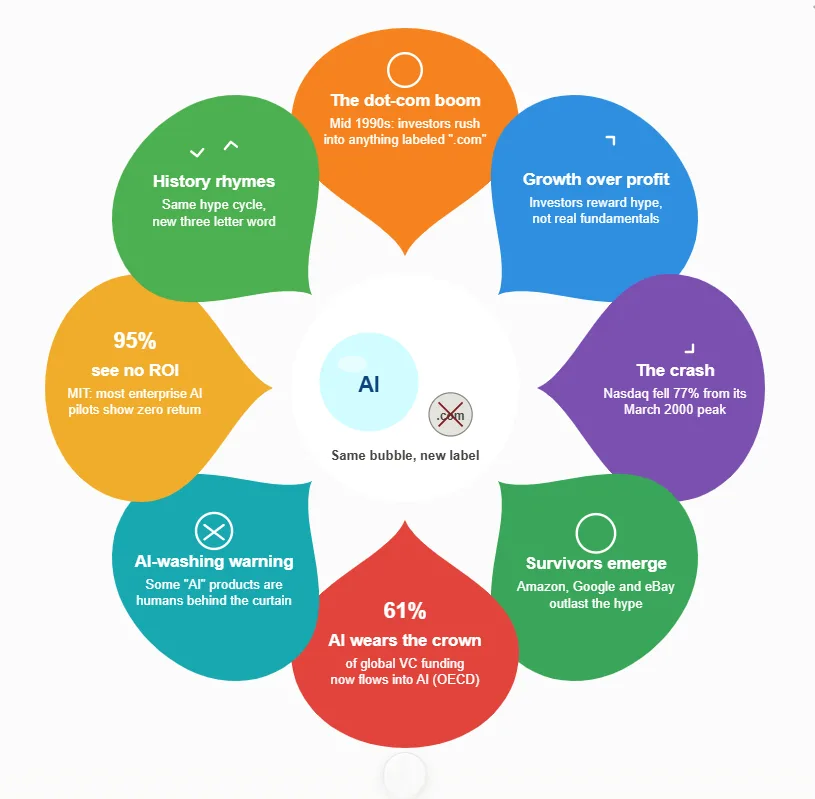
Then Netscape went public in 1995, and its stock price rocketed on the very first day of trading. That moment flipped a switch in investors' brains. Suddenly, a company didn't need to be profitable to be valuable. It just needed to be online. "Growth first, profits later" became the unofficial motto of an entire era.
What came next was chaos, but exciting chaos. Startups burned through cash on ads and flashy launch parties while their actual business models made very little sense. Regular people put their savings into internet stocks because nobody wanted to miss the next big thing. Founders became celebrities. It was less "sound business strategy" and more "collective fear of missing out."
Then, by 2000, things turned. Interest rates climbed, Y2K jitters lingered longer than expected, and Japan's economy was shaky. Investors got shaken up, and once a few of them started selling, it turned into a stampede.
The damage was brutal. The Nasdaq dropped 77 percent between its March 2000 peak and its October 2002 low, according to Goldman Sachs, erasing trillions of dollars in value along the way. Companies that had been worth billions on paper became worthless within months. Regular employees lost jobs and savings almost overnight.
But here's the part people tend to forget: the internet wasn't the problem. Companies like Amazon, Google, and eBay came out the other side stronger than ever, because they actually had working business models underneath all the hype. The dot-com crash didn't kill the internet. It just killed the companies that were riding its success without a real plan.
Now swap ".com" for "AI"
Here's where it gets interesting for anyone paying attention today. AI is a genuinely powerful technology. Nobody's disputing that. But look at how many products slap "AI-powered" onto features that barely qualify. A basic autocomplete function suddenly becomes "advanced AI assistance." A simple filter becomes "AI-driven personalization."
According to OECD analysis of global venture capital data, AI firms captured 61 percent of all global venture capital investment in 2025, more than doubling their share since 2022. That's an extraordinary concentration of money flowing into one label. Some of it is going toward genuinely groundbreaking work. Some of it is going toward companies that figured out the magic words investors want to hear.
A very real, very recent story
If you want proof this concern isn't just theoretical, look at what happened with a few companies. The company pitched itself as revolutionary: build custom software as easily as ordering a pizza, powered by an AI assistant. It sounded incredible, and investors, including Microsoft, believed it enough to push the company's valuation to $1.5 billion.
Then the cracks showed. Investigations found that hundreds of human engineers were quietly doing the work the AI model was supposedly doing on its own. To make things worse, an internal audit revealed the company had overstated its 2024 revenue significantly, reporting around $220 million when the real number was closer to $50 million. Builder.ai filed for bankruptcy in May 2025, and employees reportedly found out on a single, sudden company-wide call.
It's not proof that every AI startup is a scam. It's a reminder that the label and the substance aren't always the same thing, and it's worth checking which one you're actually paying for.
The numbers behind the hype
It's not just one company either. A 2025 MIT report studying hundreds of enterprise AI projects found that despite $30 to $40 billion in corporate spending on generative AI, about 95 percent of pilot programs failed to deliver any measurable financial return. Only around 5 percent of companies saw real, tangible value.
"History doesn't repeat itself, but it often rhymes." — Mark Twain
What about the office training platform your company just bought?
This same pattern shows up somewhere quieter too: workplace learning tools. AI in corporate training is real and, in some cases, genuinely useful: smarter feedback loops, personalized content, faster course creation. But it's worth asking a slightly uncomfortable question: is your company investing in an AI-powered learning platform because it actually fixes a training problem, or because every competitor's product page now has the word "AI" on it and nobody wants to be the one without it? Not every tool needs the label to be valuable, and not every label means the tool is better.
So, are we heading for another crash?
Nobody can promise a specific outcome here. What we do know is that hype cycles have a rhythm: excitement, overinvestment, a reality check, and then a smaller group of companies that deliver value survive and thrive long after the noise dies down.
It's staying curious enough to ask real questions. Does this product solve something? Would it still be worth using if the word "AI" were removed from its marketing entirely? Those two questions alone will tell you more than any pitch deck will.
And maybe that's the real skill worth building right now, not predicting the next crash, but getting better at telling the difference between genuine innovation and a well-dressed buzzword. The companies asking themselves hard questions today are the ones more likely to still be standing when the next hype cycle rolls in, whatever three-letter word it happens to be wearing.
FAQs
1. Is AI as overhyped as the dot-com era was?
Some of it is, and some of it genuinely isn't. The technology itself is powerful and real. The concern is that plenty of companies are using the AI label to attract funding without real substance behind it.
2. Do most AI investments pay off for businesses?
Not according to a 2025 MIT report, which found around 95 percent of enterprise AI pilot programs failed to show any measurable financial return, with only about 5 percent delivering real results.
3. How much money is going into AI right now?
A lot. OECD data shows AI firms captured 61 percent of all global venture capital in 2025, more than double their share from just a few years earlier.
4. Should I be sceptical of every product that says, "AI-powered"?
Not sceptical exactly, just curious. Ask what the AI does and whether the product would still hold up without the label. That question filters out a lot of noise fast.