
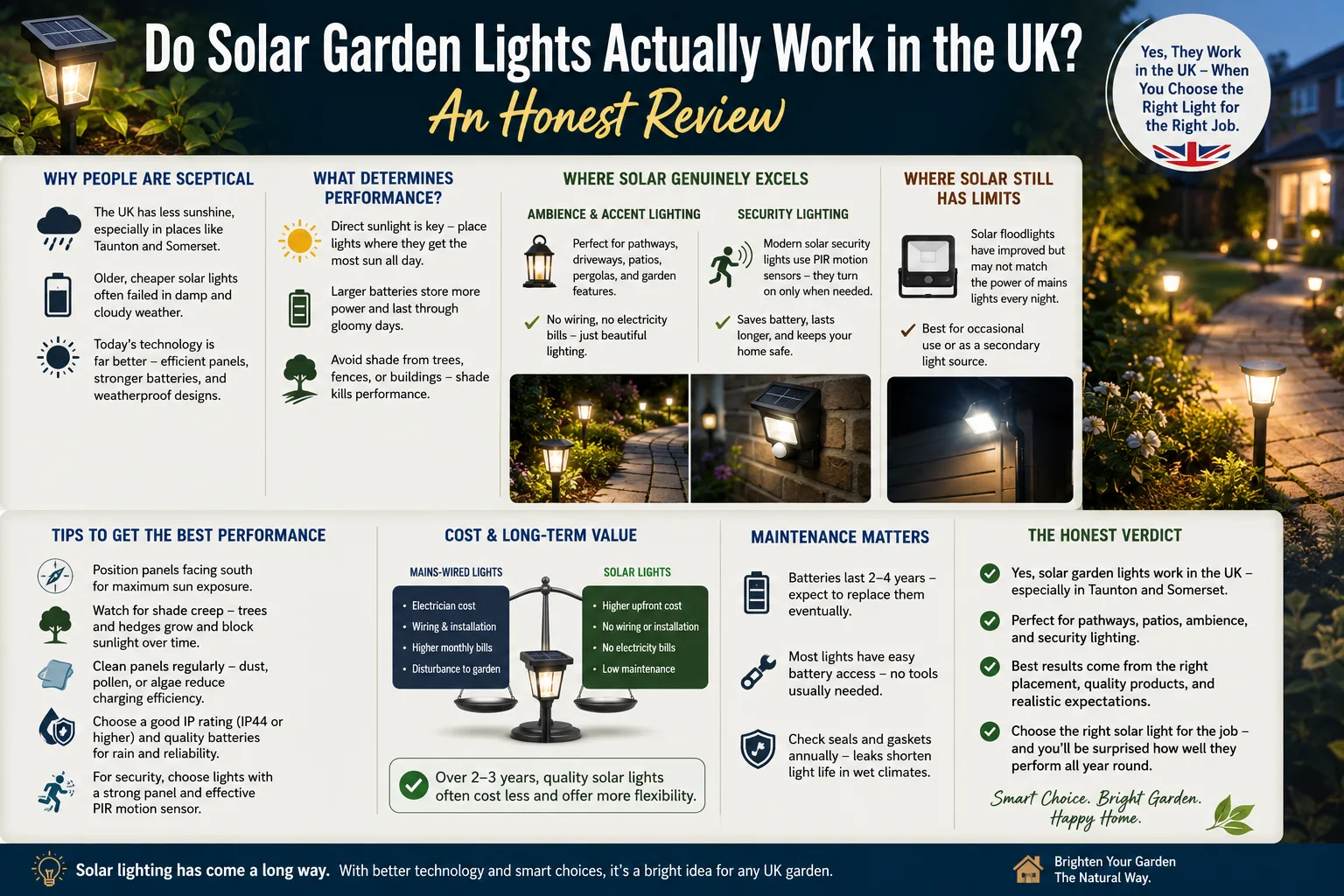
Now, you that have stood in a Taunton garden centre debating the purchase of a box of stake lights with solar power must have asked yourself (and so must everyone in the South West) “do these things actually work here, or are they made for more sunny climates and useless when the clouds roll over Somerset?” It's a legitimate question, and the reality is more complex than yes or no, but such solar garden lights certainly work in the UK, but it depends on the type of light, where it is going and what it is being used for.
Why People Are Sceptical
There's reason enough to be skeptical. Britain isn't a place known for its sunshine, and Taunton's relatively mild and cloudy conditions aren't providing as much sunshine as, say, Spain or California. To these years of affordable solar lighting that didn't last past the damp winter months add a few years of mains-powered lights, and it's no wonder homeowners think solar is too unreliable. However, much technology has advanced since then. The panels' more efficient monocrystalline cells are used, and batteries are no longer disposable nickel-cadmium but are now much more efficient with lithium or NiMH cells. Also, manufacturers are much better at making the panels weatherproof against the persistent drizzle that is found over much of Somerset for much of the year.
What Actually Determines Performance
Weather is the biggest factor on whether a solar light works well or not – positioning. A solar panel requires the unobstructed and direct sun to operate as much of the day as possible. Bright lights placed under trees, near fences or under the shadows of a house, and used throughout the afternoon, will always underperform, no matter the season or the quality of the product. When a light doesn't seem to work, on many Taunton gardens it may well be due to mature hedging or trees on boundary lines that are blocking the light. Battery size also is important. Cheap lights may only have enough battery life to get through the review period, while more carefully designed lights will have enough capacity to "catch" enough sunlight to get through a few gloomy days. Somerset's weather conditions will rarely provide a full week without some useful daylight and a well specified solar light will therefore provide enough light for most of the year, even in November and December when daylight is at a minimum.
Where Solar Genuinely Excels
Solar is excellent for decorative and accent lighting purposes in the UK climate. It is what it's made to do and it does it all with no wiring, no electrician, without putting a penny on your electricity bill--path markers, lights along a driveway, and soft white lights around a patio or pergola. The low draw applications are able to be applied to the low light conditions found in the UK without needing to produce a lot of light. Solar is also a viable lighting choice for home security lights. Most modern solar security lights are equipped with a good size panel and a PIR motion sensor, so the light will not conduct electricity and consume battery until there is an object close to a doorway, side passage or driveway, at which point the light will turn on for a set period before switching off, to conserve battery life. This 'on-demand' method is actually quite appropriate for solar energy, as the light is not continuously on, but only comes out of the battery when someone or something activates the sensor, and thus the light can be used much longer than if it was constantly illuminated.
Where Solar Still Has Limits
The trouble with solar is its performance in the floodlight category especially if you're hoping it will be as powerful as a unit connected to the mains. They've come a long way with solar floodlights, but if you need super high lumen power each and every night for a massive driveway or patio, no matter what the weather is like the previous week, then a wired floodlight or one that has a mains back-up would be more reliable through a long overcast Somerset winter. Solar floodlights are ideal for use as a second source of light to illuminate a particular area when needed, not to replace the light source that is necessary for a particular space at night for its safety.
Getting the Best Out of Solar Lighting in a Taunton Garden
Some helpful tips can make a difference to performance. Wherever possible place panels south, and remember that in spring and summer, shade creep may be an issue if the trees and hedges grow and block the sun from the panels by August. The panel surface should be cleaned every few months as a dust, pollen or algae layer can have a significant reduction on the amount of light reaching the cell. Don't buy the first IP44 or rated battery size that's on the shelf; if it's placed in an area that receives a lot of rain, it will make a huge difference. If you're after security over ambience, you'll want to consider a unit equipped with a good panel, and a highly effective PIR motion sensor, which can provide the most effective and cost effective security that you're likely to find for driveways, side gates, and back doors.
A Note on Cost and Long-Term Value
Also consider solar light in terms of overall cost and not just price. A mains-wired lighting plan generally requires a call for an electrician, light cable running all through the garden and an increase in your bills each month. Solar lights, on the other hand, have a higher price tag for the more specific ones but no other costs. No wiring, no trenching in the lawn or patio, and no impact on the household running costs is measurable. The combination of a well-selected set of solar lights around a Taunton garden generally fares significantly better over two or three years than the wired version, especially when considering that batteries may need replacing here and there as cells degrade over a number of UK winters. It requires minimal maintenance, but not none. Even the best solar lights have battery life that can be expected to diminish over two to four years of daily charging and discharging – and it's realistic to expect a battery swap at some point – not fit-and-forget for years and years. Most good brands do this easily, and there is one small compartment that doesn't require any tools. It is worthwhile to watch the seals around that compartment every year, because one of the more frequent ways in which the light life is shortened in a wetter climate such as ours is the failure of a rubber gasket.
The Honest Verdict
Solar garden lights are not a compromise product in the UK, they're certainly not a compromise product in Taunton. Solar is now truly a great option for pathways, patios and garden ambience (outside of the garden room), and may be better suited that cable running through a lawn for a few low-wattage fittings. Solar is a viable and growing solution for security lighting particularly when combined with a PIR motion sensor which only turns on the light when it is required, thus maximising the available winter daylight. The only place where the expectation has to be tempered is in terms of heavy duty floodlighting where a hybrid or mains backed product is still more reliable during the darkest and greyest periods of the year. So, when you are thinking about having a solar garden in Taunton or anywhere in Somerset, it is not a question of whether it works or not, it is whether you have got a solar light that is correctly matched to the job in your garden. With a decent match, a soundly constructed unit with a suitable IP rating and a decent PIR motion sensor where security is their main concern, you'll find that solar lighting is much more effective over a British year than kudos would usually have you believe.