
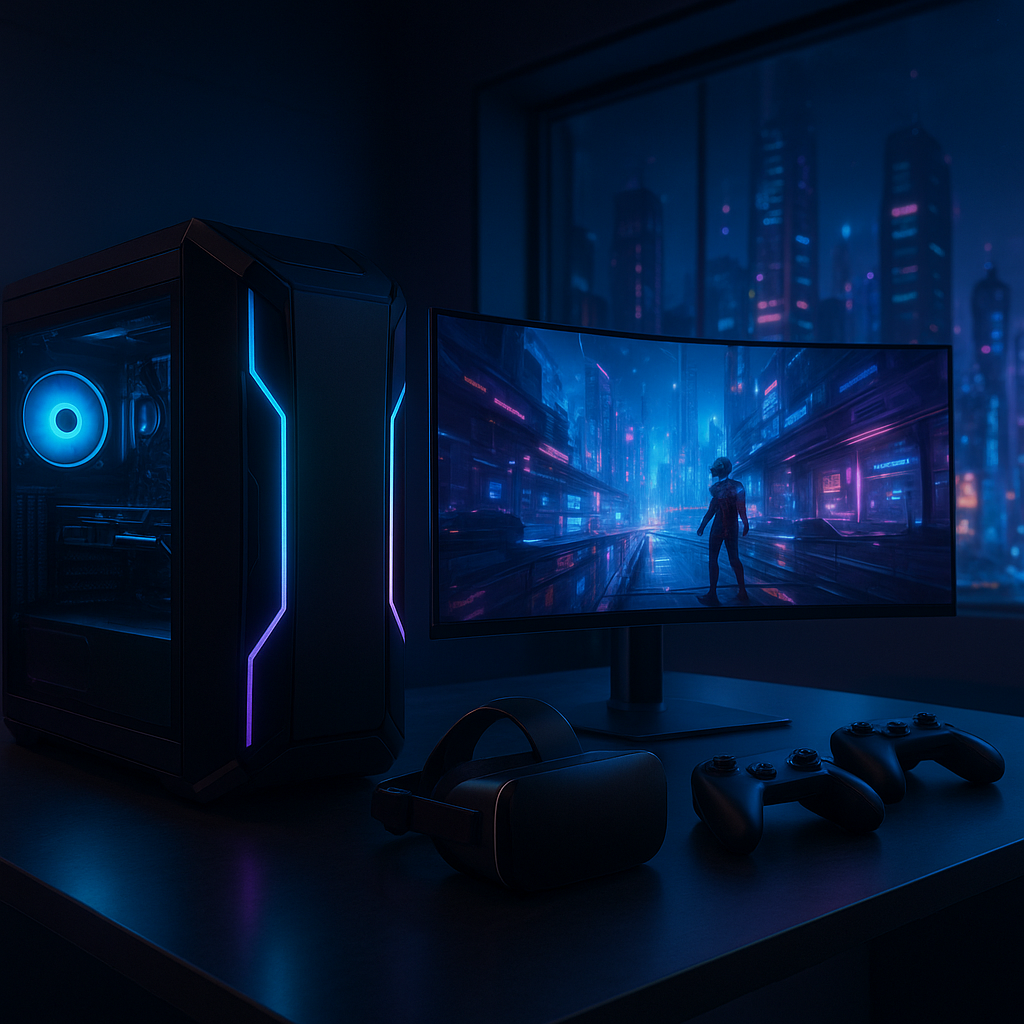
Unveiling the Revolution: A Glimpse into Modern Gaming Hardware
The hum of a high-performance PC, the crisp response of a mechanical keyboard, and the immersive soundscapes delivered by spatial audio headsets are no longer niche luxuries but essentials in the gaming ecosystem of 2026. Gaming hardware has transcended its role as mere tools for gameplay; they now shape the very essence of how players interact with virtual worlds. Recent industry reports highlight that the global gaming hardware market surpassed $35 billion in 2025, with an annual growth rate exceeding 12%, underscoring its accelerating significance. The increasing demand for ultra-realistic graphics, low-latency responsiveness, and ergonomic design has spurred manufacturers to innovate at an unprecedented pace.
Consider the latest NVIDIA GeForce RTX 5090 Ti GPU, launched late 2025, which boasts advanced ray tracing and AI-driven upscaling technologies, delivering photorealistic visuals at 8K resolution. Meanwhile, AMD’s Ryzen 9000 series CPUs have set new benchmarks for multi-threaded gaming performance, enabling smoother multitasking and streaming. These advancements are complemented by the rise of specialized gaming monitors with refresh rates surpassing 480Hz and microsecond response times, creating a seamless visual experience.
“The hardware is no longer just a support system; it’s an active participant in the gaming narrative, amplifying immersion and competitive edge alike,” says Julian Kim, senior analyst at TechInsights.
Tracing the Path: How Gaming Hardware Has Evolved to 2026
Gaming hardware's evolution over the past two decades has been transformative. In the early 2000s, gaming PCs were luxury builds dominated by bulky towers and CRT monitors. Consoles offered limited graphical fidelity, and peripherals were basic. However, the 2010s sparked a rapid tech acceleration driven by the rise of eSports and streaming platforms such as Twitch. This era saw the introduction of mechanical keyboards, high-DPI gaming mice, and the first wave of VR headsets, which began to change how players engaged with games.
The 2020s ushered in a new era characterized by AI integration, cloud gaming, and cross-platform connectivity. Hardware manufacturers responded by developing modular components, allowing users to upgrade GPUs, CPUs, and cooling systems with ease. The launch of USB4 and Thunderbolt 5 standards facilitated faster data transfer rates, enhancing external device performance. Concurrently, peripherals evolved with customizable RGB lighting, haptic feedback, and biometric sensors that monitor player vitals to adapt gameplay in real time.
Wireless technology matured significantly, with ultra-low latency protocols like WiGig becoming mainstream, enabling wireless VR and high-fidelity audio without compromise. The integration of AI-driven software in hardware, such as NVIDIA DLSS and AMD FSR, has further optimized performance, enabling hardware to intelligently upscale lower-resolution images and improve frame rates without sacrificing graphical quality.
“The past decade redefined gaming hardware from static tools to dynamic systems that learn and adapt alongside players,” reflects Dr. Erica Vasquez, hardware strategist at GameTech Innovations.
Core Hardware Components: Analysis of 2026’s Leading Technologies
The backbone of any gaming setup remains its core components: the CPU, GPU, memory, storage, and display technology. In 2026, these elements have reached levels of sophistication that blur the lines between consumer and professional-grade computing.
Central Processing Units (CPUs): AMD's Ryzen 9000 and Intel’s 15th Gen Core processors dominate the market, offering 24-core configurations optimized for gaming and multitasking. These CPUs leverage advanced 3D stacking technology, improving power efficiency and thermal management. According to industry benchmarks, Ryzen 9 9950X offers up to 25% better single-threaded performance compared to its predecessor, crucial for titles dependent on CPU speed.
Graphics Processing Units (GPUs): The NVIDIA GeForce RTX 5090 Ti and AMD Radeon RX 8900 XT exemplify the cutting edge in GPU technology. Both cards support real-time ray tracing, AI-driven rendering, and feature expanded VRAM capacities (up to 32GB GDDR7) to handle ultra-high-resolution textures. Frame rates exceeding 240fps at 4K resolution are now achievable, critical for competitive gaming.
Memory and Storage: DDR6 RAM modules with speeds surpassing 10,000 MT/s are standard in flagship builds, reducing latency and improving loading times. SSDs have transitioned entirely to PCIe 5.0 NVMe drives, with capacities up to 16TB now commonplace. These drives offer sequential read/write speeds exceeding 15,000 MB/s, dramatically reducing game launch times and in-game asset streaming.
Displays: OLED and microLED gaming monitors have eclipsed traditional LCDs, offering superior contrast ratios, near-instantaneous response times, and HDR capabilities compliant with the latest VESA DisplayHDR 1400 standards. Curved ultrawide formats with aspect ratios of 32:9 enhance peripheral vision in immersive titles.
- CPUs: Multi-core, 3D stacked, energy-efficient designs
- GPUs: Ray tracing, AI upscaling, 32GB+ VRAM
- Memory: DDR6 with ultra-low latency
- Storage: PCIe 5.0 NVMe SSDs, up to 16TB
- Displays: OLED, microLED, ultrawide HDR
The synergy of these components is crucial. For example, pairing a high-end GPU with insufficient RAM or an outdated CPU creates bottlenecks, limiting overall performance. Enthusiasts now rely on dynamic benchmarking tools and AI diagnostics embedded in hardware to optimize their setups continually.
2026’s Pivotal Advances and Industry Shifts in Gaming Hardware
This year has witnessed several paradigm shifts in gaming hardware. Notably, the rise of AI-driven peripherals has gained momentum. Keyboards and mice now incorporate machine learning algorithms that adapt button sensitivity and macros based on player behavior, enhancing precision and comfort.
The emergence of neural interface devices—still experimental but progressing rapidly—promises to revolutionize input methods. Companies like NeuralPlay and Synaptic Games have announced prototypes that translate neural impulses into in-game commands, offering unprecedented control fidelity. While commercial adoption remains tentative, these developments hint at the future of gaming immersion.
Additionally, sustainability has become a core consideration. Manufacturers are adopting eco-friendly materials and designing hardware for easier recycling. The shift towards modular designs extends product lifecycles and reduces e-waste.
Cloud gaming hardware has also advanced, with edge computing nodes now deployed globally to minimize latency. This infrastructure supports 8K streaming at 120fps with minimal buffering, making high-end gaming accessible without expensive local rigs.
- AI-adaptive peripherals enhancing gameplay
- Neural interfaces advancing input technology
- Eco-conscious hardware design and modularity
- Edge computing powering cloud gaming at scale
The convergence of these factors is reshaping how gamers approach hardware investment, balancing performance needs with ethical and practical considerations.
Industry Voices and Market Impact: Insights from Experts
Industry leaders emphasize that the gaming hardware landscape is increasingly player-centric, driven by data analytics and community feedback. Sarah Lin, CTO of HyperPixel Technologies, notes, “We’ve moved from designing hardware in isolation to co-creating with gamers, leveraging telemetry and AI to deliver personalized experiences.”
Esports organizations report that hardware performance directly correlates with player success. Competitive teams invest heavily in custom setups tuned for specific titles and playstyles. According to a 2025 Esports Performance Report, players using top-tier hardware improved reaction times by an average of 18%, translating into measurable competitive advantages.
Investors are also keen on hardware startups focusing on AI integration, sustainability, and neural tech. Venture capital funding for gaming hardware firms hit $3.2 billion in 2025, with projections signaling continued growth.
“The fusion of hardware innovation and player data analytics is unlocking new frontiers in gaming performance and engagement,” asserts Rajesh Patel, lead analyst at MarketWave Research.
Moreover, traditional hardware companies are diversifying into software ecosystems, enabling seamless updates and cloud synchronization, as highlighted in our recent coverage of gaming industry evolution at TheOmniBuzz. You might enjoy exploring Video Games in 2026: Innovation, Impact, and Industry Evolution and How Esports Is Redefining Competition, Culture, and Commerce in 2026 for broader context.
Future Horizons: What to Watch in Gaming Hardware Beyond 2026
Looking ahead, several trends promise to redefine gaming hardware further. First, quantum computing remains on the horizon, potentially offering exponential leaps in processing power. While practical quantum gaming rigs are years away, research collaborations between gaming firms and quantum startups are underway.
Second, the integration of augmented reality (AR) with traditional gaming hardware is expected to deepen. Lightweight AR glasses with full environmental mapping could become standard peripherals, blending real and virtual worlds seamlessly.
Third, advancements in biometrics and emotional AI will enable hardware to respond to player stress, fatigue, and excitement, dynamically adjusting game difficulty or ambiance.
Finally, the continued expansion of cloud and edge computing architectures will democratize access to high-end gaming experiences, reducing reliance on expensive personal hardware.
- Quantum computing potential in gaming
- Augmented reality integration and peripherals
- Biometric and emotional AI-responsive devices
- Cloud and edge computing democratizing access
For gamers and industry stakeholders, staying informed and adaptable will be essential. As hardware increasingly shapes the narrative and accessibility of gaming, strategic investment and innovation will drive the next generation of player experiences.
In summary, the gaming hardware landscape of 2026 reflects a sophisticated blend of cutting-edge technology, player-centric design, and emerging trends that together elevate gaming from pastime to immersive art form. For further insights on player behavior and industry trends, also worth reading is How Game Reviews Shape Player Choices and Industry Trends Today.