How Data-Driven Tools Are Changing Competitive Gaming in 2026
There's a small ritual at the start of every competitive gamer's evening, and a decade ago it didn't exist. Open a phone. Check what the meta looks like since this morning. Decide what to play tonight based on a number that updated while you were eating dinner.
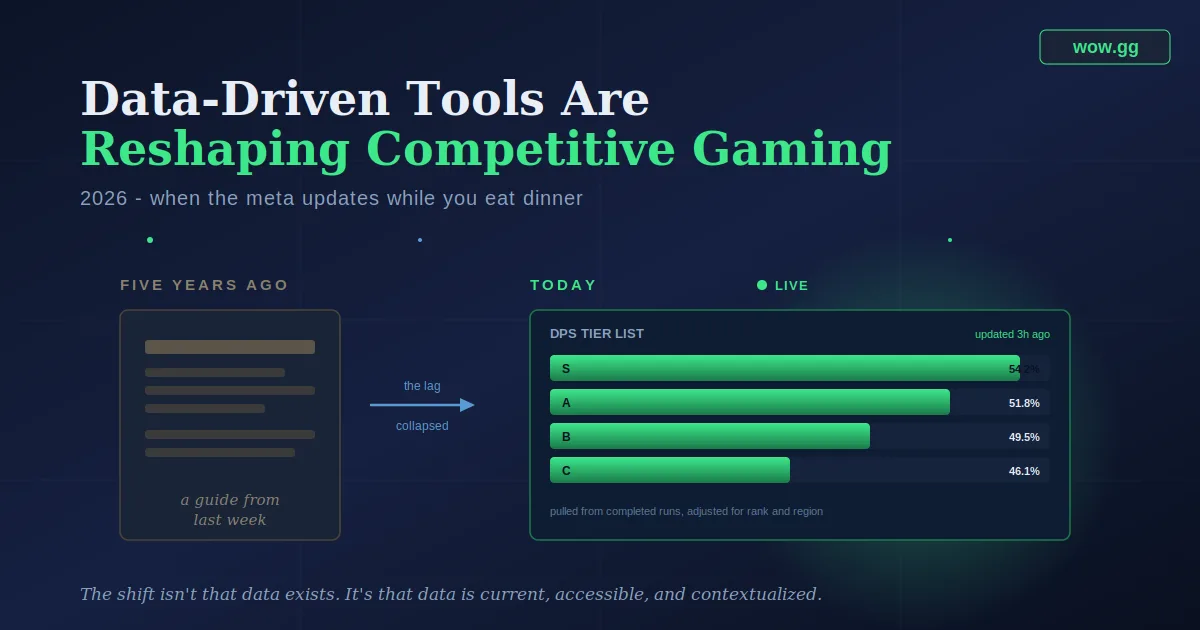
This used to be impossible. Five years ago, the meta you played tonight came from a guide someone wrote last week. Today it comes from a database that updated three hours ago. The lag between what happens in a game and what players know about it has collapsed, and the consequences are bigger than most observers expected when the shift started.
What "real-time" actually means now
The phrase has changed meaning twice in the past five years. Half a decade ago, "real-time" in gaming analytics meant updated within a day. Three years ago, it meant updated within twelve hours. Today, for most major platforms, it means updated within a few hours. For the cutting-edge ones, it means minutes.
That doesn't sound like much of a change on paper. In practice it changes what the data can be used for. A daily update is a reference. An hourly update is a decision tool. A minute-level update is operational.
Take World of Warcraft as a working example. The current expansion launched earlier this year with dungeon seasons that turn over every few months. Class balance shifts weekly. Player optimization used to lag balance changes by days or weeks — guide writers needed time to analyze the new state, calculate optimal builds, and publish updates. Today, the wow dps tier list on wow.gg pulls live data from completed runs and updates the rankings every few hours, automatically.
The practical effect is that a player checking the rankings at eleven in the morning sees them based on runs completed before breakfast. A balance hotfix at noon shows up in the rankings by dinner. The question "what should I play tonight" gets answered by data from this morning, not by an essay someone wrote last week.
The pattern across platforms
This isn't unique to one game. Major multiplayer titles across genres have character or class winrate dashboards updating by region and skill bracket in near-real-time. Shooter games have player-tracker dashboards reading match data within minutes of completion. Tournament-driven scenes use analytics platforms that surface meta shifts within a single competition cycle.
The common thread is the API. Game publishers have, slowly, opened up live data feeds — sometimes intentionally, sometimes through reverse-engineering that the publishers chose not to fight. Third-party developers consume those feeds, transform them into player-facing dashboards, and monetize them through subscription tiers, donations, or advertising.
The platforms doing this well have something in common. They don't just show data. They contextualize it. A raw winrate number is noise. A winrate number adjusted for rank, region, and patch is signal. The difference between the two is the difference between a database query and an analytics company.
The skill gap nobody noticed
The strange consequence of all this data democratization is that the players with the most analytical literacy have a bigger edge than they used to, not a smaller one. Mechanical skill still matters — it always has — but the gap between an optimally informed player and an under-informed one keeps widening.
A player who checks the live rankings, reads the patch notes, and absorbs the dungeon analytics before a season starts is operating on different information than a player who plays the same character he's played for two expansions. The first adapts in days. The second adapts in weeks, or never. In a competitive context, that's the difference between the top of the ladder and the middle of it.
This shifts the value proposition of competitive gaming. Time-to-adapt is now a measurable skill. Tools that compress that time become genuinely valuable, not as crutches but as competitive advantages. The five-dollar-a-month subscription that gets you faster data than the free tier isn't paying for the data — it's paying for the time you save by getting the data sooner.
What this means for game design
Publishers noticed all of this years ago. Some have built in-game tools that compete with third-party platforms — better adventure journals, in-client meta data, in-game leaderboard tooling. The official framing is that these tools "help players understand the game." The competitive framing is that they reduce the publisher's dependence on third-party platforms that have started to shape player perception of the game without the publisher's input.
The third-party platforms responded by going faster and contextualizing more. The arms race has been good for players. Five years ago, finding ranking data meant trusting a single editor's opinion. Today, it means looking at aggregated data with the editor's commentary as one input among many. The information asymmetry has collapsed.
This shift has reshaped what "expertise" looks like in competitive gaming. A guide writer five years ago was an authority because she had access to data players didn't. A guide writer today is an authority because she can interpret data that everyone has access to. The expertise moved from collection to analysis.
The honest limitations
Real-time data isn't omniscient. It captures what's measurable, which is mostly outcomes — wins, losses, completion times, scores. It misses everything that's subjective — how a character feels to play, how fun a strategy is to execute, how high a build's ceiling actually goes when somebody good runs it.
Rankings driven purely by data tend to over-recommend specializations and strategies that are statistically optimal but mechanically punishing. The support-specialization problem in one major multiplayer game is the canonical example. The data says the specialization is excellent. The player experience says it's exhausting to play while making everyone else's job easier. Both are true. Data captures the first. The second still matters.
The good analytics platforms acknowledge this. They show the data clearly, contextualize where context exists, and don't pretend the numbers are the entire story. The bad ones present a winrate as gospel and watch players make decisions they regret two weeks later.
What's coming next
The next jump is likely predictive rather than descriptive. Current platforms show what's happened. The next generation will model what's likely to happen — patch impact projections, meta shift forecasts, individual player performance predictions. Some of this exists already in private tools used by professional teams. Some of it is sitting in research labs at game studios waiting for the right product fit.
Whether players want predictive analytics is an open question. Some players would rather discover the meta themselves. Others would pay for a tool that tells them what to play before the rest of the player base figures it out. The market will decide. The technology already works.
What's clear is that competitive gaming in 2026 is more legibly analytical than it's ever been, and the gap between data-literate and data-illiterate players is widening rather than narrowing. The tools available to anyone — for free or for a few dollars a month — would have been impossible to build five years ago and unimaginable a decade ago.
That's the actual shift. Not "data exists" — data always existed. The shift is "data is current, accessible, and contextualized." Everything else follows from that.