
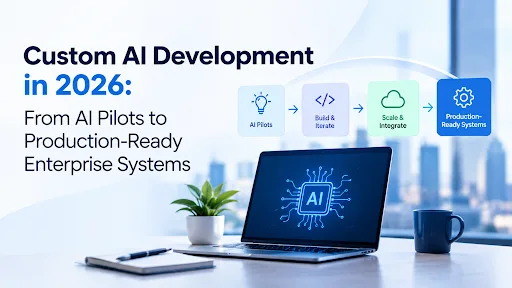
You’ve probably already run an AI pilot. Most enterprises have. What you probably haven’t done is turn it into something that actually moves your P&L. MIT’s NANDA initiative reviewed over 300 enterprise AI programs in 2025 and found that 95% of generative AI pilots deliver zero measurable financial return. IDC puts it even more starkly: for every 33 AI proofs of concept an enterprise starts, only about 4 ever reach production.
That gap isn’t a technology problem. It’s a discipline problem, and closing it is exactly what custom AI development is supposed to solve in 2026. Here’s what’s actually happening with enterprise AI right now, why most pilots stall out, and what it takes to build something that survives contact with a real production environment.

The State of Enterprise AI in 2026: Adoption Is High, Production Is Rare
• 91 percent of businesses say they will use AI in some way in 2026, which's higher than 78 percent in 2024 and 55 percent in 2023.
• 65 Percent of organizations use AI in at least one business function, about twice the amount from just ten months before.
• Even though adoption is up S&P Global found that AI initiative abandons before production rose from 17 percent in 2024 to 42 percent in 2025 and on average 46 percent of proofs of concept were scrapped before they ever went live.
• McKinsey reports that 88 percent of organizations use AI in at least one function but only 39 percent can point to any measurable EBIT impact from AI.
In other words, nearly everyone has started. Very few have finished. And board patience for the gap between the two is running out — 98% of directors are now demanding demonstrated AI ROI before approving the next budget cycle.
Why Most AI Pilots Never Make It to Production
It’s Rarely the Model’s Fault
If your instinct is to blame the algorithm, the data doesn’t back you up. BCG’s research attributes roughly 70% of AI project failure to people and process issues, with only about 10% tracing back to the AI itself. RAND’s 65-interview study of enterprise AI initiatives found that 84% of practitioners cited leadership-related causes — not model performance — as the primary reason projects failed.
“Pilot Purgatory” Has a Recognizable Shape
Across dozens of enterprise case reviews, the pattern repeats: a pilot impresses in a demo, wins a champion, and then stalls the moment that champion’s attention moves elsewhere. McKinsey found nearly two-thirds of organizations remain stuck in pilot mode, unable to scale AI across the business. In a survey of 72 executives across 30-plus industries, workflow redesign — not model choice — was the single biggest factor separating pilots that reached production from those that didn’t, named by 61% of respondents.
• No named business owner accountable for the production outcome
• Selection based on “look what it can do” demos instead of production-readiness criteria
• A workflow left untouched, with AI bolted onto the old process instead of redesigning around it
What “Production-Ready” Actually Means for Custom AI Systems
A production-ready system isn’t just a bigger model or a fancier demo. It’s a system built to survive real data, real users, and real audits.
Data and Infrastructure Readiness
IDC’s AI CIO Playbook points to weak data, process, and infrastructure readiness as the core blocker behind the low POC-to-production conversion rate. Custom development that starts with your actual data pipelines, not a clean demo dataset, catches this problem months earlier.
Governance and Security Built In, Not Bolted On
Agentic AI adoption is moving faster than the guardrails around it. Eighty-two percent of organizations are using AI agents now but only forty-four percent have security policies to manage them.. Eighty percent of companies say their AI agents have already done things they weren't supposed to. These things include going into systems or giving out data without permission. Custom-made systems can build in rules about who can do what and keep track of everything from the start. This is better than trying to add these rules after something goes wrong.
Workflow Integration, Not a Chatbot Bolted On Top
A production system changes how work actually gets done — routing, approvals, escalation paths — rather than sitting next to the existing workflow as an optional extra employees can ignore. This is the redesign work that off-the-shelf pilots almost always skip.
Getting all three of those right at once — data readiness, governance, and real workflow redesign — is rarely something an internal team can bolt on alongside its existing roadmap. That’s the gap a Custom AI Development Company is built to close: architecture, security, and integration work scoped around your actual systems instead of a generic pilot that was never meant to survive production traffic.
The ROI Case for Actually Reaching Production
The payoff for getting through the gap is real, even if it takes longer than most roadmaps admit:
• Companies that put AI to work see an average of 5.8 times their money back within 14 months according to McKinsey’s Global AI Survey
• The market for intelligence is valued at 67 billion dollars in 2026 and is projected to expand to 1.3 trillion dollars by 2032
• The average company now runs 4.2 AI models in production, which is more than double the 1.9 AI models used by the average company in 2023. This proves that moving beyond a test project is not just possible—it’s happening
• So Gallagher’s 2026 research shows that organizations take an average of 28 months to see measurable return on investment after a system goes live. So "production-ready" still means planning for patience not expecting results
How Enterprise Teams Actually Close the Pilot-to-Production Gap
• Name a single business owner accountable for the production outcome before the pilot even starts
• Redesign the workflow around the AI system instead of bolting the AI onto an unchanged process
• Run short, time-boxed proof-of-impact sprints — roughly 90 days — with a defined P&L metric, not a demo metric
• Put security and access-governance policies in place before an agent gets connected to production systems, not after
• Budget realistically for the 12–28 month window most organizations actually need to see measurable return
Where This Is Already Working
The enterprises pulling ahead aren’t necessarily using more advanced models than everyone else — they’re applying custom-built systems to narrow, well-scoped problems instead of chasing a single do-everything pilot:
• Customer. Support, where agentic AI is expected to manage sixty‑eight percent of technology‑vendor interactions by the year two thousand twenty‑eight.
• Back‑office document processing and compliance workflows, where narrow automation cuts review time while leaving customer‑facing systems untouched.
• Supply chain and demand forecasting, where models built into existing planning systems beat standalone dashboards that nobody looks at.
In every case the common thread remains the same: the system was built around an existing workflow rather than a broad capability searching for a use case.
Conclusion
The bad news for enterprise AI in 2026 is that nearly everyone is running a pilot, and few people can point to any kind of production system as a result. It's not going to get smaller on its own, nor is it going to get smaller with the addition of a better prompt or a larger model. It closes with data readiness, governance built in from the start, and a workflow that was actually redesigned around the system instead of decorated with it. Get those three things right, and you join the minority of enterprises turning AI investment into results a board doesn’t have to defend — instead of another pilot quietly shelved before it ever reaches production.