
Key Takeaways
- Telegram offers crypto projects a direct channel for community communication, education, support, and product updates.
- Member acquisition works better when campaigns attract people who have a genuine reason to join and participate.
- Conversion depends on trust, useful content, responsive moderation, and a defined path from community member to user.
Introduction
Crypto Telegram marketing has become an important part of Web3 community building. Unlike traditional social networks, Telegram places direct communication at the center of the experience. Projects can publish updates, answer questions, organize discussions, distribute educational content, and maintain ongoing relationships with users from one platform.
Telegram passed 1 billion monthly active users in 2025, according to its official press information. The platform also supports groups with up to 200,000 members and channels with unlimited subscribers.
This scale makes Telegram attractive for cryptocurrency projects, token launches, exchanges, wallets, DeFi protocols, NFT platforms, and Web3 applications. Yet a large member count does not automatically create business value. A group filled with inactive accounts, bots, or users attracted only by giveaways can create the appearance of growth without producing meaningful engagement.
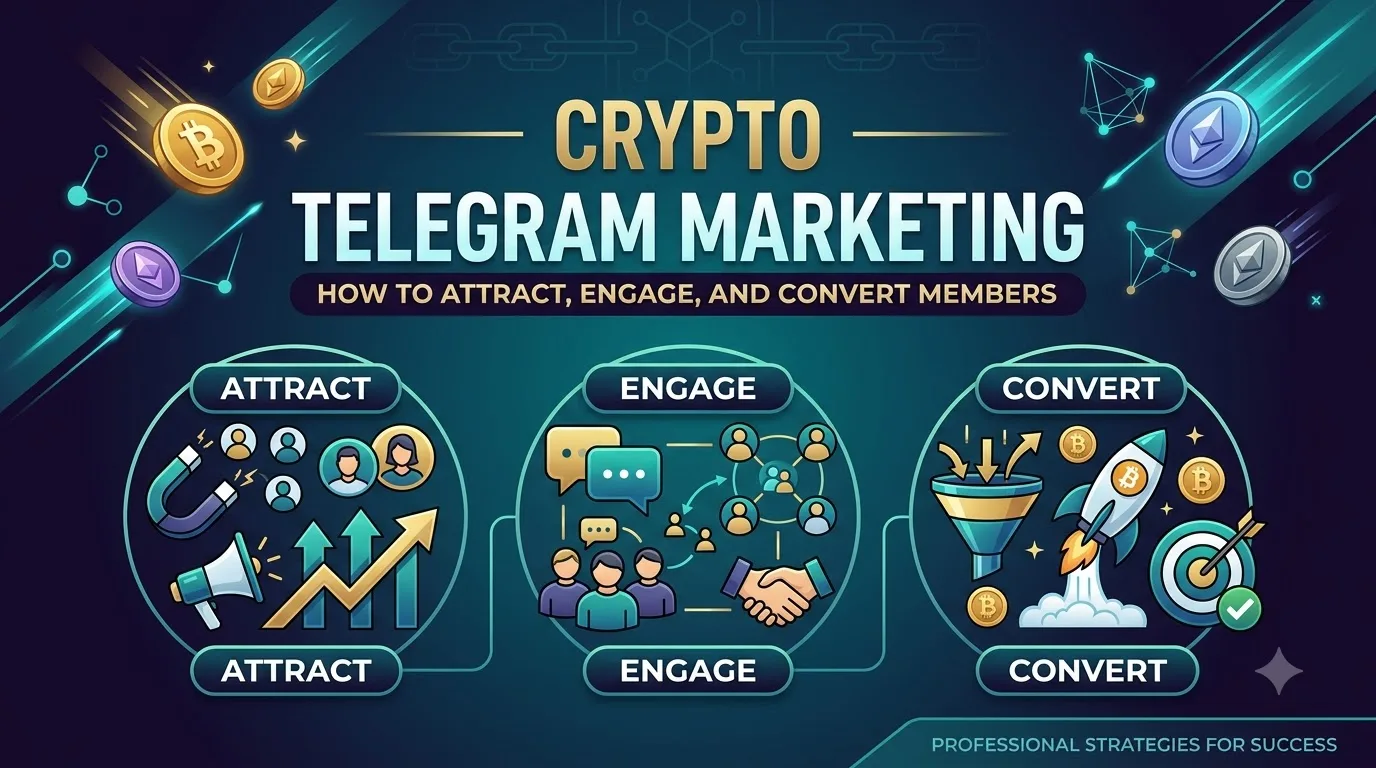
Effective crypto Telegram marketing focuses on the complete member journey. A person first needs a reason to join, then a reason to stay, and eventually a reason to take a relevant action.
Why Telegram Matters for Crypto Projects
Crypto communities often require continuous communication because products, token economics, governance decisions, partnerships, listings, roadmaps, and market conditions can change frequently. Telegram gives projects a direct communication environment where these updates can reach community members without depending entirely on external algorithms.
The platform also supports different community structures. A Telegram channel can function as the project's official announcement hub, while a connected discussion group can provide space for questions and community conversations. Telegram officially supports linking discussion groups with channels, giving projects a way to combine broadcasting with two-way communication.
This structure is particularly useful for crypto projects. Announcements can remain organized in one place while community members discuss product releases, technical developments, ecosystem news, and educational topics separately.
Telegram also supports bots, Mini Apps, payments, automated notifications, and community management functions. These capabilities allow projects to connect parts of their user journey directly to the platform.
How to Attract the Right Telegram Members
The first mistake in Telegram marketing is treating member acquisition as a numbers game. Buying low-quality members or relying on irrelevant traffic may increase the displayed community size, but it rarely improves engagement.
A better acquisition strategy begins with audience definition. A DeFi protocol, for example, may want liquidity providers, traders, developers, and users interested in its particular blockchain ecosystem. A token project preparing for a launch may need potential investors, ecosystem participants, community advocates, and users interested in its product.
The acquisition message should reflect that audience.
Educational content gives potential members a reason to join beyond speculation. Crypto marketing agencies like Blockchain App Factory can promote project content across relevant channels, attract interested audiences, and grow the Telegram community.
Cross-platform promotion can extend this process. X, YouTube, Reddit, newsletters, websites, Discord communities, crypto media, KOL campaigns, and search content can all introduce people to the Telegram community. The important factor is consistency. The message used to attract a member should match what they encounter after joining.
Telegram also provides invite-link functionality that allows administrators to create different links and track which users joined through each link. This can help marketers compare acquisition sources instead of treating every new member as equivalent.
Turning New Members Into Active Participants
Attracting someone into a Telegram group is only the beginning. The first few interactions influence whether that person remains active or leaves.
A new member should quickly understand what the community represents, where to find important information, and what they can do next. A pinned welcome message can explain the project's purpose, official resources, community rules, support channels, and important links.
Content should then give members practical reasons to return. Instead of publishing promotional messages repeatedly, community managers can maintain a balanced content mix.
Useful categories include:
- Product and development updates
- Educational explanations
- Community discussions and polls
- Founder or team updates
- Ecosystem and market research
- Events, AMAs, and community sessions
- User support and frequently asked questions
The objective is to create an environment where members receive information that helps them understand the project.
Large communities require additional organization. Telegram supports topics in groups, allowing discussions to be separated into dedicated areas. This can prevent technical questions, trading conversations, announcements, and general discussions from becoming one continuous stream.
Moderation also matters. Fast responses to legitimate questions can improve the quality of the community experience, while spam, impersonation, phishing attempts, and misleading promotions can damage trust.
Building Trust Through Consistent Communication
Trust has particular importance in crypto because users frequently evaluate projects involving financial assets. Community members may ask difficult questions about token supply, smart contracts, liquidity, security, treasury management, partnerships, or development timelines.
Avoiding difficult questions can create more suspicion than answering them.
A professional Telegram strategy should establish clear communication practices. Official announcements should be distinguishable from ordinary community discussions. Team members should use identifiable accounts where appropriate. Important claims should be supported by verifiable information, and corrections should be communicated when previously published information changes.
Security awareness is also part of community management. Chainalysis has documented the expanding role of cryptocurrency in scams, fraud, stolen funds, and other illicit activity. Its research has also identified Telegram as part of infrastructure used by scam networks.
For legitimate crypto projects, this makes impersonation protection and user education especially important. Community managers should regularly remind members that administrators will not request private keys, seed phrases, passwords, or sensitive wallet credentials.
Converting Telegram Members Into Users
Conversion should not mean repeatedly asking members to buy a token. The appropriate conversion event depends on the project's business model.
For a DeFi application, conversion may mean connecting a wallet and testing the product. For an exchange, it could mean creating an account and completing the required onboarding process. For a blockchain infrastructure project, the desired action might be starting a developer integration. For an upcoming token launch, it could involve joining a waitlist or learning about the project before the launch.
The Telegram journey should therefore connect community education with relevant product actions.
A useful conversion path might look like this:
Discover → Join → Learn → Participate → Evaluate → Try → Become a User
Each stage requires different content. New members need orientation. Active members need useful discussions and product information. Interested users need evidence, documentation, demonstrations, and answers to objections. Existing users need support and reasons to remain involved.
This approach also makes performance measurement more meaningful. Instead of tracking only total members, marketers can examine member growth by source, post views, participation, click-through rates, event attendance, bot interactions, website visits, wallet connections, sign-ups, and other project-specific actions.
Real-World Community Structure
Consider a hypothetical DeFi protocol launching a new application. Instead of directing every message into one large Telegram group, the project could create an announcement channel for official updates and connect it with a discussion community.
The announcement channel could publish product releases, governance updates, security notices, educational resources, and ecosystem news. The discussion area could handle technical questions, user support, community debates, and feedback.
The marketing team could then use separate invite links for X campaigns, KOL promotions, website traffic, community partnerships, and educational campaigns. Over time, the team could compare which sources produce members who actually participate or become product users.
This provides a more useful picture of marketing performance than simply reporting that the community gained thousands of members.
Measuring Crypto Telegram Marketing Performance
Telegram marketing should be measured across the entire community funnel.
Acquisition: Track new members, source links, acquisition cost, and member quality.
Engagement: Measure post views, replies, reactions, polls, event participation, and recurring activity.
Retention: Monitor whether new members remain active after joining rather than disappearing after the first interaction.
Conversion: Track clicks, registrations, product usage, wallet connections, event sign-ups, or other meaningful actions.
Community health: Watch spam levels, moderation workload, unanswered questions, impersonation attempts, and recurring member participation.
These metrics help distinguish community growth from community value.
Conclusion
Crypto Telegram marketing works best when community building becomes part of the wider Web3 marketing strategy rather than operating as an isolated promotional channel. Telegram provides the infrastructure for large communities, direct communication, discussion, automation, and product interactions.
The real challenge is turning those capabilities into a meaningful member journey. Projects need relevant acquisition campaigns, useful content, active moderation, credible communication, and measurable conversion paths. When these elements work together, Telegram can become more than a chat group. It can serve as a continuous communication layer between a Web3 project and the people who follow, evaluate, and use it.