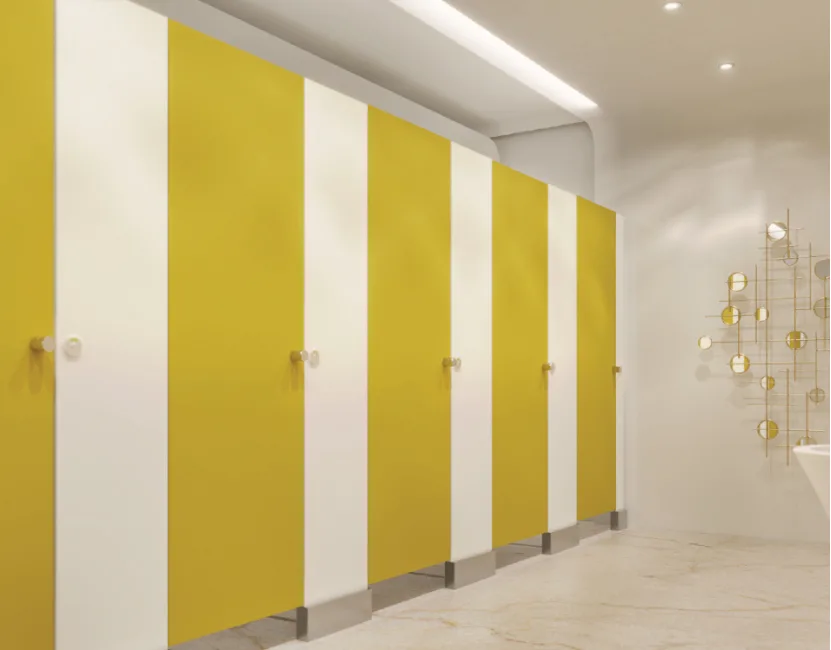
Commercial and institutional buildings need to have materials that can be relied upon at all times. Schools, offices, hospitals, and other social establishments' partitions should be stable, clean, and aesthetically unified. The durability and long-term maintenance planning directly depend on the selection of materials to be used during the installation of shower cubes and restroom cubes. When the selection of materials is thoughtful, facility managers reduce operational inconveniences and create a better user experience in general.
Material selection must be a trade-off between strength, water resistant, safety compliance and aesthetic balance. All these are contributing towards the effectiveness of the space in its daily operation.
Performance Requirement Knowledge:
The panels and partitions are exposed to frequent stress in busy environments. Doors are frequently opened, surfaces are exposed to moisture and cleaning procedures are conducted several times a day. The material used to make the shower cubicles must not swell, warp or deteriorate on the surface. Similarly, the installation of all restroom cubicles must be stable structurally, even when they are used repeatedly, without compromising the alignment.
Besides being strong, there should be hygiene in institutions. The surfaces should be cleanable and prevent the growth of bacteria. The surface integrity and moisture resistance are the factors that project planners need to take into account when selecting materials. Such performance standards are applied to ensure that the shower cubes are operational and that all restroom cubes do not go out of shape over time.
Moisture Resistance and Structural Stability:
Bathing and washrooms are not to be avoided as far as exposure to moisture is concerned. Without sufficient resistance, panels may swell or become structurally inaccurate. The materials that are applied in the shower cubicles must be capable of withstanding the constant humidity without deforming the surface. Stability ensures that doors open and close, and partitions are aligned.
The day-to-day maintenance of institutional restrooms entails cleaning of the chemical and water contact surfaces. With a well-designed restroom cubicle, one ought to be capable of withstanding these conditions without straining joints or hardware support. Moisture-resistant materials will reduce the frequency of repairs and prevent premature replacement. This time-saving increases the effectiveness of business premises.
Safety and Compliance:
Commercial and institutional projects should comply with safety standards and accessibility requirements. Shower cubicle materials must offer clean edges, fixings, and fire-compliant functionality where needed. These standards safeguard users and facilitate regulatory acceptance.
The comfort and privacy of the user should also be taken into account in each restroom cubicle. A safe environment is achieved through proper panel thickness, locking systems, and stable framing. Facility managers are assured of the installation when safety and structural integrity are in line. In institutional spaces, compliance is not a choice. It should be incorporated in all material decisions.
Design Consistency and Visual Integration:
The functionality is still important, but the visual presentation also affects perception. Business areas are indicative of brand recognition and institutional authority. Shower cubicles should be made of materials that match the general interior finishes. A unified design produces a professional impression.
Likewise, all restroom cubicle installations must be incorporated into flooring, wall treatments, and lighting plans. Long-term flexibility in institutions is usually facilitated by neutral finishes. Uniformity in texture and colour minimises visual distraction and maximises order. The environment is organised and in good condition when material and design collaborate.
Ease of Maintenance and Lifecycle Value:
The cost of maintenance has a great influence on business activities. Shower cubicles should be made of materials that can be easily cleaned without losing their surface clarity. Hardy finishes eliminate staining and minimise maintenance work. This consistency facilitates foreseeable budgeting.
The finish of each restroom cubicle should also be maintained even after repeated cleaning. Surface damage and scratches can undermine the standards of appearance and hygiene. Lifecycle value is enhanced by the choice of materials that are resistant to wear. In the long run, good surface performance lowers the replacement time and safeguards capital investment.
Installation Efficiency and Structural Support:
Commercial developments have project timelines that are usually run on tight deadlines. The materials used in shower cubicles must be able to be installed easily without affecting the strength. Accuracy in panel manufacturing guarantees easy on-site assembly.
An adequately designed restroom cubicle system makes alignment and hardware integration easier. Stable structural support eliminates post-installation misalignment. Contractors save time and extra labour expenses when the installation process is successful. Effective material level planning helps in the completion of the project on time.
Durability in High-Traffic Areas:
Light usage is not common in institutional settings. Schools and hospitals are working every day, and commercial complexes are working during working hours. Shower cubicle materials should be able to sustain this continuous load without apparent wear.
Similarly, every restroom cubicle must be structurally sound even after being hit and used repeatedly. Permanent partitions facilitate continuous facility operations. When materials are consistent, organisations reduce downtime and maintain continuity in operations.
Making an Informed Material Decision:
Choosing cubicle materials requires technical evaluation rather than surface-level comparison. Moisture resistance, safety compliance, maintenance efficiency, and visual consistency must align. Reliable materials for shower cubicles and each restroom cubicle installation contribute to long-term performance and cost stability.
In commercial and institutional projects, material integrity defines operational success. CenturyPly offers dependable solutions engineered for demanding environments. By selecting proven materials from CenturyPly, project planners can ensure that every shower cubicle installation and each restroom cubicle system supports durability, hygiene, and structured performance for years to come.