
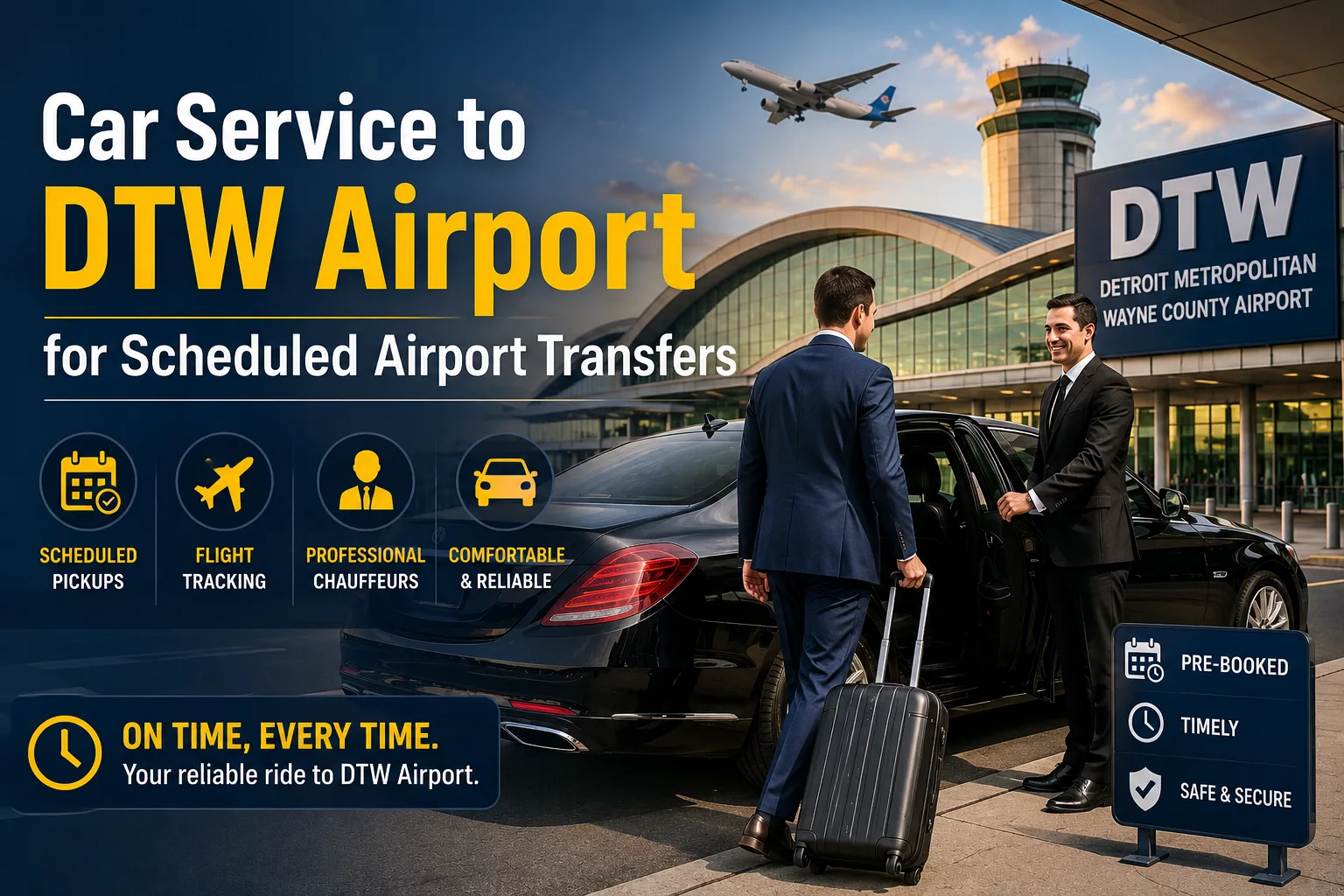
Detroit Metropolitan Wayne County Airport (DTW) is one of the busiest travel hubs in the Midwest. It handles tens of millions of passengers every year and connects Detroit with major domestic and international routes. With that volume comes one consistent issue for travelers—timing uncertainty on the ground.
Traffic patterns in Metro Detroit are not stable throughout the day. Highway congestion on I-94 and I-275, early morning flight clusters, and peak business travel hours all affect how predictable an airport trip can be.
That is why car service to DTW airport for scheduled airport transfers has become a preferred choice for travelers who want control over departure timing instead of relying on last-minute ride availability.
What Scheduled Airport Transfers to DTW Actually Mean for Travelers
A scheduled airport transfer is a pre-booked transportation service where the pickup time is fixed in advance. The driver arrives at the agreed time based on flight details, not on real-time ride requests.
This system is widely used for DTW because airport travel in Detroit is highly time-sensitive. A delay of even 10–15 minutes can affect check-in, baggage drop, and TSA clearance.
From most parts of Metro Detroit, DTW is about 20 miles away. The drive usually takes 25 to 40 minutes. However, that timing changes depending on traffic flow, weather, and time of day.
This variation is the reason scheduled transport exists—it removes guesswork from airport travel.
Pre-booked airport transfers vs on-demand rides
On-demand rides like Uber or Lyft depend on driver availability at the exact time you request a ride. This works well during normal hours but becomes less reliable early in the morning or during peak demand periods.
Scheduled airport transfers work differently. The ride is confirmed in advance. A driver is assigned specifically for that trip. There is no waiting for a match or surge pricing uncertainty.
For airport travel, this difference is critical because timing is non-negotiable.
Why DTW requires structured timing
DTW operates two major terminals: McNamara Terminal and North Terminal. McNamara handles a large share of Delta operations and often experiences higher passenger density.
During peak hours, curbside areas can become congested, especially around morning departures and evening arrivals. This affects both pickup and drop-off timing.
How Car Service to DTW Airport Scheduling Works in Practice
The booking process for scheduled airport transfers is built around flight coordination rather than immediate ride matching.
When a traveler books a car service to DTW airport, they provide pickup location, flight time, airline, and sometimes luggage details. This information is used to plan the entire trip.
Once confirmed, the ride is assigned to a specific chauffeur.
Booking confirmation and driver assignment
After booking, the system assigns a driver ahead of time. The driver is not waiting for multiple requests. The trip is locked into their schedule.
This ensures availability even during early morning hours when ride demand is low.
Route planning and traffic management
In Metro Detroit, traffic conditions can change quickly depending on commuter flow. Highways like I-94 and I-75 are common routes to DTW, and both can experience congestion during peak travel hours.
Scheduled services account for this by planning departure time rather than reacting to traffic in real time. This reduces the risk of last-minute delays.
Flight tracking adjustments
Many airport car services now track flight status in real time. If a flight is delayed or rescheduled, pickup timing can be adjusted. This is important at DTW because airline schedules often shift due to hub-based connections and weather conditions.
Why Scheduled Airport Transfers Matter at DTW Airport
The demand for scheduled transfers is not driven by luxury. It is driven by reliability.
Early morning flight challenges
Early morning flights between 4 AM and 7 AM are common at DTW. During these hours, ride availability can be inconsistent because fewer drivers are active.
This creates a gap between demand and supply. Scheduled airport transfers eliminate this issue by guaranteeing a vehicle in advance.
Business travel requirements
Detroit has a strong corporate travel base, especially in the automotive and manufacturing sectors. Business travelers often operate under fixed schedules where missing a flight can disrupt meetings or production timelines.
For this reason, car service to DTW airport for business travel is widely used as a standard transportation option. It ensures that departure timing is controlled and predictable.
Risks of on-demand ride systems
On-demand transportation introduces variability that is not ideal for airport travel:
- Drivers may cancel close to pickup time
- Prices can increase during peak demand
- Availability may drop during early hours or weather disruptions
At DTW, where timing is critical, these risks can directly affect travel success.
Car Service Options Available for DTW Airport Transfers
Different travelers choose different vehicle types depending on purpose and group size.
Private sedan transfers
Private sedans are used by solo travelers and professionals who prioritize efficiency. These rides focus on direct routes and minimal delays.
SUV airport transfers
SUV services are suitable for families or groups with multiple bags. They provide more space and flexibility for longer trips within Metro Detroit.
Executive black car service
Executive services are used for corporate travel. They prioritize consistency, professional drivers, and strict adherence to scheduled pickup times.
DTW Airport Pickup and Drop-Off Process Explained
Understanding how DTW operates helps travelers use scheduled transfers more effectively.
Terminal layout and pickup zones
DTW has two main terminals:
- McNamara Terminal (high-volume Delta operations)
- North Terminal (other airlines and international carriers)
Each terminal has designated commercial pickup areas to manage traffic flow and reduce congestion at curbside points.
Meet-and-greet vs curbside pickup
Meet-and-greet service involves the driver meeting the passenger inside the terminal, usually at baggage claim. This is helpful for international arrivals or passengers with heavy luggage.
Curbside pickup is faster. The passenger exits the terminal and meets the driver at a designated zone.
Departure drop-off timing
For departures, timing is structured around airline and TSA requirements. Standard travel planning suggests:
- 2 hours before domestic flights
- 3 hours before international flights
This buffer ensures sufficient time for check-in, security screening, and boarding.
How Scheduled Car Service Improves Travel Predictability
The main advantage of scheduled airport transfers is consistency.
No dependence on last-minute availability
Travelers do not need to wait for a ride match or deal with cancellations. The vehicle is already assigned.
Alignment with flight schedules
Pickup timing is built around flight departure times, making ground transport part of the travel plan instead of a separate variable.
Reduced travel stress
Pre-arranged transport removes uncertainty from the travel process. Travelers do not need to compare prices or wait for driver responses during critical time windows.
When to Book a Car Service to DTW Airport
Most travelers book their airport transfer 24 to 48 hours in advance. This allows enough time for scheduling and ensures availability during peak travel periods.
Scheduled services are especially important for:
- Early morning flights
- Business travel
- International departures
- Group travel
- Time-sensitive itineraries
Last-minute bookings are possible but less predictable, especially during holidays or peak hours.
Conclusion
A car service to DTW airport for scheduled airport transfers is not just a transportation option. It is a way to control timing in an environment where timing is often unstable.
DTW operates with high passenger volume, variable traffic conditions, and strict airline schedules. In that setting, scheduled transfers provide predictability that on-demand systems cannot always guarantee.
For frequent flyers, business travelers, and early departure passengers, that predictability becomes the deciding factor.