
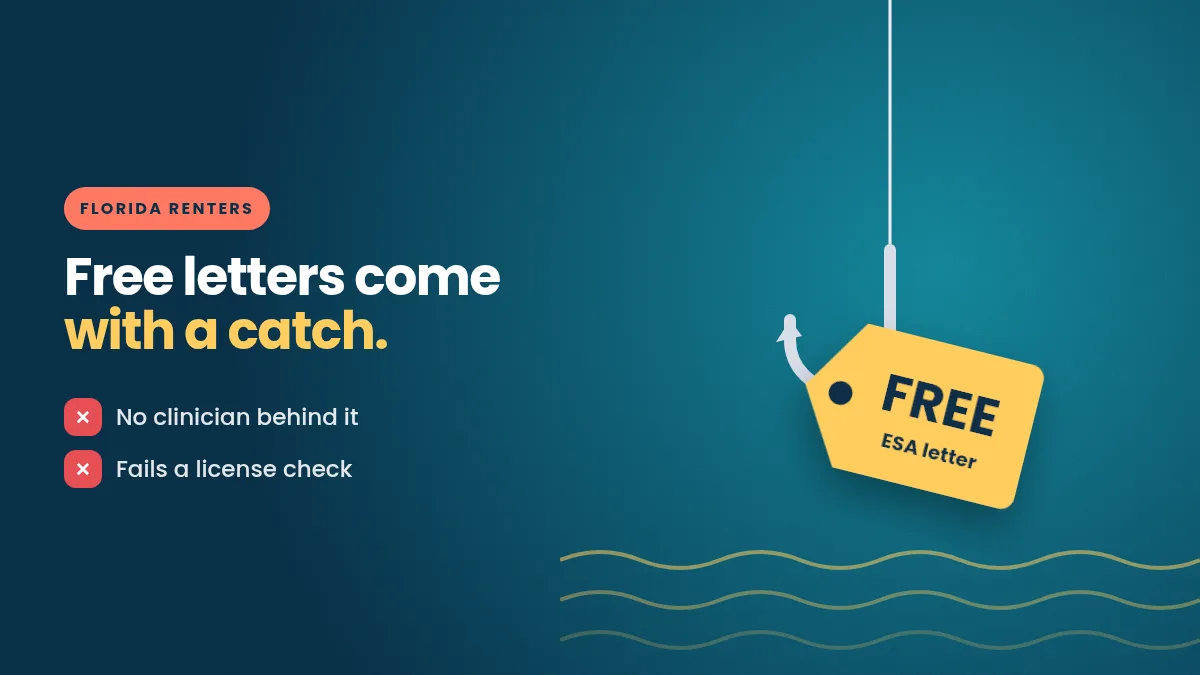
A free ESA letter in Florida sounds like an easy win, yet almost every offer of that kind ends with a document a landlord can lawfully question. Valid letters come from a licensed clinician who evaluates the person first, and that clinical time is rarely given away. What free sites usually hand out is a certificate, a registry listing or a template, none of which meets what Florida housing providers are allowed to ask for.
The search for a no cost option usually starts with a real pressure point, such as a new lease, a no pets building, or a landlord asking for paperwork by a set date. That urgency is exactly what free offers rely on. Understanding what makes a letter hold up, and where free documents fall short, helps Florida renters avoid a refusal they could have prevented.
Can I get a free ESA letter for my dog?
Only in rare cases, such as when a therapist you already see writes one as part of your existing care.
Some people already work with a licensed counselor, social worker or psychologist who knows their history well. If that clinician agrees that an animal helps with a condition that limits daily life, they may write a letter during a regular session, and the tenant pays only the usual cost of that visit, sometimes covered by insurance.
Outside that situation, a letter that costs nothing usually skips the evaluation. Dog owners searching for a free option often land on pages that promise a downloadable PDF after a short quiz. A properly issued ESA letter for dog owners comes from a clinician who reviews the person's needs before signing anything, not from an automated form.
The animal itself does not need a letter, a vest or a tag. The letter is about the person and their need for the animal, which is why the clinician's review matters far more than any document that names the dog alone.
Some community clinics and university counseling centers offer low fee mental health care in Florida. People already receiving care there can ask whether their clinician is willing to assess the need for an ESA, keeping in mind that not every provider writes these letters.
Why do most free ESA letters fail with Florida landlords?
They fail because they lack a real evaluation, a verifiable licence, or both.
Florida landlords may confirm that the clinician on a letter holds an active licence and may contact the provider listed. A free letter often carries a name that cannot be traced, a licence from another state, or no licence number at all. Once a landlord checks and finds nothing, the request can be refused for unreliable documentation.
Common problems with free or near free letters include:
- No licence number, or a number that does not match a clinician in any state database
- A clinician who is not licensed in Florida and never spoke with the tenant
- No issue date, no contact details, or no signature
- Wording copied from a template that does not describe the tenant's need
Each of these gaps gives a property manager a lawful reason to ask for better documentation. Tenants then have to start over, often after a deadline on a lease or application has already passed.
Some free letters also arrive with wording that overreaches, such as claims that the animal may go anywhere or that the landlord must approve without question. Statements like these signal to a property manager that the letter was not written by a clinician who understands fair housing rules, and they make a denial more likely rather than less.
What does a Florida landlord expect to see in a valid letter?
A valid letter shows who wrote it, where they are licensed, when it was issued, and why the animal helps.
A letter that holds up in Florida typically sits on the clinician's letterhead and lists their name, licence type, licence number and state of licensure. It includes the issue date, contact details and a signature, along with a statement that the person has a condition that limits daily life and that the animal eases those limits.
The letter does not need to name the diagnosis, and a landlord cannot demand medical records or details of the condition. That privacy protection only works, though, when the rest of the letter is solid enough that the landlord has no reason to doubt it.
Tenants who want documentation built around these points can look at a Florida ESA letter from a real clinician, which is issued after an evaluation by a provider licensed in the state. That combination is what turns a request into one a landlord should approve.
Clinicians who commonly provide these letters include licensed mental health counselors, licensed clinical social workers, licensed professional counselors, psychologists and psychiatrists. The title matters less than the licence being active in Florida and the evaluation being real.
Is an ESA certificate or registration the same as an ESA letter?
No. A certificate or registry listing has no legal weight, and no state runs an official ESA registry.
Many free offers are really registration services. They add a name and a photo of the animal to a private database, then send a certificate or ID card. These products can look official, but fair housing law does not recognize them, and a landlord is not required to accept them as proof of anything.
The difference between an ESA certificate and a letter comes down to who stands behind the document. A certificate is backed by a website. A letter is backed by a licensed clinician who can be contacted and whose licence can be checked.
Anyone weighing these options can read more on whether ESA registration is a scam before paying for a listing or downloading a free card. Knowing the difference early saves time and avoids a denial that was never necessary.
RealESALetter issues clinician signed letters rather than registry certificates. Each letter follows a live evaluation and carries the clinician's licence number, issue date and contact details, so a Florida landlord can verify it directly.
What should you check before choosing an ESA letter online in Florida?
Check the clinician's licence, the evaluation process, and what happens if a landlord questions the letter.
Before paying anything or accepting a free offer, run through a short checklist. It takes a few minutes and filters out most services that would leave a tenant with an unusable document.
- Will a clinician licensed in Florida evaluate you through a live conversation?
- Will the letter list a licence number you can look up yourself?
- Is there a clear way for the landlord to contact the provider?
- Does the service explain what support it offers if the letter is questioned?
- Are the price, renewal terms and refund terms written plainly on the site?
Be cautious of any service that promises approval before an evaluation, or that sells extras such as vests and ID cards as if they were required. Neither approval nor accessories can be promised in advance, because a clinician has to decide whether the person qualifies.
Legitimate ESA letter cost varies between providers, so compare the published terms on each site rather than relying on figures quoted in ads or forums. A clear refund policy is often a better sign of a reliable service than the lowest price.
It also helps to think about the full cost of a failed letter. A rejected request can mean a lost apartment, a missed move in date, or paying for a second letter after the first one is refused. Measured that way, a free document that does not hold up often ends up costing more than a proper one.
How does Florida law treat misleading ESA documentation?
Florida takes misrepresentation of ESA need seriously, which makes a poorly sourced letter a real risk.
Florida's fair housing rules allow landlords to request reliable supporting information when an ESA need is not obvious, and the state treats false claims about needing an emotional support animal as a serious matter. A letter bought without an evaluation can leave a tenant exposed rather than protected.
The rules also reflect a wider change in enforcement. After HUD's May 2026 enforcement memo rescinded older federal guidance on assistance animals, state agencies took the primary role, with HUD in a secondary position. Tenants can review Florida ESA laws to understand how requests and documentation are handled locally.
For Florida renters, the practical takeaway is simple. A real evaluation by a clinician licensed in the state protects both the tenant and the landlord, while a free download protects neither.
Frequently asked questions
Is any ESA letter for free legitimate?
A letter can be legitimate at no extra cost when it comes from a clinician already treating you who agrees an animal helps. A letter offered free to strangers after a quiz is almost never backed by a real evaluation, which is what a landlord needs to see.
Do I need to renew an ESA letter in Florida?
Many landlords prefer a letter issued within the past year, especially at lease renewal. Keeping the letter current avoids questions about whether the need still exists and makes verification with the clinician straightforward.
Can a Florida landlord charge a pet fee for my ESA dog?
Generally no. Under the Fair Housing Act an ESA is an accommodation rather than a pet, so pet rent, pet deposits and pet fees usually do not apply. The tenant remains responsible for any actual damage the animal causes.
Does any condition automatically qualify me for an ESA?
No condition qualifies automatically. Depression, anxiety disorders, PTSD, bipolar disorder and ADHD are often evaluated, but a clinician licensed in Florida decides during the evaluation whether the condition limits daily life and whether an animal helps.
Can I use an ESA letter in stores or restaurants in Florida?
No. ESAs have no public access rights, so businesses can generally refuse them. The letter applies to housing covered by the Fair Housing Act. People who need an animal with them in public usually need a psychiatric service dog and different documentation.