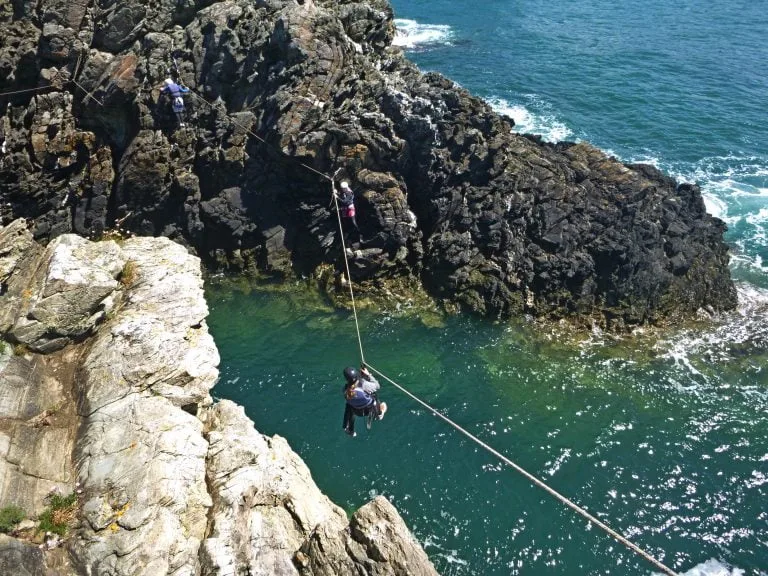
North Wales knows how to turn an ordinary trip into an extraordinary story to tell your friends. In just one day, you can jump off a sea cliff and drop into clear water, and the next day you can be at Snowdonia training someone else on how to climb. You won’t find many places in the UK as unusual as North Wales that can provide visitors with just as much adventure since this area is packed with activities for all sorts of thrill-seekers or those who want a real job in adventure sports.
In this article we talk about two extraordinary experiences that you can have in North Wales: coasteering in Wales and the chance to become a qualified rock-climbing instructor. Each of these activities is based in the same location and both are delivered by Arete Outdoor Centre, an outdoor education and activity centre based in Llanrug, near Caernarfon, in Gwynedd.
What Is Coasteering in Wales?
Coasteering is defined as the method of travelling beside a coast full of rocks without the means of any watercraft whatsoever. Thus, this type of traveling takes place with the use of different techniques used by sea water. It includes climbing over rocks, climbing up cliffs, swimming through gullies, and jumping from different cliffs into the waters below.
Wales is a perfect location for coasteering because of its dramatic coastline full of different and interesting features like tunnels, rock formations, and narrow inlets. A successful coasteering session feels as if you are exploring a secret world only visible from a cliff.
Why Anglesey Is a Top Spot for Coasteering in Wales
When talking about coasteering in North Wales, it is important to mention the fact that the best island for this activity is Anglesey. Arete offers many sites for coasteering. All they need to do is to choose the location suitable for sea conditions and the group.
Coasteering routes can also be modified. The amount of swimming can be changed according to the wishes of the participants, and the duration of the session can be either half a day or the whole day.
What to Expect on a Coasteering Session
Every session comprises four elements:
- Swimming in the open water. You float, paddle, and drift through the waves around the rocks, while donning the full-wetsuit and buoyancy vest that keeps you warm and afloat. This means that non-swimmers can also join the sessions.
- Cliff jumping. Various cliffs are used by younger participants, and most of the older ones require a leap, which allows them to think on their way down. You are given the liberty to choose your own height, and the trainers make you learn the proper way of jumping and how to identify a good jumping place.
- Rock climbing and scrambling. Reaching from one area of the coast to another one implies scrambling over the rocks, climbing challenges high over deep waters, caves to explore and stacks to find.
- Team spirit. Few activities build trust amongst people faster than helping someone in your group to overcome a tricky area or sending him off the cliff.
Regarding educational institutions, coasteering also functions as outdoor education for them. It teaches coastal dangers and erosion in particular, and it fosters resilience and self-confidence as well as awareness of other’s needs. Many groups add a half-day of coasteering with sea level traversing, a roped activity at the same sea cliff venues, to make a varied full day on the coast.
Is Coasteering Safe for Beginners?
One of the most frequently asked questions, and the truth is that it depends on the instructor. Look for a company that has an Adventure Activities Licence, employs certified instructors and runs small groups. Arete Outdoor Centre has an AALA licence, it has received Learning Outside the Classroom award and it’s a Mountain Training provider too – this company provides classes with a maximum ratio of one instructor for eleven students. All levels of abilities and age groups are welcome: beginners, pupils, students and adults.
From Adventurer to Rock Climbing Instructor
When people go for a day trip to the coast or try rock climbing for the first time, they begin to wonder whether it is something they could do for a living. The Rock Climbing Instructor will help them. The award by Mountain Training gives its holders the right to take groups rock climbing and abseiling at single pitch crags and climbing walls. It is a respected qualification for everyone working at outdoor centres, schools or youth organisations.
Training and evaluation of Rock Climbing Instructors in Snowdonia
The natural environment of Snowdonia, or Eryri, serves as a great venue for the award offered by Arete. Arete conducts training as well as assessment of rock climbing instructors with the help of its central location adjoining various types of rock formations in the mountains.
The training will continue for a period of three days and will cover the following topics: selection of a venue, management of the group while on the crag, crag etiquette, conservation, and access laws, use of guides to specify the routes, leading and protection of a second climber, running a team abseil.
The assessment would last for two days. During this period of time, candidates can demonstrate their capability of working as instructors, including such competencies as leading a group, protecting a climber, establishing safety systems, and leading a team on a crag.
What You Need Before You Book
Since this qualification relies on climbers' actual climbing experience, there are some prerequisites. To take the training course, a participant should be registered with Mountain Training, provide a logbook (DL for short), and have experience leading:
- 15 traditional-protected climbs
- 15 indoor climbing wall routes
- 5 sport climbing routes
To take the examination, a climber should have undergone some relevant training or received an exemption from Mountain Training and satisfied the following criteria:
- led 40 climbs, 20 of which are at Severe
- performed over 30 indoor climbing wall routes at F4 grade
- assisted in 20 instructed sessions
- possess evidence of a first-aid certificate
Check the course page for up-to-date details about prerequisites and course dates and whether you need on-site lodging.
Combine the Coast and the Crag
The two activities are better related than you may think, as coasteering is the basis for rock climbing instructor, teaching how to read rock and manage risks, as well as to supervise others and make decisions as the environment changes. If you're considering a career in outdoor activities, a day out on Anglesey cliffs as well as a course in Snowdonia's crags will help you figure out whether this is the right choice for you.
North Wales makes it easier to do that, as all terrains are available from one point of base and a center which knows the place well can plan your days according to the weather.
Plan Your North Wales Adventure
Whether you are looking for adventure from coasteering in Wales with your friends though family or school or want to start a career as a rock climbing instructor, our team at Arete Outdoor Centre will help you plan everything.
- Explore: Coasteering in North Wales
- Train: Rock Climbing Instructor training and assessment
- Get in touch: Contact Arete Outdoor Centre, email info@aretecentre.co.uk or call 01286 672136
Arete Outdoor Centre, Llanrug, Caernarfon, Gwynedd LL55 4AP, North Wales.