

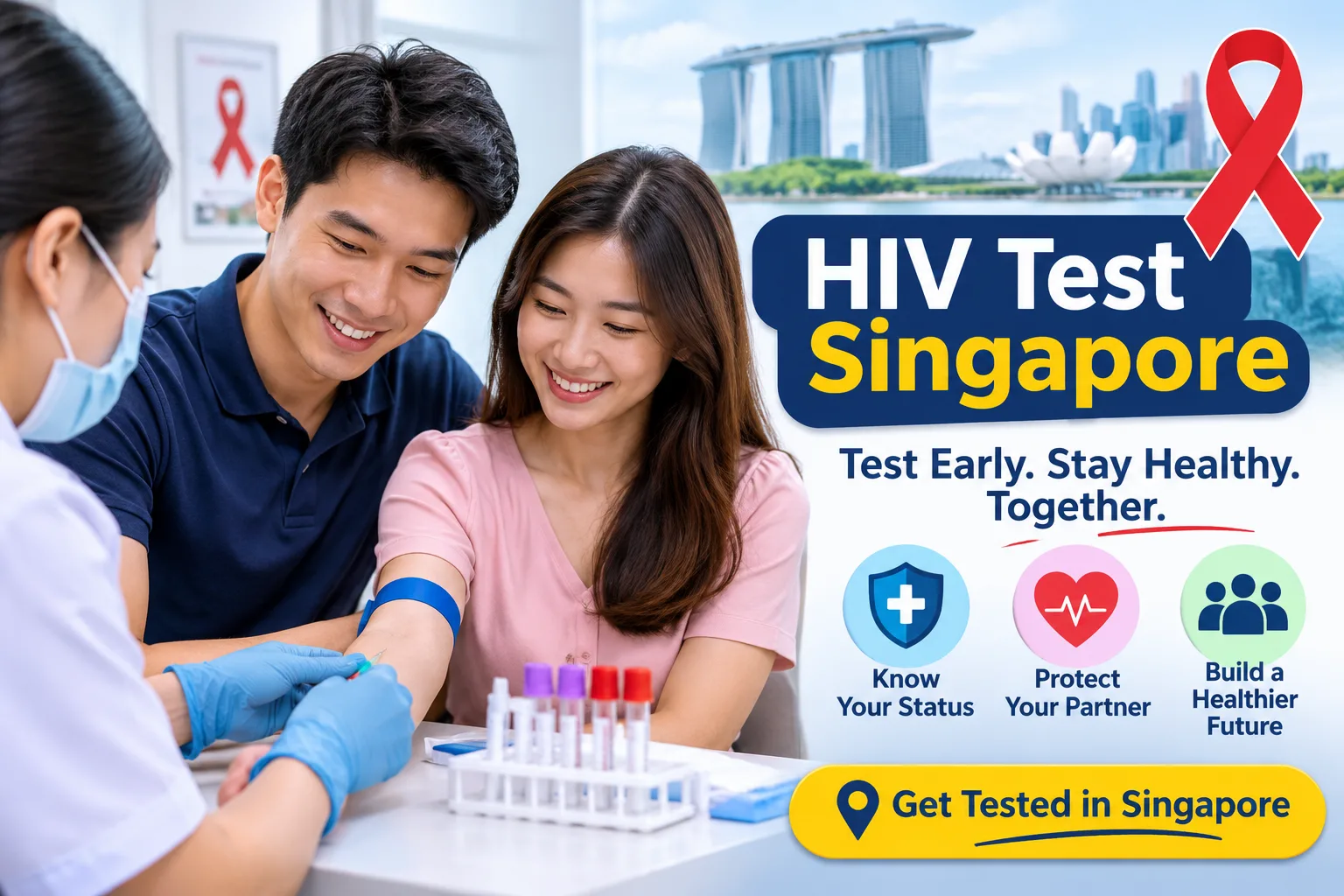
Worried about your HIV status but uncomfortable sharing your personal information at a medical clinic? Anonymous HIV testing in Singapore offers an alternative for people who want to check their HIV status without going through the usual identity-registration process.
Hiv test Singapore is an important part of maintaining good sexual health. However, concerns about privacy, social stigma, and confidentiality can sometimes prevent people from getting tested. Anonymous testing services are designed to make HIV screening more accessible to individuals who may otherwise delay testing.
Singapore has designated anonymous HIV testing providers, including services operated by Action for AIDS (AfA) and selected medical clinics.
Unlike conventional confidential testing, anonymous HIV testing generally uses a unique identification number instead of the person's name or identification details to identify the test. This provides an additional level of privacy during the screening process.
In this guide, you will learn how anonymous HIV testing works in Singapore, where to find testing services, what to expect during an appointment, how much testing may cost, and what steps to take after receiving your results.
What Is Anonymous HIV Testing?
Anonymous HIV testing is a screening service designed to allow individuals to check their HIV status without providing their usual identifying information for the test registration process.
In conventional healthcare settings, patients generally provide personal details such as:
- Full name.
- National identification number or passport details.
- Contact information.
- Medical history.
With designated anonymous HIV testing, the provider may instead assign a unique testing number to identify the sample and communicate the result.
This means the screening process does not follow the usual identity-linked registration arrangements.
How Does Anonymous HIV Testing Work in Singapore?
Singapore has an established anonymous HIV testing programme involving designated healthcare providers and community organisations.
The process generally involves:
- Visiting a designated anonymous HIV testing provider.
- Receiving information about the testing procedure.
- Being assigned a unique identification number.
- Providing the required sample.
- Waiting for the screening result.
- Receiving the result using the provider's specified procedure.
The exact process may differ between providers.
It is important to understand that anonymous testing does not mean that every aspect of medical care is automatically anonymous. If further investigation, confirmatory testing, or ongoing treatment is required, different registration and medical follow-up arrangements may apply.
Anonymous vs Confidential HIV Testing: Understanding the Difference
One of the most common questions people ask is whether anonymous HIV testing and confidential HIV testing mean the same thing.
Although both approaches aim to protect patient privacy, they are different.
Anonymous HIV Testing
Anonymous testing is designed to avoid routine identity registration during the screening process.
A unique testing number may be used instead of the person's name or identification number.
This option may appeal to individuals who do not want their identity linked to their initial HIV screening record.
Confidential HIV Testing
Confidential HIV testing involves registering your personal details with a healthcare provider.
Your medical information is handled under applicable confidentiality and privacy requirements.
The healthcare provider may maintain medical records, communicate results, and arrange follow-up consultations.
Key Differences
| Feature | Anonymous HIV Testing | Confidential HIV Testing |
| Personal identification | Usually not required for the anonymous screening process | Generally required |
| Test identification | Unique testing number may be used | Personal medical record |
| Medical records | Different from standard identity-linked records | Maintained by healthcare provider |
| Result communication | Provider-specific identification procedure | Usually through registered contact details |
| Follow-up care | May require separate arrangements | Generally easier to coordinate |
| Main benefit | Additional identity privacy | Continuity of medical care |
Neither option should be viewed as a guarantee that information can never be disclosed under applicable legal or medical requirements.
Before testing, ask the provider exactly how your information and results are handled.
Where Can You Get Anonymous HIV Testing in Singapore?
Singapore has designated anonymous HIV testing clinics where eligible individuals can receive screening without routine identity registration.
These providers are particularly useful for people who want to know their HIV status while maintaining additional privacy.
Other Anonymous HIV Testing Providers
HealthHub's published directory also lists additional providers, including:
| Provider | Location |
| Dr Tan & Partners | 11 Unity Street, Robertson Walk |
| Kensington Family Clinic | 14D Kensington Park Road |
| M Lam Clinic | 739 Geylang Road |
| Q&M Medical & Aesthetic Clinic (Tampines Central) | 10 Tampines Central 1 |
| Tanjong Pagar Medical Clinic | 1 Tanjong Pagar Plaza |
These are listed as anonymous HIV testing providers in HealthHub's directory. Confirm the latest availability and registration procedure directly with each clinic.
What Happens During an Anonymous HIV Testing Appointment?
If you have never used an anonymous HIV testing service, you may be unsure about what happens during the appointment.
The process at AfA's Anonymous Testing Service provides a useful example of how designated testing services operate.
Step 1: Registration Without Your Name or NRIC
At AfA's service, you complete a registration form and receive a unique Client ID.
The reception team uses this number to identify your testing appointment.
You do not need to provide your name or NRIC for the anonymous HIV screening process.
Step 2: Pre-Test Counselling
A trained counsellor discusses your sexual health history and potential HIV exposure.
You may be asked questions about:
- The date of your most recent potential exposure.
- Whether you have previously undergone HIV screening.
- Whether you have experienced any possible HIV-related symptoms.
- Whether you are taking PrEP or have recently taken PEP.
- Whether you need information about other STI testing options.
The purpose is to help determine whether the selected test is appropriate.
The discussion takes place privately, and AfA states that information shared during its anonymous service is handled anonymously and confidentially.
Step 3: Sample Collection
For its rapid testing service, AfA collects a small blood sample through a finger-prick procedure.
The sample is applied to the appropriate rapid testing device.
The organisation states that sterile, single-use equipment is used during testing.
Step 4: Receiving Your Results
AfA states that results are generally available within 20–30 minutes.
The counsellor communicates the result using the service's identification procedure and provides post-test counselling.
If the screening result is reactive, further testing and medical follow-up will be arranged.
ACTION FOR AIDS (AfA SINGAPORE)
How Much Does Anonymous HIV Testing Cost in Singapore?
The cost depends on the testing provider and the type of test selected.
For example, AfA publishes separate prices for third-generation and fourth-generation rapid HIV tests.
Other clinics may have different fees depending on consultation arrangements and testing methods.
What Can Affect the Cost?
Testing technology: Different HIV screening methods involve different testing equipment and procedures.
Consultation requirements: Some providers include counselling in the service, while conventional clinics may charge a separate consultation fee.
Additional screening: If you request testing for other sexually transmitted infections, additional charges may apply.
Confirmatory testing: A reactive screening result requires further laboratory investigation, and the cost may depend on the provider and follow-up arrangements.
Is Free Anonymous HIV Testing Available?
Action for AIDS has previously provided free HIV testing through certain programmes.
However, its published notice updated 10 June 2026 states that free HIV tests are currently unavailable due to stock limitations.
Its usual paid testing services remain listed as available.
Because funding and test-kit availability can change, contact AfA directly before relying on a free-testing offer.
HIV Testing Window Period: When Should You Get an Anonymous Test?
Choosing an anonymous testing centre is only one part of the process. You also need to consider when you should take the test.
The HIV window period is the time between potential exposure and when a particular test can reliably detect infection.
A negative result obtained too early may not rule out HIV.
Different HIV Tests Have Different Window Periods
AfA publishes the following window-period guidance for its testing options:
| Test type | Published window period |
| 4th-generation rapid HIV test | 14–90 days |
| 3rd-generation rapid HIV test | 21–90 days |
| HIV self-test kit | 45–90 days |
These are provider-specific recommendations for the tests it offers. Different products and laboratory testing methods can have different detection windows.
AfA recommends follow-up testing at 90 days to confirm the result when using its rapid testing approach.
ACTION FOR AIDS (AfA SINGAPORE)
Can You Get an HIV Test Immediately After Exposure?
You can seek medical advice immediately, but testing too soon may not provide a reliable answer.
For example, if you had potential exposure five days ago, an antibody-based rapid test may not detect an infection at this stage.
A healthcare professional can advise whether an early laboratory test is appropriate and when you should repeat testing.
What If Your Exposure Happened Within 72 Hours?
This is particularly important.
If you believe you may have been exposed to HIV within the last 72 hours, seek urgent medical assessment for post-exposure prophylaxis (PEP).
PEP is a short course of HIV medication used after a potential exposure to reduce the risk of infection.
It should be started as soon as possible and no later than 72 hours after exposure.
Do not wait until the HIV window period has passed before seeking medical advice.
Is Anonymous HIV Testing Accurate?
Anonymous HIV testing can be highly reliable when the appropriate test is used correctly and at the right time.
The accuracy of the test does not depend on whether you provide your name.
It depends on the testing technology, sample quality, timing, and correct interpretation of the result.
Third-Generation HIV Tests
Third-generation tests primarily detect HIV antibodies.
They are useful for screening but may take longer to detect infection compared with tests that also identify HIV antigens.
Fourth-Generation HIV Tests
Fourth-generation tests detect:
- HIV antibodies.
- The p24 antigen.
Detecting both markers can help identify infection earlier than antibody-only testing.
However, a rapid fourth-generation test and a laboratory-based fourth-generation test do not necessarily have identical window periods.
Always follow the testing provider's guidance for the exact product being used.
Does Anonymous Testing Produce False Results?
Like other HIV screening methods, anonymous tests can occasionally produce false-negative or false-reactive results.
A false-negative result may occur if testing is performed during the window period.
A reactive result does not automatically mean that you have HIV.
Additional laboratory testing is required to confirm an HIV diagnosis.
What Happens If Your Anonymous HIV Test Is Positive?
Receiving a reactive HIV screening result can be stressful.
However, it is important to understand that a preliminary screening result is not the same as a confirmed diagnosis.
Singapore's CDA recommends follow-up testing for all positive screening results.
Communicable Diseases Agency
1. Confirmatory Testing
The testing provider will explain how to arrange additional laboratory testing.
At AfA, the organisation states that its team can arrange confirmatory testing for clients with reactive screening results.
2. Medical Consultation
If HIV infection is confirmed, a healthcare professional will discuss your medical condition and available treatment options.
This may include additional blood tests to assess your immune system and viral load.
3. HIV Treatment
HIV is treatable with antiretroviral therapy (ART).
Modern treatment can suppress the virus to undetectable levels, helping people living with HIV maintain their health and quality of life.
People who maintain an undetectable viral load through effective treatment do not sexually transmit HIV. This is known as Undetectable = Untransmittable (U=U).
4. Transition From Anonymous Testing to Medical Care
An important point about anonymous HIV testing is that ongoing treatment may require a different registration process.
AfA explains that if a client chooses local treatment and agrees to provide personal details, the organisation can help connect them with a healthcare provider.
The initial screening can be anonymous, while subsequent medical treatment is arranged through confidential healthcare records.
This transition allows individuals to receive appropriate treatment without unnecessarily delaying medical care.
ACTION FOR AIDS (AfA SINGAPORE)
Is Anonymous HIV Testing Available for Foreigners and Tourists?
Yes. Singapore's anonymous HIV testing services are designed to serve people regardless of nationality.
AfA specifically states that its Anonymous Testing Service welcomes clients regardless of nationality, gender, race, or sexual orientation.
This can be helpful for:
- Foreign workers living in Singapore.
- International students.
- Expatriates.
- Tourists visiting Singapore.
- Individuals who do not have a Singapore NRIC.
- People who prefer not to use conventional identity-linked screening.
However, anonymous screening and ongoing medical treatment have different requirements.
If a visitor or foreign worker receives a reactive result, they should discuss available confirmatory testing and treatment arrangements with the provider.
Do not assume that anonymity at the initial testing stage automatically extends to every subsequent healthcare service.
Anonymous HIV Testing vs HIV Self-Testing: Which Is Different?
Some people confuse anonymous clinic-based HIV testing with HIV self-testing.
Although both options offer additional privacy, they involve different procedures.
| Feature | Anonymous clinic testing | HIV self-testing |
| Testing location | Designated testing centre | Home or another private location |
| Sample collection | Performed with assistance from a tester | Collected by the individual |
| Counselling | Available through the testing service | Usually not automatically provided |
| Result interpretation | Explained by a counsellor | Interpreted using kit instructions |
| Reactive result | Provider arranges follow-up | Professional confirmatory testing required |
| Personal support | Available during testing | Depends on external support |
When Should You Choose Anonymous Clinic Testing?
Consider a designated clinic if:
- You want assistance from a trained tester.
- You need pre-test counselling.
- You are unsure which HIV test is appropriate.
- You want help understanding the result.
- You may require confirmatory testing.
When Might Self-Testing Be Suitable?
A self-test may be useful if you prefer testing in your own environment and understand the limitations of the kit.
However, it should not replace medical assessment after recent exposure or professional confirmatory testing after a reactive result.
How to Prepare Before Visiting an Anonymous HIV Testing Centre
Preparing for your appointment can make the experience more straightforward.
Here are some practical recommendations.
Know your exposure date. Write down when the potential exposure occurred so the counsellor can recommend an appropriate testing schedule.
Check the provider's operating hours. Anonymous testing services may operate during specific sessions rather than standard clinic hours.
Ask about appointment requirements. Some services accept walk-ins, while others offer advance online bookings.
Confirm the testing price. Ask whether the quoted fee includes counselling and the screening procedure.
Understand the window period. Ask when a negative result can be considered conclusive for the specific test.
Avoid unnecessary delays. If you may need PEP, seek urgent medical attention within 72 hours.
Frequently Asked Questions (FAQs)
1. Can I get an HIV test in Singapore without providing my name?
Yes. Designated anonymous HIV testing centres in Singapore allow eligible individuals to undergo screening without routine identity registration. A unique testing number may be used instead of your name or NRIC.
2. Is anonymous HIV testing available for foreigners in Singapore?
Yes. Action for AIDS welcomes individuals regardless of nationality. Foreign workers, expatriates, tourists, and international students can access its anonymous testing service.
3. How long does an anonymous HIV test take?
At Action for AIDS, rapid HIV screening results are generally available within 20–30 minutes. Other providers may have different processing times.
4. How much does anonymous HIV testing cost in Singapore?
At AfA, the published prices are S35forathird-generationrapidHIVtestandS45 for a fourth-generation rapid HIV test. Prices at other designated providers may differ.
5. Can I receive my HIV results without revealing my identity?
Yes. Designated anonymous testing services use a unique identification number to communicate screening results. Follow the provider's instructions for collecting your results.
6. What happens if my anonymous HIV test is reactive?
You will need additional laboratory testing to confirm whether HIV infection is present. A reactive screening result alone does not establish an HIV diagnosis. The testing provider can explain the follow-up process and available medical support.
7. Can I get an anonymous HIV test within 24 hours of exposure?
You may be able to access screening, but a test within 24 hours cannot reliably rule out infection from that exposure. If the exposure occurred within 72 hours, seek urgent medical assessment for PEP.


