
Introduction
The role of Chartered Accountants has evolved significantly over the last decade. Today's firms are expected to deliver far more than bookkeeping, auditing, and tax filing. Clients expect faster responses, real-time financial insights, proactive advisory services, and seamless digital collaboration. At the same time, regulatory changes, increasing compliance requirements, and growing documentation have made practice management more complex than ever.
A modern CA Practice requires technology that simplifies daily operations while maintaining accuracy, security, and compliance. Artificial intelligence, workflow automation, cloud platforms, and document intelligence are enabling accounting professionals to manage clients, automate repetitive tasks, organize records, and improve decision-making from a single digital workspace.
Rather than replacing professional expertise, intelligent technology allows Chartered Accountants to spend less time on administrative work and more time delivering strategic financial guidance that creates value for clients.
The Changing Landscape of CA Practice
Accounting firms today handle multiple services simultaneously, including taxation, auditing, GST compliance, ROC filings, payroll processing, financial reporting, business advisory, and corporate compliance. Managing these engagements using spreadsheets, email threads, and disconnected software creates operational inefficiencies and increases the likelihood of missed deadlines.
Modern CA Practice management requires integrated systems capable of organizing client information, tracking assignments, monitoring statutory timelines, managing documentation, and facilitating team collaboration. As firms continue to grow, digital processes become essential for maintaining service quality while handling increasing workloads.
Technology has shifted from being a support function to becoming a competitive advantage for accounting firms seeking operational excellence and long-term scalability.
Challenges Faced by Modern Chartered Accountants
Every accounting practice encounters operational challenges that affect productivity and client satisfaction. Regulatory deadlines demand precise execution, while increasing client expectations require firms to deliver faster turnaround times without compromising quality.
Managing large volumes of financial documents across multiple engagements often leads to version control issues and inefficient document retrieval. Communication scattered across emails and messaging platforms creates confusion regarding responsibilities and approval status. Teams also spend considerable time performing repetitive administrative activities such as preparing standard documents, tracking compliance deadlines, scheduling client meetings, and updating records.
As firms expand, these challenges become more pronounced. Without structured digital workflows, maintaining consistency across teams becomes increasingly difficult, limiting the firm's ability to scale efficiently.
How Technology Is Transforming CA Practice
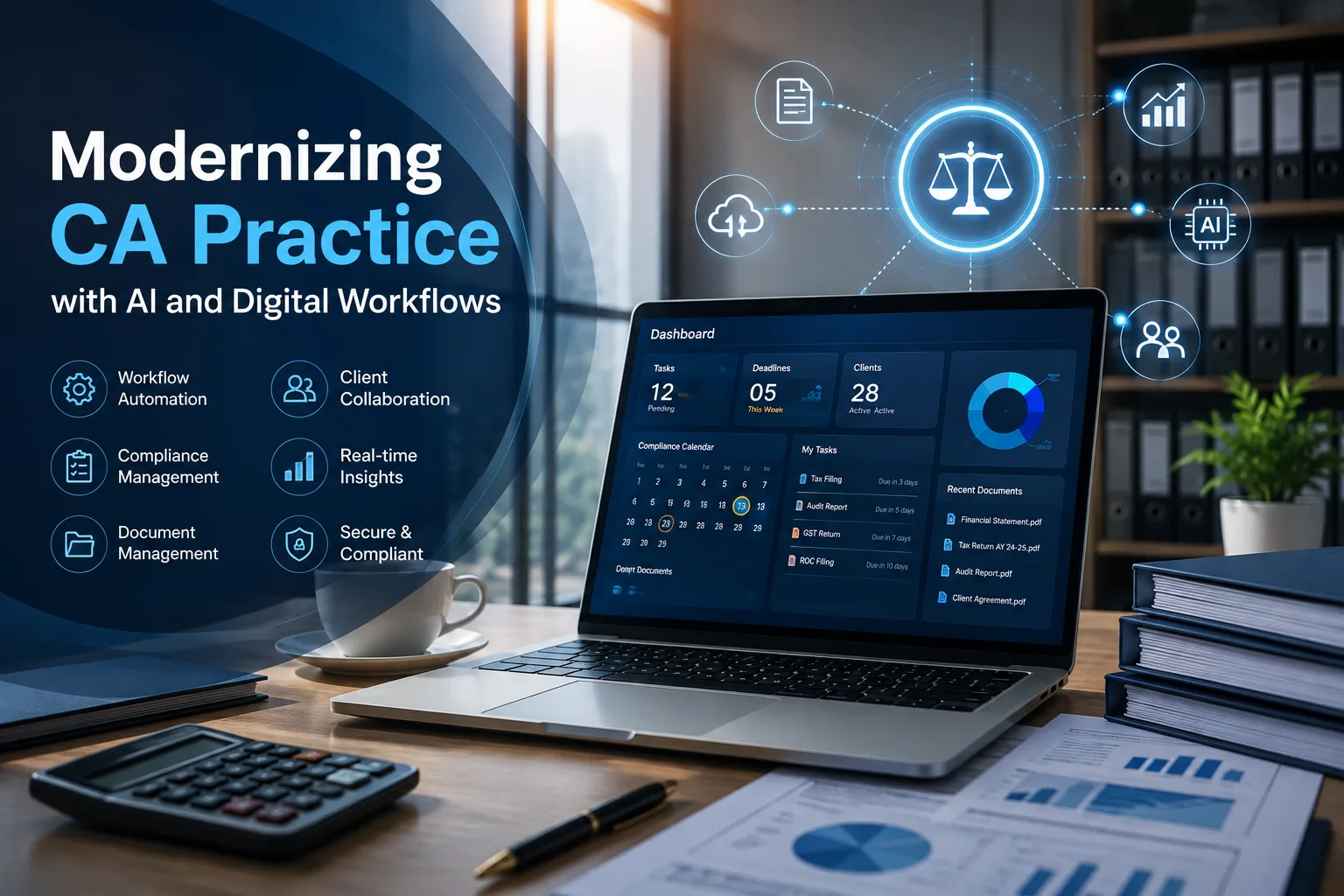
Artificial intelligence and workflow automation are redefining how accounting professionals manage day-to-day operations. Intelligent platforms centralize client information, automate recurring processes, and provide secure access to financial documents from anywhere.
Instead of manually tracking compliance activities, digital systems automatically generate reminders for tax filings, audits, statutory submissions, and recurring client engagements. AI-powered search capabilities enable professionals to retrieve historical records, financial statements, agreements, and correspondence within seconds.
Automation also improves consistency across engagements by standardizing workflows, reducing manual intervention, and minimizing the risk of administrative errors. These capabilities allow accounting firms to deliver faster services while maintaining high professional standards.
Essential Features of a Modern CA Practice Platform
Centralized Client Management
A unified client database provides instant access to engagement history, compliance records, financial documents, communication logs, and ongoing assignments. This eliminates fragmented information and enables better client servicing across departments.
Compliance and Deadline Tracking
Automated calendars help firms monitor statutory due dates, tax filings, audits, regulatory submissions, and recurring compliance activities. Intelligent reminders reduce the likelihood of missed deadlines and improve operational discipline.
Document Management
Accounting firms manage thousands of documents every year, including tax returns, financial statements, audit reports, invoices, agreements, and supporting records. A centralized document repository with version control and advanced search capabilities simplifies document retrieval while maintaining proper organization.
Workflow Automation
Routine activities such as task assignment, approval workflows, engagement creation, document review, and follow-up reminders can be automated. This reduces administrative workload and ensures standardized execution across the organization.
Secure Collaboration
Modern platforms enable secure collaboration between accountants, clients, auditors, and internal teams through controlled document sharing, comments, notifications, and approval workflows without relying on lengthy email chains.
Business Benefits of Digital CA Practice Management
Adopting digital solutions significantly improves operational efficiency across accounting firms. Teams spend less time performing repetitive administrative tasks and more time providing financial analysis and advisory services. Centralized information improves collaboration while reducing duplication of work.
Better visibility into ongoing engagements enables managers to allocate resources more effectively and monitor workloads across teams. Automated compliance tracking minimizes regulatory risks and improves service reliability. Clients benefit from faster responses, organized documentation, and greater transparency throughout engagements.
For firm leadership, real-time dashboards provide valuable insights into project status, employee productivity, pending compliance activities, and business performance, supporting more informed operational decisions.
AI Applications in CA Practice
Artificial intelligence is becoming an integral part of modern accounting operations. AI-powered document intelligence extracts information from financial statements, invoices, tax documents, and regulatory filings, significantly reducing manual data entry.
Machine learning models assist with anomaly detection, helping firms identify inconsistencies during audits or financial reviews. Intelligent search enables professionals to locate historical client records instantly, while AI-generated summaries simplify the review of lengthy financial reports and compliance documentation.
Natural language processing also supports faster document drafting, internal knowledge retrieval, and client query management. These capabilities improve productivity without replacing professional judgment, allowing Chartered Accountants to focus on higher-value analytical work.
Best Practices for Building an Efficient CA Practice
Successful digital transformation begins with clearly documenting internal processes before introducing technology. Standardized workflows make automation more effective and reduce operational inconsistencies across teams.
Maintaining organized digital records improves information accessibility and simplifies compliance management. Firms should also establish role-based access controls to protect confidential financial information while ensuring employees can collaborate efficiently.
Regular employee training is essential for maximizing the adoption of new technologies. Continuous monitoring of workflows and operational performance helps firms identify improvement opportunities and adapt to changing regulatory requirements without disrupting service delivery.
The Future of CA Practice
The future of CA Practice will be shaped by intelligent automation, cloud computing, predictive analytics, and artificial intelligence. Rather than focusing solely on compliance execution, accounting firms will increasingly position themselves as strategic business advisors supported by advanced digital capabilities.
AI will continue to automate routine accounting activities such as document classification, reconciliation, compliance monitoring, and financial reporting. Predictive analytics will provide early insights into financial risks, tax planning opportunities, and business performance trends, enabling firms to deliver more proactive advisory services.
Cloud-native collaboration platforms will strengthen communication between accountants and clients through secure digital workspaces that provide real-time access to financial information and engagement status. Regulatory technology will also become more sophisticated, helping firms adapt quickly to legislative changes through automated updates and intelligent compliance monitoring.
As client expectations continue to evolve, technology will become an essential component of every successful CA Practice. Firms that embrace digital transformation will be better positioned to improve operational efficiency, deliver higher-quality services, and scale sustainably in an increasingly competitive professional landscape.
Conclusion
The accounting profession is undergoing a significant transformation driven by technology, automation, and evolving client expectations. A modern CA Practice is no longer defined only by technical expertise but also by the ability to manage information efficiently, streamline compliance, improve collaboration, and deliver strategic financial guidance. Digital platforms equipped with AI capabilities allow firms to simplify routine administrative work, reduce operational risks, and create more structured workflows across every engagement.
As accounting firms continue to expand their advisory role, investing in intelligent practice management becomes essential for long-term success. Automation, centralized document management, compliance tracking, and real-time analytics enable professionals to focus on high-value decision-making rather than repetitive administrative tasks. Firms that embrace these innovations will improve productivity, strengthen client relationships, and build a resilient foundation capable of adapting to future regulatory and business challenges. Technology is no longer just supporting CA Practice—it is becoming a key driver of efficiency, service quality, and sustainable growth.