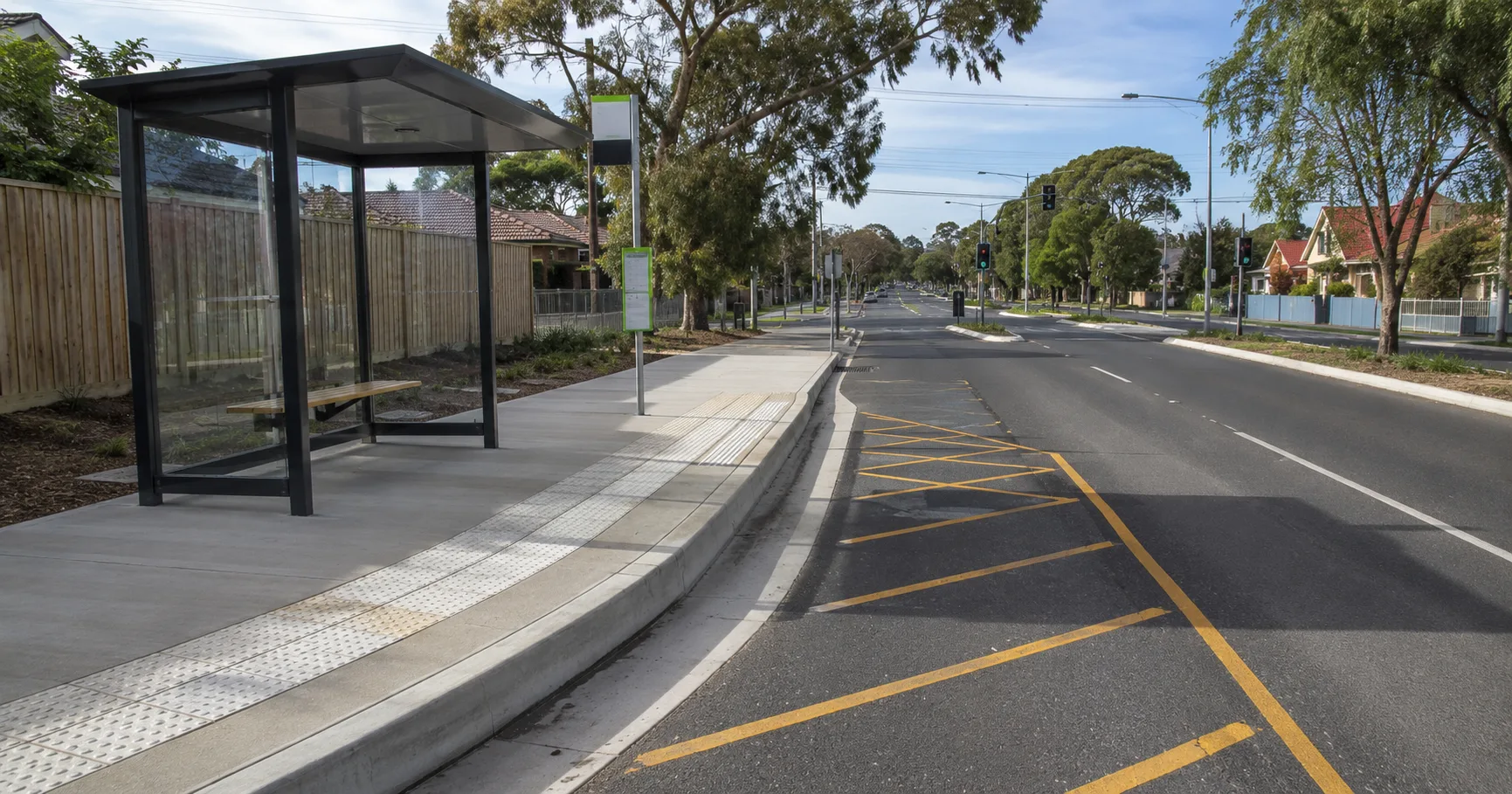
It is one of the first decisions made on any bus stop project, and one of the most expensive to get wrong: does this site need an indented bay, or will a standard kerbside stop do the job?
The answer changes the scope completely. A kerbside stop is essentially a concrete hardstand, a kerb upgrade and some furniture. An indented bay means demolishing and rebuilding kerb and channel, reconstructing pavement, reworking drainage and often relocating services. On some sites that is money well spent. On others it buys nothing but a slower bus route and a bigger bill.
This guide sets out how experienced teams working in bus stop construction Melbourne wide actually make that call — the compliance floor both options must clear, the site conditions that push you one way or the other, and the buildability issues that decide whether a design survives contact with the road reserve.
The compliance baseline: both options must meet DSAPT
Before configuration comes compliance. Bus stop infrastructure in Victoria sits under the Disability Standards for Accessible Public Transport 2002 (DSAPT), made under the Disability Discrimination Act 1992. We cover the full framework in our guide to the standard bus stop design requirements in Melbourne. The Australian Human Rights Commission publishes a dedicated guideline for assessing bus stop compliance against those standards, including a compliance checklist and worked examples of stop layouts.
The compliance deadline for bus infrastructure has already passed — the DSAPT schedule required 100 per cent of bus stop infrastructure to comply by 31 December 2022. That is why Victorian councils are still working through backlog upgrade programs today.
Critically, the accessibility requirements do not change between an indented bay and a kerbside stop. Both need:
- A level, sealed boarding area (hardstand) connected to the pedestrian network
- Unobstructed circulation space for a wheelchair to complete a 180-degree turn — 2070mm × 1540mm under the relevant Australian Standard
- Tactile ground surface indicators (TGSIs) marking the boarding point
- A kerb height that supports safe ramp deployment. The PTV standard drawing for an indented stop between a road and service lane specifies a hardstand of at least 9.2m in length against a kerb between 150mm and 190mm high measured from the kerb invert, and requires replacement of any barrier kerb below that height along the hardstand
- Gradients and crossfall within tolerance so mobility aids do not roll
Source: PTV / VicRoads Standard Drawing STD_S0075 — Indented Bus Stop Between Road and Service Lane
So the configuration question is not "which one is compliant". It is which one is safe, operationally sensible and buildable at that specific site.
The case for a kerbside stop
A kerbside (or in-lane) stop keeps the bus in the running lane while passengers board. It is the default across most of metropolitan Melbourne, for good reason.
Faster, more reliable running. The bus does not have to merge back into traffic. Re-entry delay is the single biggest operational penalty of an indented bay, and it compounds across every stop on a route.
A legal safety net in built-up areas. Under the Victorian Road Safety Road Rules 2017, a driver in a built-up area must give way to a bus that has stopped or is moving slowly at the far left of the road or in a bus-stop bay, where the bus displays a give way to buses sign and its right indicator is operating.
Source: Road Safety Road Rules 2017 (Vic) reg 77 — Giving way to buses
This matters for design. In a built-up area the merge penalty is partly mitigated by law. Outside built-up areas, it is not.
Better sightlines and simpler geometry. The bus stops parallel and close to the kerb, so the driver can see waiting passengers and the ramp deploys onto a predictable surface.
- Lower cost and shorter construction windows. No pavement reconstruction, no kerb realignment, far less traffic management. For a bus stop builder working under a council's annual upgrade program, that is the difference between delivering 40 stops in a season and delivering 15.
The default position in some Australian jurisdictions is explicitly against indented bays. South Australia's master specification for bus infrastructure design states that stops in indented bays are not to be adopted, citing the reduction in bus operational efficiency, unless the location is a timing point or layover, or there are safety concerns about traffic queuing behind a stopped bus.
When an indented bay is the right call
Despite the operational cost, there are sites where an indented bay is clearly justified.
- High-speed road environments. On roads with higher posted speeds, a stationary bus in the running lane is a genuine rear-end and overtaking risk. The give-way-to-buses protection also applies only in built-up areas, so the merge penalty is real but the safety benefit outweighs it.
- Timing points and layovers. Where a bus dwells for an extended period to hold to timetable, holding a running lane is unacceptable. This is the standard exception in most design specifications.
- Constrained sites with heavy through traffic. Single-lane approaches to signalised intersections, or locations where a stopped bus would block a turn movement or queue traffic back through an intersection.
- Service road and boulevard configurations. Melbourne's older boulevard roads with parallel service lanes often require an indented arrangement, which is why PTV maintains a specific standard drawing for it.
- Interchanges and school precincts. Multiple bus movements in a short window need separation from general traffic.
Where an indented bay is adopted in Victoria, the construction detail is dictated by the standard drawings — VicRoads Standard Drawing 2071B for the indent itself, together with the PTV bus stop standard drawing suite. The PTV service-lane detail, for example, calls up a 125mm deep 25MPa concrete pad on 50mm compacted Class 3 FCR with centrally located SL72 mesh dowelled to the kerb, with 15m kerb transitions at each end.
Source: VicRoads Standard Drawing 2071B — Indented Bus Bay; PTV Standard Drawing STD_S0075
Side-by-side comparison
ConsiderationKerbside stopIndented bayBus travel timeMinimal delay; no re-entryRe-entry delay at every stopTraffic flowBuses briefly hold the laneThrough traffic unimpededSafety in high-speed environmentsHigher rear-end riskPreferredRoad reserve requiredMinimalSignificant — bay plus tapersKerb and pavement worksLocalised kerb upgradeFull kerb and channel reconstructionDrainage impactUsually minorOften requires pit relocation or new invertService relocation riskLow to moderateHighTraffic managementFootpath-focusedLane closures, often night worksRelative capital costLowerSubstantially higherTypical use caseStandard urban routesHigh-speed roads, timing points, interchangesThe buildability factors that decide it on site
Design intent is one thing. What the ground gives you is another. Any competent bus stop builder Melbourne councils engage will pressure-test these before the design is locked:
Underground services. An indented bay excavates into the carriageway, where water, gas, telecommunications and electrical assets tend to live. Service location and potholing at the design stage is the single highest-value investment on an indented bay project. Discovering a service at construction stage means a variation, a redesign and a program blowout.
Drainage and the kerb invert. Cutting an indent changes the flow line. If the existing pit sits within the new bay, it must be relocated or reconstructed, and the bay must be graded so water does not pond at the boarding point. Ponding at the hardstand fails an accessibility audit and the customer experience test alike, which is why drainage and kerb upgrade details belong in the DDA-compliant bus stop design package rather than being resolved on site.
Available road reserve and property boundaries. A bay plus its entry and exit tapers consumes a long section of frontage. Where the reserve is narrow, an indent can push the footpath into private land or leave insufficient width for the shelter and clear path of travel.
Shelter clearances. The PTV standard drawings require the shelter roof to sit clear of the kerb face — nominally 800mm, reducible to 600mm where buses swing in, such as at an indented bay. Where a shelter is provided, the minimum pad width increases to 3.0m. If your available footpath cannot deliver that, the configuration decision is effectively made for you. Source: PTV / VicRoads bus stop standard drawings
Parking and loading impacts. An indented bay removes parking bays and requires enforceable clearances. In retail strips that is a community consultation issue as much as an engineering one.
Approvals. Works in the road reserve require consent from the coordinating road authority. On declared arterial roads that is the Department of Transport and Planning; on local roads it is the council. Indented bays attract far more scrutiny than kerbside upgrades, and securing consent is usually best handled as part of the construction project management scope rather than left to the build phase.
A simple decision sequence
- Confirm the road authority and speed environment. High-speed or non-built-up area? Indented bay moves to the front.
- Check the operational role of the stop. Timing point, layover or interchange? Indented bay.
- Test the traffic case. Would a stopped bus queue traffic through an intersection or block a turn lane? If not, kerbside is likely defensible.
- Survey the reserve and the services. If there is no room for the bay and tapers, or the service risk is unmanageable, kerbside with a compliant hardstand is the pragmatic outcome.
- Verify DSAPT compliance either way. Circulation space, TGSIs, kerb height, gradient and path-of-travel connection are non-negotiable regardless of configuration.
- Cost the full scope, not the slab. Traffic management, service proving, drainage and asphalt pavement reconstruction often exceed the concrete cost on an indented bay.
Frequently asked questions
Q. Is an indented bus bay more DDA compliant than a kerbside stop?
Ans - No. Compliance is determined by the boarding area, circulation space, TGSIs, kerb height, gradients and connection to the footpath network — not by whether the bus leaves the traffic lane. A poorly detailed indented bay can fail an audit just as easily as a kerbside stop.
Q. Which standard drawings apply in Victoria?
Ans - Indented bays are constructed to VicRoads Standard Drawing 2071B, with the PTV bus stop standard drawing suite covering hardstands, kerbing, flag poles, shelters and TGSI layouts. Always confirm the current revision with the coordinating road authority before design.
Q. Why do most new Melbourne bus stops use kerbside configurations?
Ans - Because they are faster for passengers, cheaper to build, less disruptive to construct, and — in built-up areas — supported by give-way-to-buses rules that reduce the merge problem an indented bay is designed to solve.
Q. How long does an indented bay take to construct?
Ans - Considerably longer than a kerbside stop. Pavement reconstruction, kerb and channel works, concrete curing and reinstatement typically require multiple staged shifts and lane closures, whereas a kerbside hardstand upgrade can often be completed within a single footpath-based work window.
The bottom line
Kerbside should be your starting assumption. Indented bays are a targeted solution to specific problems — speed environment, dwell time, traffic queuing — not a general upgrade. Adopting one without a clear justification trades permanent bus route performance for a benefit the site may never realise.
The decision is best made early, with survey data, service information and the coordinating road authority in the room. Retrofitting a configuration change after design approval is where budgets and programs come undone.
If you are scoping a bus stop upgrade program and need input on configuration, standard drawing compliance or constructability, talk to an experienced bus stop builder in Melbourne before the design is locked in. Infra Projects delivers council-compliant bus stop works across metropolitan Melbourne and regional Victoria — get in touch for a site assessment.
Sources and further reading
- Australian Human Rights Commission — Guideline for compliance of bus stops with the Disability Standards for Accessible Public Transport
- Disability Standards for Accessible Public Transport 2002 (Cth), made under the Disability Discrimination Act 1992 (Cth)
- VicRoads Standard Drawing 2071B — Indented Bus Bay
- PTV / VicRoads Bus Stop Standard Drawings (STD_S0062, STD_S0069, STD_S0075)
- Road Safety Road Rules 2017 (Vic), reg 77 — Giving way to buses
- Transport Victoria — Driving or riding with buses
- SA Department for Infrastructure and Transport — Master Specification RD-PT-D1 Bus Infrastructure Design