
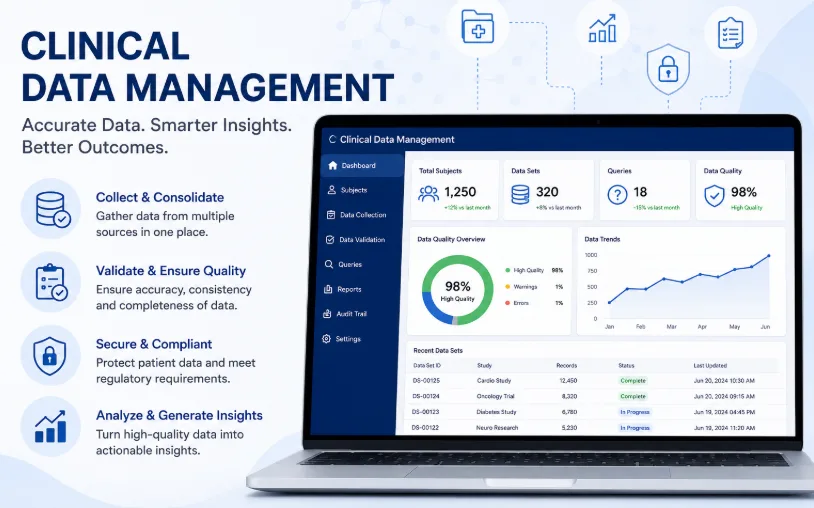
Clinical research is no longer confined to information entered at a single investigative site. Participants may contribute data through mobile applications, home devices, virtual visits, local laboratories, pharmacies, and electronic health records. These models can broaden the ways research is conducted, but they also create a more distributed data environment that requires careful coordination.
A modern clinical data management strategy must connect people, processes, and technology across locations. The goal is to preserve context and traceability as data move between participants, sites, service partners, and sponsors. Achieving that goal requires more than a central repository; it depends on clear ownership, validated integrations, controlled access, and visible exception handling.
Build Around the Complete Data Journey
Every data source should have a documented path from origin to final use. Teams need to understand how a measurement is created, transmitted, transformed, reviewed, corrected, and stored. This mapping can expose hidden manual steps, duplicated transfers, or gaps in responsibility.
For connected devices, teams should define how the system handles missed readings, device replacement, connectivity interruptions, and values recorded outside the expected window. For EHR-derived information, they must consider patient matching, source terminology, encounter context, and changes made after extraction. Laboratory and imaging feeds introduce their own requirements for reconciliation and version handling.
Integrated Clinical Data Management Systems should provide traceability across these transitions. Authorized users may need to see the original source, transfer time, transformation history, validation status, and any subsequent modification. Clear audit records make it easier to investigate discrepancies without relying on informal communication or disconnected spreadsheets.
Design Access Around Roles and Tasks
Distributed research involves users with different responsibilities. Site coordinators, monitors, data managers, medical reviewers, statisticians, and external partners do not all need the same access. Role-based controls should follow the principle of minimum necessary access while still allowing each person to complete assigned work.
The interface should also reflect these differences. A site user may need a focused view of incomplete forms and queries, while a central data manager may need cross-site quality trends. Monitors may require source-review status, and medical reviewers may need clinically relevant listings. Presenting every function to every user can increase complexity and make important tasks harder to find.
Support Remote Oversight With Meaningful Signals
Remote monitoring is most useful when it directs attention toward potential issues. Dashboards can show delayed entry, unusual patterns, unresolved discrepancies, missing visits, or repeated protocol-related data problems. These indicators should lead to review rather than being treated as automatic conclusions.
Experienced Clinical Data Management Services can support operating-model design, standards mapping, form development, validation planning, query workflows, reconciliation, and closeout preparation. Responsibilities between internal teams and external partners should be explicit, including who reviews exceptions, approves changes, and communicates with sites.
Central oversight should not remove local context. A pattern that appears unusual in aggregated data may have a reasonable explanation at the site level. Escalation workflows should allow teams to investigate collaboratively and document the outcome.
Prepare for Change and Interruption
Studies evolve. Protocol amendments may change forms, visit schedules, eligibility rules, or data interfaces. A controlled change process should assess downstream effects, test revised configurations, train affected users, and preserve the meaning of data already collected.
Downtime and transfer failures also require defined procedures. Teams should know how data will be captured temporarily, how delayed information will be identified, and how systems will be reconciled after restoration. Silent failures are particularly risky because users may assume that data have arrived when they have not.
The success of clinical data management in decentralized research depends on making a complex data journey observable and governable. By mapping every source, tailoring access, combining central signals with local review, and planning for change, research organizations can build data operations that remain understandable from collection through archival.