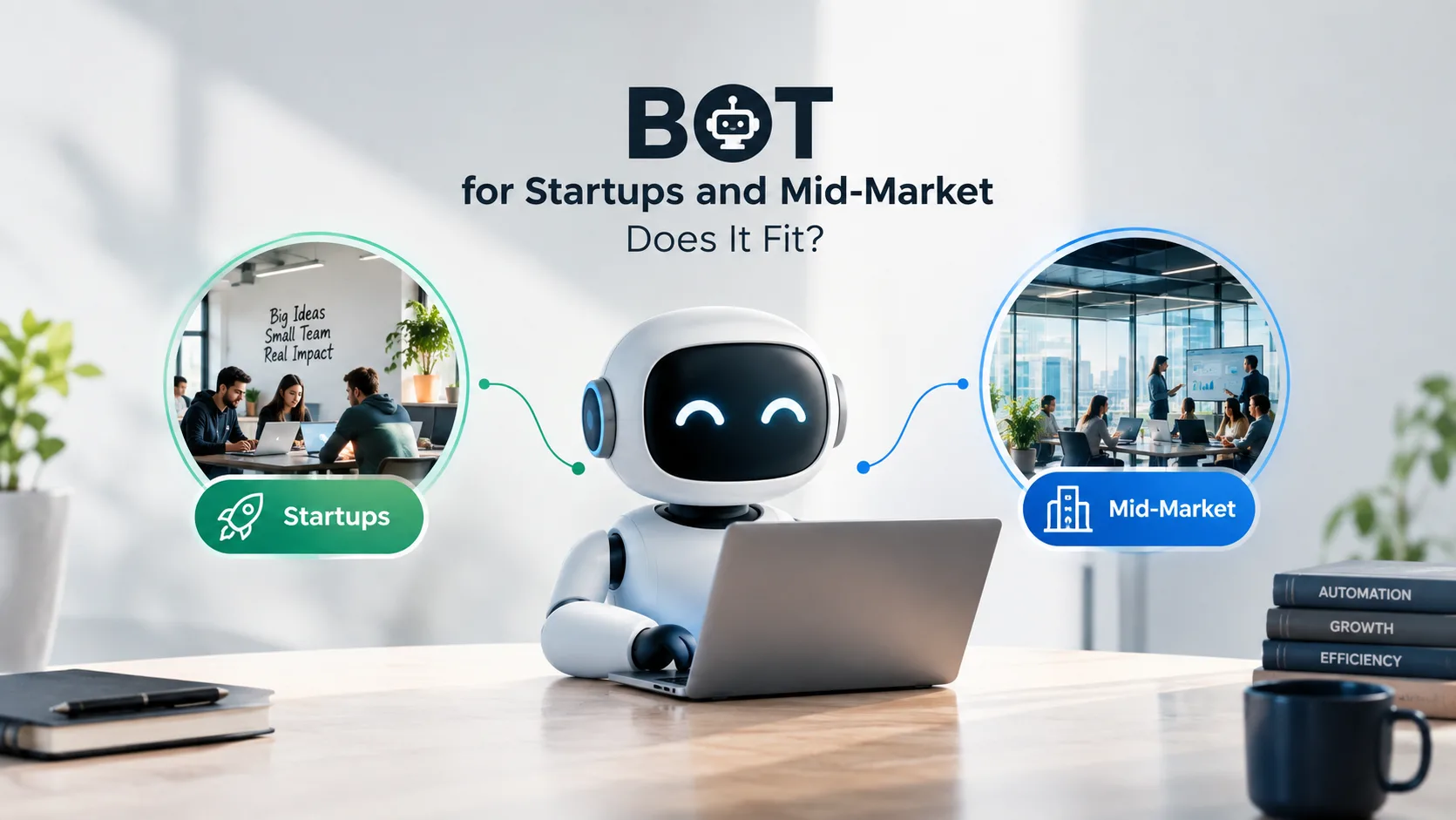
Build Operate Transfer has a reputation as a big-company play. Fortune 500 firms use it to stand up large captive centers, and the case studies usually feature enterprises with deep pockets. So a fair question if you run a startup or a mid-market company is simple: can we actually use this model, or is it out of our league?
The honest answer is that BOT can work for smaller companies, but only under the right conditions. This article lays out when Build Operate Transfer fits a startup or mid-market business, when it does not, and what smaller buyers should do instead when the full model is too much.
What BOT Actually Requires
A Build Operate Transfer engagement ends with you owning a Global Capability Center in India: your legal entity, your team, your IP. A partner builds and runs it first, then transfers it to you. Reaching that end state takes a real commitment. There is a setup cost, usually in the $200,000 to $500,000 range depending on headcount and city, a run cost per engineer, and a horizon long enough to justify owning an entity rather than renting capacity.
That is why team size and time horizon matter more than company size on paper. A well-funded startup with a clear three-year plan can be a better BOT candidate than a larger company chasing a six-month project.
When BOT Fits a Mid-Market Company
You Want 20 or More Engineers You Plan to Keep
The economics of owning a center turn positive once the team is large enough that avoiding a vendor margin pays back the setup cost. That break-even commonly sits around 20 to 50 engineers. If your plan is to grow an India team to that size and keep it, BOT starts to make sense.
You Have a Multi-Year Horizon
Owning an entity only pays off over time. If you are building capability you intend to run for three years or more, the upfront setup amortizes well. If your need is short and uncertain, it does not.
You Want Control Over IP and Talent
Startups in regulated or IP-heavy spaces often cannot accept the vendor-owns-everything model of traditional outsourcing. If owning your code, your roadmap, and your people is a requirement, BOT gets you there with less day-one risk than a cold captive build.
You Are New to India and Risk-Averse
This is the core BOT advantage for smaller buyers. A partner absorbs the entity, hiring, and compliance while the center matures, then transfers a working operation to you. You do not need India operating muscle on day one. You inherit it.
When BOT Does Not Fit
Be honest with yourself here, because the wrong model is expensive.
BOT is a poor fit if you need a handful of people for a short project, if your funding or roadmap cannot support a multi-year commitment, or if you are not sure the India team is permanent. Standing up an entity for five contractors you need for eight months makes no sense. In those cases, staff augmentation or traditional outsourcing is cheaper and simpler.
The Smaller-Company Path: Start Small, Transfer Later
The good news is that BOT is not all-or-nothing, and smaller buyers have on-ramps.
A micro GCC or managed model (sometimes called GCC as a Service) lets you run a small India team of roughly 20 to 50 people under a service arrangement, without building the entity yourself first. It suits mid-market companies that want an owned-style team without the full captive commitment up front. From there, you can transfer to a fully owned GCC as you scale. This is the phased route: prove the model with a smaller team, then own it when the numbers justify it.
So the realistic sequence for many startups is staff augmentation or a managed team first, then BOT as the team grows past the break-even band, then a fully owned GCC. You step up the commitment as your confidence and headcount grow.
Real-World Use Case
A mid-market software company wanted its own India engineering team but had no legal presence there and could not justify a full captive build on day one. It used BOT with a delivery partner who handled the entity, hiring, and compliance, and had a 40-person center running in under three months, with a clear path to transfer ownership once the model proved out. That is BOT working for a company well short of Fortune 500 scale, because the team size and horizon fit.
How to Decide
Ask three questions. How many engineers will I realistically keep in India over the next three years? Do I need to own the IP and the team, or just rent capacity? Can my funding and roadmap support a multi-year commitment? If the answers point to a sizable, permanent, owned team, BOT fits. If they point to a small, short, flexible need, start with augmentation or a managed model and revisit BOT later.
MetaDesign Solutions runs all four engagement models, including staff augmentation, BOT, managed and micro GCC, and full GCC, so a smaller buyer can start where the risk fits and step up over time. The recommendation is based on your team size and horizon, not the biggest contract.
Conclusion and Next Step
Yes, startups and mid-market companies can use Build Operate Transfer, as long as the team size and horizon justify owning a center. When they do not yet, a managed or micro GCC is the smarter first step, with BOT and full ownership later. The model should match your stage, not the other way around.
Not sure which model fits your stage? Book a consultation with MetaDesign Solutions. We will look at your headcount, horizon, and budget, and recommend the lowest-risk route to an India team, whether that is augmentation, a managed GCC, or a phased BOT. We sign NDAs and respond within one business day.
Frequently Asked Questions
Can a startup use the Build Operate Transfer model?
Yes, if the team size and time horizon justify owning a center. A funded startup with a multi-year plan for 20 or more engineers can be a strong BOT candidate.
What is a Global Capability Center?
A company-owned office, usually in India, that runs engineering, product, and support as your own team rather than an outsourced vendor, giving you control of talent, IP, and roadmap.
What team size makes BOT worth it?
Owning a center tends to pay off from around 20 to 50 engineers, where avoiding a vendor margin covers the setup cost. Below that, a managed or micro GCC is usually better first.
How much does BOT or GCC setup in India cost?
Setup commonly runs $200,000 to $500,000 depending on headcount, city, and entity type, plus a run cost per engineer well below US or UK levels.
What is a micro GCC?
A small owned-style center, roughly 20 to 50 people, often run under a managed arrangement first. It suits mid-market buyers who want a team without a full captive build on day one.
What is GCC as a Service?
A managed model where a partner sets up and operates your India team under a service arrangement, so you get an owned-style team without building the entity yourself first.
When should a smaller company avoid BOT?
When the need is small, short, or uncertain. For a handful of people on a short project, staff augmentation or outsourcing is cheaper and simpler than owning an entity.
Can I start small and move to a full GCC later?
Yes. The common path is augmentation or a managed team first, BOT as the team grows past break-even, then a fully owned GCC as you scale.
Does BOT give me ownership of my IP?
Yes, after transfer. A well-structured BOT passes full ownership of the entity, team, and IP to you, which is why IP-heavy startups prefer it over traditional outsourcing.
How fast can a mid-market company get a team running?
First hires can arrive within the first few months, and a full center is typically operational in 6 to 9 months, then transfers to you once the model is proven.