
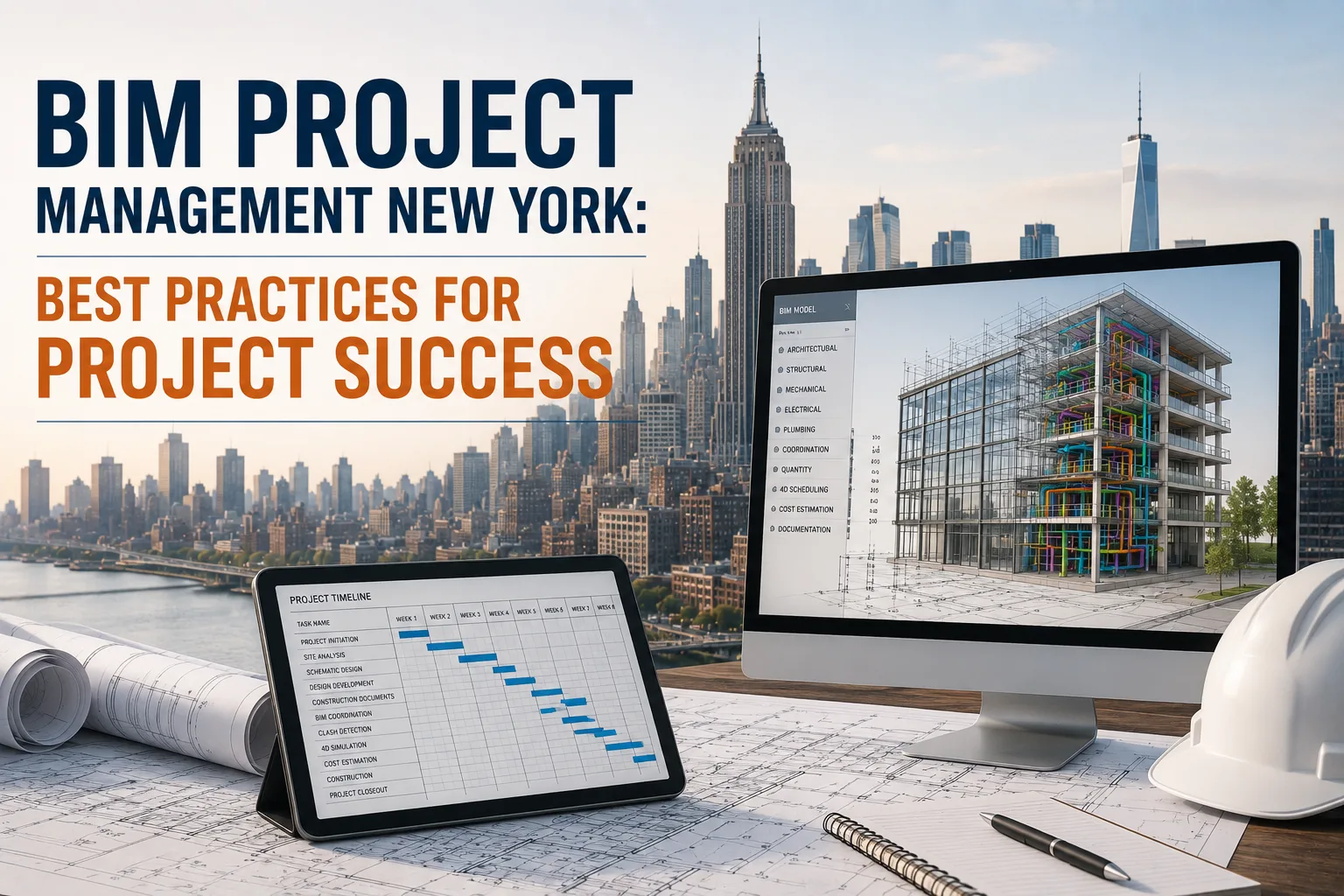
Building Information Modeling (BIM) project management in New York helps construction teams reduce costs, prevent spatial clashes, and streamline compliance with local building codes. Success requires early stakeholder collaboration, standardized data protocols, and experienced partners like Archdraw Outsourcing to navigate complex urban logistics and zoning laws effectively.
Navigating the construction landscape of New York City presents unique logistical and regulatory hurdles. High-density zoning, aging infrastructure, and strict compliance codes make executing a building project an intricate puzzle. Traditional 2D blueprints often fall short when coordinating dozens of specialized contractors in these tight urban spaces.
Building Information Modeling (BIM) has fundamentally changed how developers, architects, and engineers approach these urban developments.
Instead of relying on flat drawings, teams now utilize dynamic 3D models that contain functional data about every building component. This intelligent workflow allows stakeholders to visualize the entire lifecycle of a facility before a single shovel hits the dirt.
Implementing BIM project management New York requires more than just purchasing software. It demands a structural shift in how project data is shared and managed across different teams.
By understanding the core benefits, adopting proven workflows, and learning from common industry challenges, developers can significantly reduce delays and budget overruns on their next big build.
What are the key benefits of BIM project management in New York?
Construction projects in dense metropolitan areas benefit immensely from the predictive capabilities of BIM technology.
Advanced clash detection and spatial coordination
In a city where underground utilities and adjacent structures leave little room for error, spatial coordination is critical. BIM software automatically flags physical intersections between different building systems, such as a plumbing pipe running through an HVAC duct. Resolving these clashes digitally prevents expensive on-site rework and keeps the construction schedule intact.
Accurate cost estimation and material tracking
By integrating the 3D model with cost data (known as 5D BIM), project managers can generate highly accurate material takeoffs. This precision prevents over-ordering expensive materials and helps general contractors provide realistic budget forecasts to developers and investors.
Streamlined compliance with NYC building codes
New York City enforces some of the strictest building and safety regulations in the United States. BIM platforms allow architects to test their designs against local compliance standards early in the schematic phase. This proactive approach reduces the likelihood of Department of Buildings (DOB) permit rejections.
What are the best practices for implementing BIM in NYC projects?
Deploying a new digital framework across a massive construction team requires careful planning. Adhere to these strategies to maximize efficiency.
Establish a comprehensive BIM Execution Plan (BEP)
Before modeling begins, all stakeholders must agree on a BIM Execution Plan. This living document defines project goals, outlines the level of development (LOD) required at each phase, and specifies which software platforms the team will use. A strong BEP eliminates communication silos and sets clear expectations for data sharing.
Partner with experienced BIM consultants
Navigating the technical complexities of a massive digital model can overwhelm in-house teams. Engaging a specialized partner like Archdraw Outsourcing ensures that your project benefits from industry-standard modeling techniques. External experts provide scalable drafting and coordination services, allowing your core team to focus on high-level project management.
Prioritize early stakeholder collaboration
Bring mechanical, electrical, and plumbing (MEP) engineers into the modeling process during the design phase rather than the construction phase. Early collaboration allows specialists to route their systems efficiently, reducing the need for costly redesigns later on.
How can teams overcome challenges in NYC BIM adoption?
While the advantages are clear, transitioning to a fully integrated digital model presents specific organizational roadblocks.
Managing the initial financial investment
Adopting new software licenses and upgrading computer hardware requires a significant upfront cost. Firms should view this not as an expense, but as a strategic investment. Choose phased software rollouts instead of replacing every system at once. This approach spreads out the financial impact while allowing teams to adjust to the new technology gradually.
Bridging the digital skills gap
Many veteran construction professionals possess decades of practical experience but lack digital modeling skills. Pair these experienced superintendents with younger BIM technicians. This mentorship dynamic ensures the digital model reflects real-world construction logic while simultaneously upskilling the existing workforce.
Which New York projects successfully used BIM management?
Large-scale infrastructure and commercial developments across the five boroughs have demonstrated the power of digital project delivery. High-profile developments, such as the Hudson Yards megaproject and various MTA station expansions, relied heavily on digital modeling to coordinate complex supply chains and navigate active railway lines.
By modeling pedestrian flow, structural loads, and subsurface utilities, the management teams on these projects avoided catastrophic delays. These successes prove that detailed digital twins are practically mandatory for major urban developments.
What is the future of BIM in the New York construction landscape?
The evolution of digital construction management is accelerating. We are rapidly moving toward the integration of BIM with artificial intelligence and Internet of Things (IoT) sensors.
In the near future, AI algorithms will analyze historical BIM data from past New York projects to predict schedule delays before they occur. Furthermore, digital twins connected to live building sensors will allow facility managers to monitor energy consumption and structural integrity in real-time. Organizations that establish strong digital workflows today will be perfectly positioned to adopt these advanced capabilities tomorrow.
Maximizing construction project success with digital tools
Implementing comprehensive BIM project management New York is no longer a futuristic luxury; it is a baseline requirement for executing complex urban builds profitably. By committing to early collaboration, establishing clear data standards, and leveraging the expertise of firms like Archdraw Outsourcing, construction leaders can transform potential logistical nightmares into streamlined, highly profitable developments.
Take the time to evaluate your current project delivery methods. If your teams are still struggling with outdated blueprints and costly on-site clashes, it is time to transition to a fully integrated digital model.
Frequently asked questions about BIM in NYC
What is the difference between 3D, 4D, and 5D BIM?
3D BIM represents the physical spatial model of a building. 4D BIM adds project scheduling data, allowing teams to visualize the construction sequence over time. 5D BIM incorporates cost data, enabling real-time budget tracking and material estimations as the design changes.
Do small construction projects in New York need BIM?
Yes. While megaprojects see the largest financial return, small commercial renovations and tight residential builds benefit heavily from clash detection and precise material ordering. Digital modeling prevents unexpected structural conflicts in confined historic buildings.
How does Archdraw Outsourcing support local NYC developers?
Archdraw Outsourcing provides specialized architectural, structural, and MEP modeling services. They help local developers scale their digital capabilities without the overhead of hiring full-time, in-house BIM technicians, ensuring projects meet strict local standards efficiently.