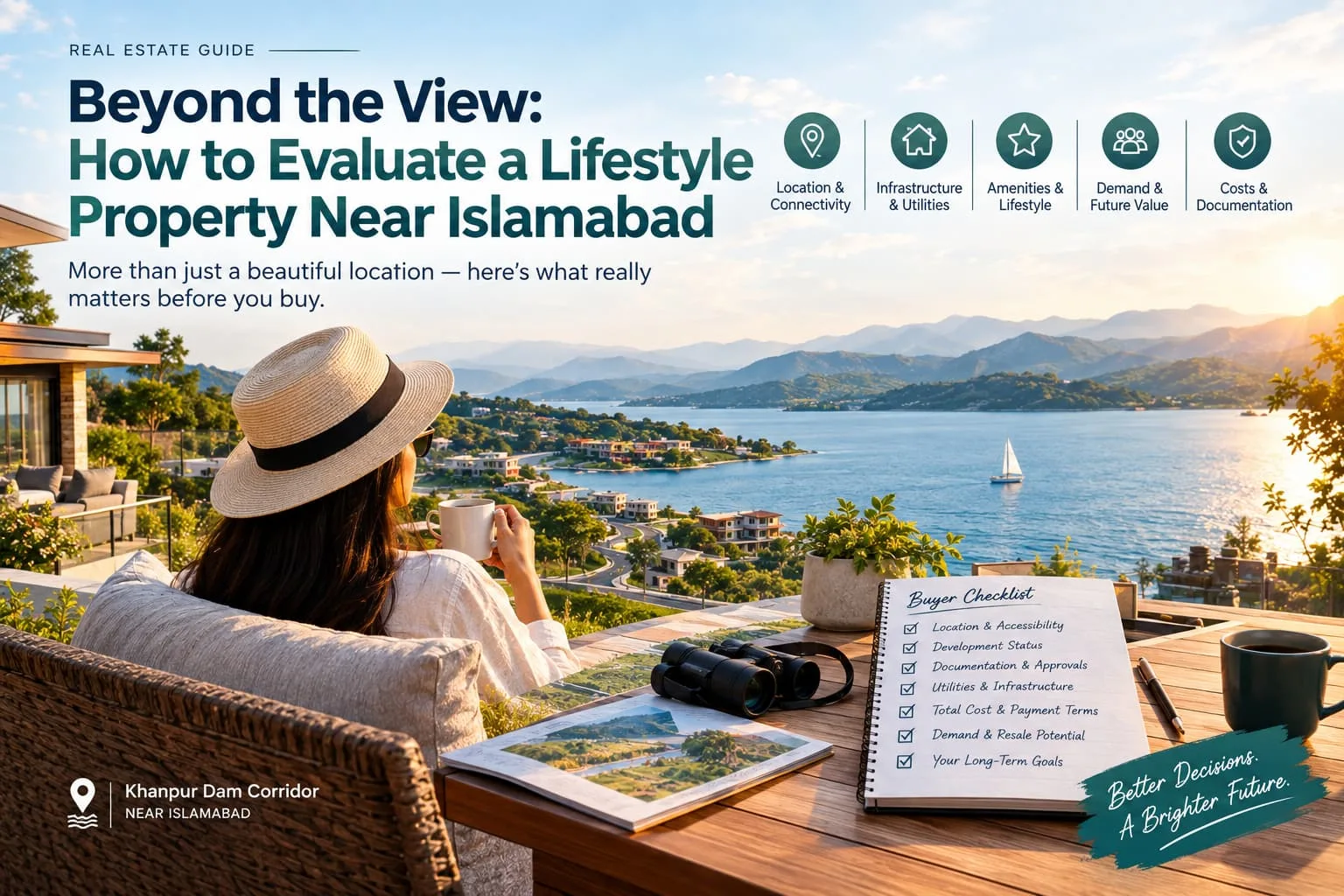
A lake view can make a property memorable, but a memorable property is not automatically a practical one.
As buyers increasingly look beyond conventional urban housing, lifestyle-led developments are attracting attention for combining residential property with recreation, nature, community facilities, and tourism access. For buyers considering a Luxury lakeside community near Islamabad, the real question is not simply whether the surroundings look attractive. It is whether the location and development can support the lifestyle the buyer actually wants.
Lakeshore City, positioned beside Khanpur Dam on the Taxila–Haripur corridor, presents this type of proposition. Its official location information highlights waterfront and hill views and proximity to Islamabad, including a stated 15-minute drive from D-12. Actual travel times, however, depend on traffic and route conditions.
Here are the factors that can help buyers evaluate lifestyle property more realistically.
1. Start With the Lifestyle, Not the Property
Before comparing plot sizes or payment plans, define what you want the property to accomplish.
Are you looking for:
- A permanent family residence?
- A weekend retreat?
- A second home?
- A long-term land holding?
- A future rental or hospitality opportunity?
- A combination of lifestyle and investment?
The answer changes how you should evaluate the property.
For example, someone purchasing a weekend property may place greater importance on scenery, recreation, privacy, and accessibility. A permanent resident may prioritize utilities, schools, healthcare, commercial services, and daily commuting.
The same property can therefore have very different value to different buyers.
2. Look at What Surrounds the Community
Lifestyle property depends heavily on its surroundings.
Khanpur Dam is an established recreational destination within reach of Islamabad and Rawalpindi, giving the area an existing tourism identity rather than creating one entirely from scratch.
Lakeshore City's published location information places the development near Khanpur Dam and several nearby destinations, including Mabali Island, Faisal Town Wah Cantt, Rajdani, and Multi Gardens B-17.
This surrounding ecosystem matters because a lifestyle community becomes more useful when residents have things to experience beyond their own plot.
3. Separate Current Facilities From Future Plans
One of the biggest mistakes buyers can make is treating every feature shown in a master plan as an immediately available facility.
Lakeshore City's published amenities include hiking, horse riding, golf, watersports, hospitality facilities, healthcare, education, community spaces, and other recreational features. However, the developer also states that some components are reflected in on-ground development while others remain announced master-plan elements.
Therefore, buyers should ask:
What can I use today, and what is planned for later?
This simple distinction provides a much clearer picture of present-day usability.
4. Evaluate Infrastructure as a Lifestyle Feature
Roads, electricity, water, security, drainage, and communication services may not sound exciting, but they determine whether a lifestyle property is genuinely convenient.
A scenic property becomes less attractive if reaching it is difficult or if essential services are unreliable.
Lakeshore City's published utilities guide discusses water supply planning, electricity infrastructure in developed phases, internal roads, security, commercial services, and other community infrastructure.
Buyers should verify the specific infrastructure available in the block or phase they are considering instead of assuming that services across the entire project are identical.
5. Consider How the Property Could Be Used Over Time
Good property decisions often begin with today's purpose but consider tomorrow's options.
A buyer may initially purchase land as an investment and later decide to construct a home. Another buyer may purchase a second home and eventually use it more frequently after retirement.
This makes flexibility an important consideration.
When evaluating a housing society near Islamabad, consider whether the property can continue to meet your needs if your circumstances change.
Ask about:
- Construction rules
- Permitted property use
- Transfer procedures
- Utility availability
- Community facilities
- Access throughout the year
- Potential resale audience
The more clearly these factors are understood, the easier it becomes to assess long-term usability.
6. Think About Demand, Not Just Appreciation
Property discussions often focus heavily on future price growth. A more useful approach is to identify why people would want the property in the first place.
A lifestyle-oriented development can potentially attract demand from families, second-home buyers, tourists, overseas Pakistanis, and investors seeking land near an established recreational destination.
For someone researching Real estate investment near Islamabad, this distinction is important.
Demand should be supported by real factors such as:
- Accessibility
- Population growth
- Tourism activity
- Infrastructure
- Community development
- Usability
- Product differentiation
Appreciation may occur when these fundamentals strengthen, but no specific return should be treated as guaranteed.
7. Compare the Complete Cost
An attractive entry price does not tell the complete financial story.
Before purchasing, calculate the total expected cost, including:
Property price + taxes + transfer charges + development charges + construction costs + financing expenses + future maintenance.
This becomes particularly important for lifestyle properties because buyers may eventually spend additional money on construction, landscaping, furnishing, or recreational use.
A property should remain financially manageable even if the market takes longer than expected to deliver the desired return.
8. Verify Before You Commit
The final stage is due diligence.
Before making a booking or payment, buyers should independently verify relevant ownership records, approvals, development status, payment terms, transfer procedures, cancellation conditions, and applicable charges.
They should also visit the location rather than relying entirely on photographs or online descriptions.
For a developing project, an on-site visit can reveal important information about road access, surrounding development, construction activity, utilities, and the actual environment.
Why Lifestyle Property Is Different
Traditional property is usually evaluated through location, price, accessibility, infrastructure, and surrounding development.
Lifestyle property adds another dimension: experience.
At Khanpur Dam, the combination of water, hills, recreation, and tourism creates an environment that can appeal to buyers seeking something different from conventional urban living. Lakeshore City's development model builds on this setting by combining residential property with recreational and community-oriented facilities.
But lifestyle appeal should complement—not replace—financial and legal due diligence.
A beautiful view can improve the experience of owning property. It cannot independently guarantee appreciation, rental income, or resale demand.
A Simple Buyer Framework
Before deciding, evaluate the property through five questions:
Purpose
Why am I buying it?
Accessibility
Can I reach and use it conveniently?
Development
What is completed today?
Affordability
Can I comfortably manage the complete cost?
Demand
Who is likely to want this property in the future?
If the answers are clear, the buying decision becomes much more structured.
Final Thoughts
The appeal of lifestyle property lies in its ability to offer more than a piece of land. It can combine nature, recreation, community, accessibility, and potential long-term usability.
However, buyers should look beyond the view.
The strongest evaluation considers the surrounding destination, current infrastructure, completed facilities, future development, total ownership cost, potential demand, documentation, and personal objectives.
For buyers exploring lakeside property near Islamabad, the key question is therefore not simply "Does this place look attractive?"
It is:
"Does this property make sense for the life and financial plan I am building?"
That question shifts the decision from emotional attraction to informed property evaluation.
Buyer Disclaimer: Property values, rental income, demand, and future appreciation are subject to market conditions, infrastructure development, regulatory changes, project execution, and broader economic factors. Buyers should independently verify documentation, approvals, development status, payment terms, costs, and other relevant information before making a property decision.