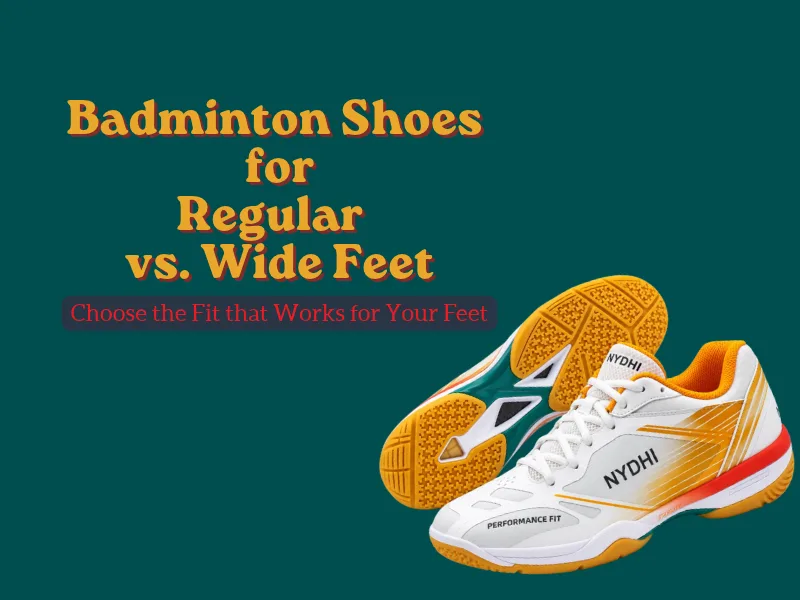
Choosing the right badminton shoes involves more than finding the correct shoe size. Foot width, toe space, heel security, and overall fit all influence how comfortable and stable your shoes feel during a match.
Badminton involves quick lateral movements, lunges, sudden stops, and changes in direction. Shoes that squeeze your toes can cause discomfort, while footwear that allows excessive foot movement may compromise stability.
So, should you choose wide-fit or regular-fit badminton shoes?
The answer depends on how the shoe fits your foot, not just what the width label says.
Wide Fit vs Regular Fit Badminton Shoes: What is the Difference?
The difference between regular-fit and wide-fit badminton shoes is the space available across the foot, particularly around the forefoot and toe area.
Regular-fit badminton shoes are designed for players with standard-width feet, while wide-fit badminton shoes include more space for wider feet.
Regular Fit vs Wide Fit Badminton Shoes: Key Differences
1. Foot Shape
Regular Fit: Designed for players with standard-width feet.
Wide Fit: Designed for players with wider feet.
2. Forefoot Space
Regular Fit: Provides standard forefoot space.
Wide Fit: Offers additional forefoot space.
3. Toe Comfort
Regular Fit: Provides a secure, comfortable fit.
Wide Fit: Offers more room for the toes.
4. Fit Sensation
Regular Fit: Provides a close-fitting feel.
Wide Fit: Offers a more accommodating fit.
5. Best Suited For
Regular Fit: Players with standard-width feet.
Wide Fit: Players experiencing forefoot pressure in regular-fit shoes.
Neither option is automatically better. A properly fitted regular shoe can be more comfortable and stable than an oversized wide shoe, just as a properly fitted wide shoe can be more suitable than a narrow regular shoe.
The objective is to find the right balance between space and support.
How to Tell if You Need Wide Feet Badminton Shoes?
Your usual shoe size doesn't necessarily tell you whether you have narrow, standard, or wide feet.
Look for these signs when evaluating your current badminton footwear.
1. Pressure Around Your Toes
If your toes feel squeezed together, particularly during lunges or sudden stops, your shoes may not provide sufficient room.
2. Tightness Across the Forefoot
Persistent pressure around the widest part of your foot, even when the shoe length is correct, can indicate that you need additional forefoot space.
3. Discomfort along the sides of your feet
Repeated rubbing or discomfort along the inner or outer edges of your feet indicates that the shoe shape or width isn’t suitable.
4. Your Foot Extends Beyond the Insole
Remove the insole and stand on it naturally. If the widest part of your foot noticeably extends beyond its edges, the shoe may be too narrow.
5. You Regularly Buy Larger Shoes for Extra Width
Buying a longer shoe to accommodate a wider foot can create excessive space around the toes and heel. A wider-fitting model may be a better solution.
How Should Badminton Shoes Fit?
This is the most important part of choosing badminton footwear. A badminton shoe should have enough room for your toes without your foot slipping forward.
Toe room: Your toes should have enough space to move naturally without feeling compressed.
Heel security: Your heel should be secured inside the shoe. Excessive heel movement can indicate the shoe size or shape isn't suitable.
Midfoot support: The middle section of the shoe should hold your foot securely without creating uncomfortable pressure.
Lateral stability: Try a few controlled side steps and lunges when testing shoes. Your foot should remain supported without excessive movement inside the footwear.
Important Features to Consider When Buying Badminton Shoes
Once you've identified the right fit, consider these performance features.
Cushioning: Look for adequate cushioning to improve comfort during repeated jumping, lunging, and landing.
Lateral support: Badminton requires frequent side-to-side movement. Choose shoes that provide secure support during directional changes.
Outsole grip: Look for non-marking rubber outsoles designed for indoor courts to provide suitable traction.
Breathability: Breathable upper materials can improve ventilation and reduce heat buildup during extended playing sessions.
Lightweight construction: Lightweight shoes may feel easier to move in, but shouldn't compromise support, comfort, or durability.
The best badminton shoes balance these features with an appropriate fit.
How to Choose the Right Badminton Shoe Fit
Before deciding between wide-fit vs. regular-fit shoes, measure your feet.
Step 1 - Measure your Feet
Stand on a sheet of paper while wearing your usual badminton socks. Mark the heel and longest toe to measure foot length. Measure the widest part of your foot to assess width.
Repeat the process for both feet, as one may be slightly larger than the other.
Step 2 - Try Different Shoe Models
Use your measurements and the manufacturer's sizing chart as a starting point. Once you identify your approximate size, try different models in both regular and wide fits, where available. Check how much room your toes have and whether your heel and midfoot remain secure.
Your measurements help narrow down your options, but the actual fit should determine your final choice.
How to Choose the Right Badminton Shoe Fit
1. Your Experience: Your feet feel comfortable in standard-width shoes.
What to Consider: Regular fit.
2. Your Experience: Your toes feel squeezed in standard-width shoes.
What to Consider: Try a wide fit.
3. Your Experience: Although the shoe length is correct, your forefoot feels tight.
What to Consider: Consider a wider model.
4. Your Experience: Your heel slips inside the shoe.
What to Consider: Reconsider the shoe size or shape.
5. Your Experience: Your foot moves excessively inside a wide shoe.
What to Consider: Try a more secure-fitting model.
One important point: don't automatically choose wide-fit shoes just because they sound more comfortable. If your feet are relatively narrow, excessive space can create unwanted movement.
Similarly, don't assume that buying a larger size will solve width-related discomfort.
Always check the manufacturer's sizing guidance, since fit and sizing can vary between brands and models. If shopping online, contact the seller for additional information and reviews.
Final Thoughts: Choose the Fit That Works Well
Choosing between wide-fit and regular-fit badminton shoes shouldn't come down to labels alone.
The right pair should give your toes adequate room while keeping your heel and midfoot secure during lateral movements.
If regular-fit shoes feel comfortable and provide sufficient space, there's no reason to switch. If you experience consistent forefoot pressure despite having the correct shoe length, exploring wider-fitting models may be worthwhile.
Ultimately, the best badminton shoes are not from the most expensive brand or the newest model. The only criteria are that they fit your feet properly, provide secure support, and allow confident movement around the court.
Are you looking to upgrade your badminton shoes? Explore regular-fit badminton shoes and wide-fit badminton shoes to find the fit that works best for your feet.