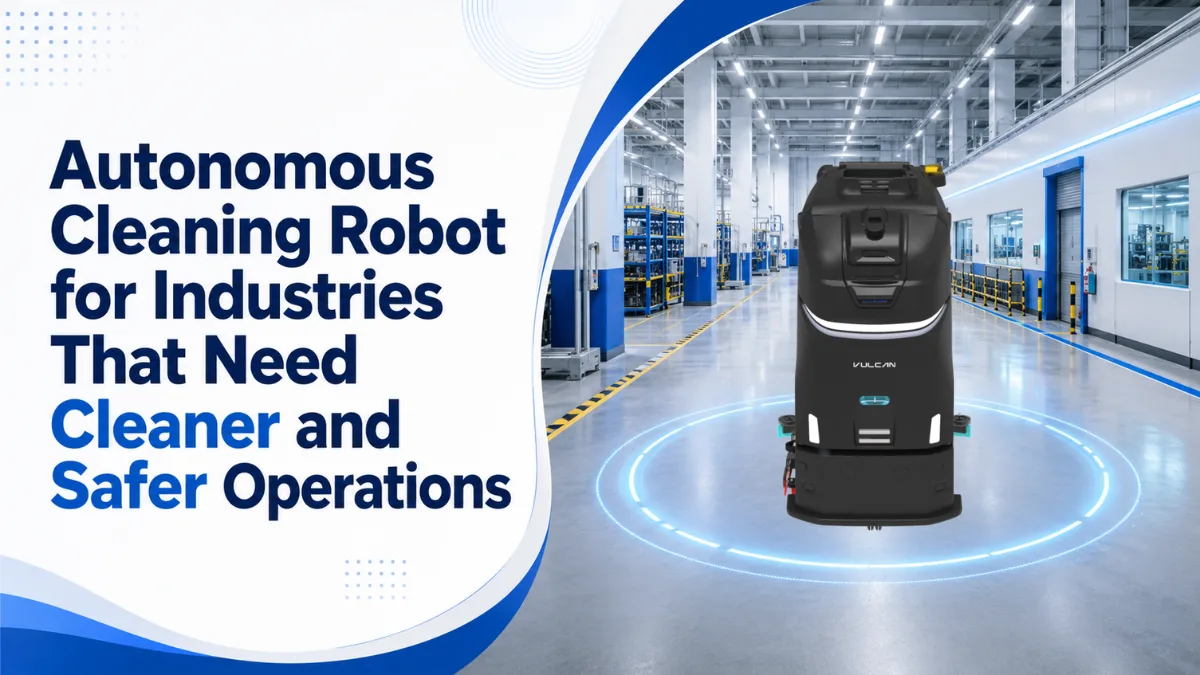
Industrial facilities work under pressure every day. Floors carry dust, oil traces, material residue, packaging waste, pallet movement, forklift traffic, worker movement, and production-related debris. A clean floor is not only a housekeeping requirement. A clean floor supports safety, productivity, compliance readiness, and overall operational discipline.
An autonomous cleaning robot gives industries a smarter way to manage repeated floor-cleaning work across large facilities. Manual teams remain important, but industrial cleaning often needs more consistency than manual effort alone can provide. Large plants, warehouses, logistics centers, factories, and production floors need routine cleaning that happens on time, across defined zones, with reduced supervision.
Vulcan by Kody Robots is a robotics company in India that fits the industrial cleaning conversation as a practical robotic solution for businesses that want cleaner floors, better staff utilization, and stronger facility management. For industries across India, the UK, Europe, the USA, and GCC, robotic cleaning is becoming a serious operational investment.
Key Takeaways
- An autonomous cleaning robot helps industries manage routine floor cleaning with better consistency.
- Industrial cleaning requires more than occasional manual scrubbing because floors face continuous movement and residue.
- Robotic cleaning supports warehouses, factories, logistics hubs, manufacturing plants, airports, malls, and large commercial buildings.
- Vulcan by Kody Robots can support businesses that want to reduce repetitive manual cleaning pressure.
- Industrial teams can use robotic cleaning to improve safety perception, hygiene, productivity, and long-term maintenance discipline.
- The best results come from a hybrid model where robots handle repeated floor routes and people handle inspections, spill response, and detailed cleaning.
Why Industrial Cleaning Needs a Better Model
Industrial floors are different from office floors or residential floors. The surface may look clean from a distance, but daily operations can leave behind dust, grime, tyre marks, footprints, packaging residue, and material particles. Such build-up can affect movement safety and create a weak impression during audits, client visits, or internal inspections.
A manual cleaning team can handle many tasks, but industrial sites create scale-related challenges. A factory may have long aisles. A warehouse may have large dispatch areas. A logistics center may operate across extended shifts. A manufacturing plant may require cleaning around production schedules.
Manual cleaning alone can struggle when cleaning needs become frequent, repetitive, and spread across wide spaces. An autonomous cleaning robot supports the routine cleaning layer and helps businesses maintain a stronger baseline.
What an Autonomous Cleaning Robot Does
An autonomous cleaning robot is designed to clean floors with less continuous human operation. The robot can move across planned routes, support routine floor cleaning, and help facility teams manage large areas more consistently.
For industrial environments, a robotic cleaning system can support:
- wide floor cleaning
- aisle cleaning
- dispatch area maintenance
- production support zones
- warehouse movement lanes
- factory common areas
- logistics center floors
- commercial building corridors
- high-footfall facility zones
The robot does not remove the need for cleaning staff. People still handle spills, corners, edges, machine-side cleaning, washrooms, inspections, and special cleaning needs. The robot supports repeated floor-cleaning work that consumes time every day.
Why Manual Cleaning Alone Falls Short in Industries
Manual cleaning has value. Human teams bring judgment, flexibility, and response ability. Still, manual-only cleaning can create gaps in large industrial facilities.
Large floor areas consume many hours
Industrial sites often cover wide spaces. Cleaning such floors manually can take many staff hours, especially when daily cleaning is required.
Cleaning quality can vary
One shift may clean carefully. Another shift may rush because production pressure is high. Robotic cleaning helps create more consistent route-based floor care.
Staff fatigue affects output
Repeated scrubbing, pushing machines, and walking long routes can create fatigue. Fatigue can affect cleaning quality and safety.
Cleaning schedules can get delayed
Urgent tasks, staff shortages, production activity, and material movement can interrupt manual cleaning schedules.
Supervision becomes difficult
Large industrial spaces make real-time supervision harder. Leaders may not always know whether every route received proper attention.
An autonomous cleaning robot helps reduce such gaps by adding structured cleaning support.
Where Industries Can Use Autonomous Cleaning Robots
Robotic cleaning works best in facilities with repeated floor-cleaning needs and clear movement routes.
Manufacturing plants
Manufacturing plants need clean floors for worker safety, material movement, and operational discipline. A robot can support common pathways, production support zones, and large internal movement areas.
Warehouses
Warehouses face continuous movement from pallets, forklifts, carts, and workers. Dust and debris can build up quickly. A robotic cleaner can support main aisles, staging zones, and dispatch areas.
Logistics hubs
Logistics operations depend on speed and floor readiness. Cleaner movement paths help support a more organized environment.
Automotive facilities
Automotive plants and component facilities often include wide floors, assembly support areas, and repeated internal movement. Robotic cleaning can support planned maintenance routes.
Food and beverage production spaces
Food-related facilities require strong hygiene culture. A robotic cleaning system can support approved areas where floor-cleaning routines need consistency.
Pharmaceutical and healthcare manufacturing
Clean, disciplined floor maintenance matters in controlled environments. Robots can support suitable zones where routine floor cleaning is part of facility management.
Heavy commercial facilities
Large commercial buildings, malls, airports, hotels, and convention centers can also benefit from industrial-grade robotic cleaning support.
How Vulcan Supports Industrial Cleaning Needs
Vulcan is a Heavy-Duty Cleaning Robot by Kody Robots fits industries that need routine floor-cleaning support across large spaces. Industrial buyers usually want more than a visually impressive machine. Operations leaders need a practical system that can support cleaning discipline every day.
Vulcan can fit facilities where:
- cleaning routes repeat daily
- floor areas are large
- staff workload is high
- cleaning consistency matters
- facility image matters
- safety culture matters
- operating hours are long
- manual cleaning pressure is increasing
A business should view Vulcan as part of a facility improvement plan. The robot should support staff, strengthen cleaning schedules, and help managers maintain better floor standards.
Benefits of Autonomous Cleaning Robots for Industries
An autonomous cleaning robot can create value across operations, safety, workforce planning, and facility image.
Better cleaning consistency
Robots can follow planned routes and support regular cleaning schedules. Consistency helps maintain a stronger baseline across large floors.
Better staff utilization
Cleaning staff can spend less time on repetitive floor routes and more time on inspections, spill response, detailed work, and supervision.
Better safety perception
Clean floors support safer movement for workers, visitors, and material-handling teams. A clean floor also signals strong operational discipline.
Better facility presentation
Industrial buyers, clients, auditors, and partners notice facility standards. Cleaner floors help create a more professional impression.
Better long-term planning
Robotic cleaning encourages facility teams to define zones, routes, schedules, and responsibilities more clearly.
Better support during long shifts
Industries with extended operating hours need cleaning support across multiple time windows. Robotic cleaning can support routine coverage more predictably.
Why India Is a Strong Market
India has a large industrial base across manufacturing, logistics, warehousing, automotive, pharmaceuticals, food processing, textiles, engineering, and infrastructure-led sectors. Many facilities are expanding in size and complexity.
An autonomous cleaning robot fits India because industrial facilities need better housekeeping standards without adding constant manual pressure. Larger warehouses, new manufacturing plants, airports, commercial hubs, and industrial parks need scalable cleaning models.
For Indian businesses, Vulcan by Kody Robots can support cleaner and more organized operations across large industrial and commercial spaces.
Also Read: Kody Robots: Pioneering Smart Service Automation for a Smarter World
Why the UK and Europe Are Strong Markets
Industrial facilities in the UK and Europe often work under strong expectations around safety, process discipline, sustainability, hygiene, and operational efficiency.
Manufacturing plants, warehouses, logistics centers, airports, hotels, and commercial facilities need cleaning systems that match higher facility standards.
An autonomous cleaning robot can help reduce repetitive manual cleaning and improve consistency across large spaces. European buyers often value systems that improve workflow without disrupting staff roles. A robotic cleaning solution should support operational control and fit smoothly into facility routines.
Why the USA Is a Strong Market
The USA has large-scale warehouses, logistics hubs, manufacturing facilities, airports, hospitality venues, and commercial campuses. Many operators focus on productivity, staffing efficiency, safety standards, and facility reliability.
An autonomous cleaning robot can help American businesses improve floor-cleaning consistency across large areas. The strongest fit appears in facilities where manual cleaning consumes many staff hours or where cleaning standards affect customer, worker, or audit perception.
For the USA market, the ROI discussion is important. Vulcan should be evaluated through routine use, labor productivity, coverage consistency, and long-term facility impact.
Why GCC Markets Can Benefit
GCC countries have strong demand for premium infrastructure, airports, malls, hotels, logistics centers, industrial zones, and large commercial buildings. Facilities in the UAE, Saudi Arabia, Qatar, Kuwait, Bahrain, and Oman often focus on high-quality presentation and operational excellence.
An autonomous cleaning robot can support GCC facilities by improving cleaning consistency across high-visibility spaces. Airports, hotels, malls, convention centers, logistics centers, and industrial campuses can use robotic cleaning to support modern facility operations.
How Autonomous Cleaning Improves Workforce Planning
Cleaning teams are often stretched across many tasks. Floor scrubbing is only one part of the job. Staff also manage washrooms, waste, detail cleaning, urgent spills, safety reporting, stock checks, and inspection rounds.
A robot can reduce the repetitive floor-cleaning burden. Staff can then focus on work where human judgment matters.
A stronger workforce model may look like:
- robot handles planned floor routes
- staff inspect cleaned areas
- staff respond to spills
- staff clean edges and corners
- supervisors monitor schedule completion
- managers adjust routes based on operations
Such a hybrid model gives industries better control without removing the human layer.
ROI Logic for an Autonomous Cleaning Robot
The ROI of an autonomous cleaning robot comes from repeated daily use. A robot should not be evaluated as a one-time purchase. The robot should be evaluated as an operational asset.
Reduced repetitive labor pressure
The robot can handle routine floor-cleaning routes that otherwise consume staff hours every day.
Improved cleaning coverage
Planned routes support better coverage across large zones.
Better operating discipline
Robotic cleaning encourages structured schedules and cleaner accountability.
Stronger facility image
Clean floors support a better impression during client visits, audits, employee movement, and public-facing operations.
Better scale
As facilities grow, robotic cleaning can help manage more floor area without increasing manual pressure at the same rate.
Better use of human skills
People focus on judgment, response, and quality control. Robots handle repetition.
Also Read: Buy or Lease Serving Robot Dasher at the Best Price in India
What Businesses Should Evaluate Before Buying
A robotic cleaning decision should start with facility needs.
Floor area
Larger areas usually create stronger value because repeated manual cleaning takes more time.
Floor type
The facility should review surface condition, obstacles, slopes, traffic flow, and cleaning requirements.
Route clarity
Clear, wide, and repeatable routes help robotic systems perform better.
Operating hours
Facilities with long hours or multiple shifts often gain stronger value from routine automation.
Staff workflow
The cleaning team should know how the robot will be loaded, supervised, maintained, and scheduled.
Maintenance support
Long-term performance depends on training, service, and reliable support.
Business objective
The goal may be labor productivity, cleaner presentation, stronger safety culture, better audit readiness, or improved facility efficiency.
Common Mistakes to Avoid
Some businesses buy automation without planning the workflow. Such decisions reduce results.
Buying for novelty
A robot should solve a cleaning problem. A facility should not buy a robot only because the machine looks advanced.
Ignoring route planning
Poor routes can reduce cleaning value. Facility teams should map high-use areas first.
Skipping staff training
Staff need clear instructions. Training helps teams trust the robot and use the system correctly.
Expecting robots to do every task
Robots support routine cleaning. People still handle exceptions, detail work, and safety decisions.
Measuring value too early
ROI needs regular use across weeks and months. Daily value matters more than first-day excitement.
Why Kody Robots Matters in Industrial Cleaning Automation
Kody Robots matters because industrial buyers need practical robotics solutions for real facilities. A successful cleaning robot should improve workflow, support staff, and deliver value across daily operations.
Through Vulcan, Kody Robots fits the industrial cleaning category for businesses that want a stronger floor-cleaning model. The focus stays on practical outcomes: cleaner spaces, better consistency, improved staff use, and stronger facility discipline.
Conclusion
Industries need clean floors because cleanliness affects safety, efficiency, brand image, and operational control. Manual cleaning remains important, but large facilities need more than manual effort alone. An autonomous cleaning robot gives businesses a stronger way to manage routine floor care across factories, warehouses, logistics centers, manufacturing plants, airports, hotels, malls, and industrial campuses.
Vulcan by Kody Robots fits businesses across India, the UK, Europe, the USA, and GCC that want cleaner facilities and more structured cleaning operations. The robot supports the repetitive layer of cleaning, while people remain responsible for inspection, response, and quality control.
For companies ready to improve facility cleanliness and reduce manual cleaning pressure, Buy or Lease Autonomous Cleaning Robot Vulcan offers a practical next step in industrial cleaning automation.