
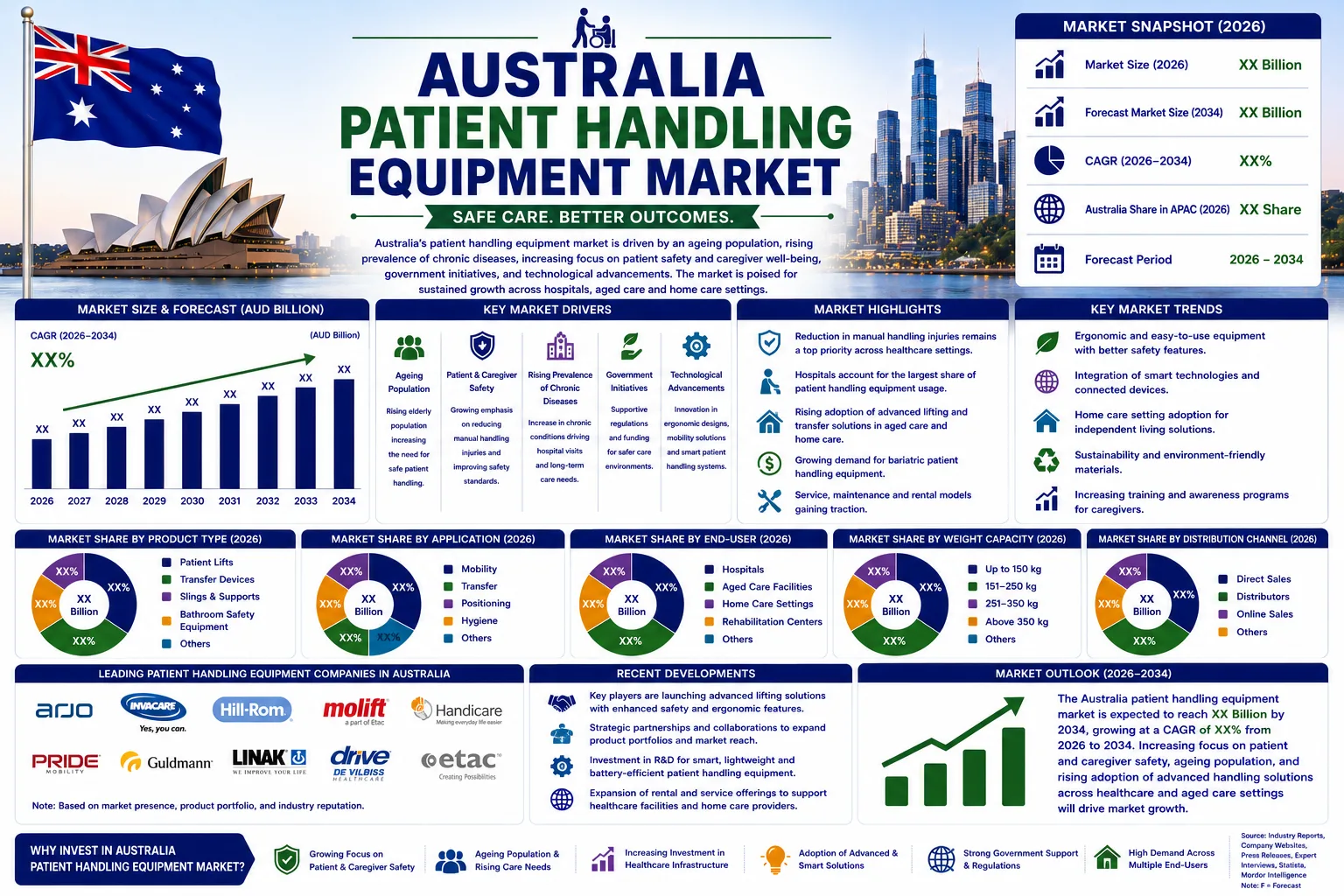
Market Overview
The Australia patient handling equipment market grew from USD 263.87 Million in 2025 to USD 280.17 Million in 2026 and is projected to reach USD 451.29 Million by 2034, growing at a compound annual growth rate of 6.14% from 2026–2034. The market is experiencing robust expansion driven by an aging population requiring specialized mobility assistance and care solutions, increasing focus on safety regulations within healthcare environments, public sector funding aimed at upgrading aged-care facilities, technological innovations in patient transfer systems and smart mobility aids, and continued awareness of caregiver injury prevention.
The market encompasses wheelchairs and scooters, medical beds, mechanical and nonmechanical equipment, ambulatory aids, and other products across bariatric care, fall prevention, critical care, wound care, and other care types, serving hospitals, home care settings, elderly care facilities, and other end users across Australian states and territories.
Read more about the market – https://www.imarcgroup.com/australia-patient-handling-equipment-market
AUSTRALIA PATIENT HANDLING EQUIPMENT MARKET SUMMARY
The Australia patient handling equipment market encompasses mobility assistance, patient transfer, and specialized support systems, integrating multinational medical technology corporations, specialized regional distributors, and healthcare providers across Australian states and territories.
The ecosystem spans global medical device manufacturers, regional distributors and service providers, hospitals and aged care facilities, home care settings, and government health departments funding infrastructure modernization and aged care reform.
By Product, the market is segmented into Wheelchairs and Scooters, Medical Beds (dominating, 28% share in 2025), Mechanical and Nonmechanical Equipment, Ambulatory Aids, and Others. By Type of Care, the market is segmented into Bariatric Care, Fall Prevention, Critical Care (dominating, 25% share), Wound Care, and Others. By End User, the market is segmented into Hospitals (dominating, 46% share), Home Care Settings, Elderly Care Facilities, and Others. By Region, the market serves Australia Capital Territory & New South Wales, Victoria & Tasmania, Queensland, Northern Territory & Southern Australia, and Western Australia.
Key trends shaping the market include integration of smart technology and IoT-enabled solutions, expansion of specialized care facility infrastructure, and rising adoption of ergonomic and automated transfer systems.
PORTER'S FIVE FORCES ANALYSIS – AUSTRALIA PATIENT HANDLING EQUIPMENT MARKET
Competitive Rivalry: Moderate. The market exhibits moderate competitive intensity characterized by established multinational medical technology corporations alongside specialized regional distributors. Major players maintain significant market presence through comprehensive product portfolios and established distribution networks, focusing on product innovation, smart technology integration, ergonomic design improvements, and IoT-enabled monitoring capabilities. Strategic partnerships with healthcare providers, group purchasing organizations, and aged care networks enable market penetration and customer retention. Business implication: Competitors must differentiate through technology integration, ergonomic design, and healthcare provider partnerships while navigating Therapeutic Goods Administration regulatory compliance.
Supplier Power (Medical Technology Manufacturers): High. Critical inputs including smart hospital beds, ceiling-mounted lift systems, and IoT-enabled monitoring technologies are concentrated among a limited number of global medical technology corporations. Advanced equipment such as Hill-Rom's Centrella Smart+ bed platform, Arjo's Maxi Move 5 mobile floor lift, and Stryker's ProCeed hospital bed require specialized manufacturing capability, proprietary technology, and regulatory approval. Business implication: Healthcare providers must build long-term supplier relationships, secure maintenance contracts, and plan for technology upgrades while managing high capital investment requirements.
Buyer Power (Hospitals, Aged Care Facilities, and Home Care): High. Hospitals, aged care facilities, and home care providers exercise purchasing power through procurement decisions, group purchasing arrangements, and budget constraints. Government funding allocations including the 2024-25 Federal Budget AUD 2.2 billion for aged care reforms and the 2025-26 Federal Budget AUD 2.6 Billion for the aged care sector shape procurement cycles. Budget-constrained regional and rural facilities often face challenges allocating sufficient capital for equipment modernization. Business implication: Suppliers must offer financing flexibility, demonstrate ROI through caregiver injury reduction, and align offerings with government funding programmes to win procurement mandates.
Threat of Substitutes: Moderate. Traditional patient handling equipment faces competition from emerging technologies including wearable technology, artificial intelligence, and smart sensors highlighted at the NSW Smart Sensing Network's Ageing Forum in October 2025. Home modification and assistive technology schemes provide alternative approaches to institutional care, with the Support at Home program and new Assistive Technology and Home Modifications Scheme from November 2025 providing funding up to AUD 15,000 for technologies and equipment. However, physical patient handling equipment remains essential for acute care, critical care, and aged care settings. Business implication: Demonstrating superior safety outcomes, ergonomic benefits, and integration with emerging smart technologies is essential to defend market position.
Threat of New Entrants: Moderate. Barriers to entry include Therapeutic Goods Administration medical device registration, established distribution networks, healthcare provider relationships, and substantial capital requirements for product development. However, specialized regional distributors are strengthening their roles, and the growing emphasis on IoT-enabled monitoring and smart technology creates opportunities for technology-focused entrants. Business implication: Incumbents must leverage regulatory credentials, distribution networks, and healthcare relationships while monitoring technology-native entrants targeting smart monitoring and specialized segments.
KEY ASPECTS REQUIRED FOR THE AUSTRALIA PATIENT HANDLING EQUIPMENT MARKET
Market Performance: USD 263.87 Million in 2025, growing to USD 280.17 Million in 2026, and projected to reach USD 451.29 Million by 2034, driven by aging population, safety regulations, government funding, and technological innovation.
Market Outlook: A 6.14% CAGR through 2034 reflects robust growth led by Medical Beds product dominance (28% share), Critical Care type of care leadership (25% share), Hospitals end-user dominance (46% share), and Australia Capital Territory & New South Wales as a leading regional market, with smart technology and IoT integration shaping the forecast.
Growth Drivers: Government investment in healthcare and aged care infrastructure with the 2025-26 Federal Budget investing AUD 2.2 billion in the aged care sector and the AUD 4.3 billion investment in the Support at Home program commencing November 2025; rising aging population with more than 22% of Australians projected to be aged 65 years and above by 2026, up from 16% in 2020; chronic disease prevalence with over 45,785 stroke cases in Australia in 2023; workplace safety regulations with healthcare and social assistance accounting for 19.9% of all serious workers' compensation claims in 2024; technological innovations in smart hospital beds and patient transfer systems; expansion of specialized care facility infrastructure; rising adoption of ergonomic and automated transfer systems.
Competitive Landscape: A market exhibiting moderate competitive intensity with multinational medical technology corporations maintaining strong distribution networks alongside specialized regional distributors, with companies focusing on product innovation, ergonomic design improvements, and strategic partnerships with healthcare providers. Recent developments include Arjo launching the Maxi Move 5 mobile floor lift in April 2025 featuring touch sensor-activated motion assist, Stryker introducing the ProCeed hospital bed in February 2025 with ultra-low profile to minimize fall hazards, and Agiliti Health launching Essentia hospital bed in February 2025 with sophisticated safety features to minimize fall incidents.
Value Chain Analysis: From medical device manufacturing and regulatory approval through regional distribution and sales, healthcare facility procurement, installation and staff training, and ongoing maintenance and technology upgrades, with multinational medical technology corporations capturing the highest value through proprietary technology and comprehensive product portfolios.
Industry Trends: Integration of smart technology and IoT-enabled solutions with sensors for fall detection, pressure ulcer prevention, and patient positioning alerts; expansion of specialized care facility infrastructure with high-dependency and intensive care facilities; rising adoption of ergonomic and automated transfer systems including motorized patient lifts, air-assisted lateral transfer systems, and ceiling-mounted hoist installations; wearable technology and AI integration transforming care delivery under the new Aged Care Act 2024.
Strategic Recommendations: Invest in smart hospital beds and IoT-enabled patient handling systems with fall detection, pressure ulcer prevention, and positioning alerts; develop ergonomic and automated transfer systems including motorized patient lifts and ceiling-mounted hoists reducing caregiver injuries; target critical care and high-dependency units with specialized mobility and transfer solutions; expand home care equipment offerings leveraging the Support at Home program and Assistive Technology and Home Modifications Scheme; develop medical beds with electric operations, integrated monitoring, and pressure ulcer prevention capabilities; pursue hospital redevelopment projects including South Australia's AUD 314 Million Queen Elizabeth Hospital redevelopment and Flinders Medical Centre's AUD 498 Million expansion; address infrastructure limitations in older facilities with space-efficient and retrofit-friendly equipment; develop workforce training programs supporting effective equipment utilization; strengthen presence in Australia Capital Territory & New South Wales; target aged care facilities with equipment aligned with government funding programmes.
Request for Sample Report – https://www.imarcgroup.com/australia-patient-handling-equipment-market/requestsample
MARKET GROWTH DRIVERS
Government Investment in Healthcare and Aged Care Infrastructure
Federal and state government commitments to healthcare infrastructure expansion and aged care reform are creating substantial demand for patient handling equipment across Australia. The 2025-26 Federal Budget invested AUD 2.2 billion in the aged care sector to deliver safe, high-quality care, building on the 2024-25 Budget allocation of AUD 2.2 billion for aged care reforms. The AUD 4.3 billion investment in the Support at Home program, commencing in November 2025, will help approximately 1.4 million people stay in their homes by 2035, driving demand for home-based patient handling solutions. State-level hospital expansion projects, including South Australia's commitment to over 600 new hospital beds and Western Australia's healthcare infrastructure investments, are generating significant equipment procurement opportunities. South Australia's state government announced 150 newly built beds opening in 2024 across multiple hospitals, including the Queen Elizabeth Hospital's AUD 314 million redevelopment and the Flinders Medical Centre's AUD 498 million expansion featuring over AUD 20 million in new major medical equipment. The 2024-25 Commonwealth Budget earmarked AUD 1.7 Billion for hospital expansion and equipment modernization across priority states.
Rising Aging Population and Chronic Disease Prevalence
Australia's demographic transition toward an older population is fundamentally driving patient handling equipment demand as mobility limitations and chronic health conditions increase among elderly individuals. Projections indicate that more than 22% of Australians will be aged 65 years and above by 2026, up from 16% in 2020 and approximately double the 8.3% recorded in the early 1970s. The Stroke Foundation reported over 45,785 stroke cases in Australia in 2023, with projections indicating continued increases that will drive demand for specialized mobility assistance and rehabilitation equipment. Rising prevalence of conditions affecting mobility, including obesity, arthritis, and cardiovascular diseases, is creating sustained requirements for wheelchairs, patient lifts, medical beds, and transfer systems across healthcare settings. Australian hospitals recorded approximately 12.1 million hospitalizations in 2022-23, creating substantial ongoing requirements for bed procurement, replacement, and technology upgrades.
Workplace Safety Regulations and Caregiver Injury Prevention Focus
Growing emphasis on healthcare worker safety and injury prevention is accelerating the adoption of mechanical patient handling equipment that reduces manual lifting requirements. Safe Work Australia's Key Work Health and Safety Statistics 2024 revealed that healthcare and social assistance accounted for 19.9% of all serious workers' compensation claims, the highest among all industries. Body stressing injuries, particularly those caused by manual handling tasks, remain the most significant contributor to serious workplace claims in the healthcare sector. Rising concerns over musculoskeletal injuries have prompted hospitals and aged-care facilities to prioritise safer handling practices, with organisations increasingly adopting mechanical lifting devices, ceiling-mounted hoists, and ergonomic transfer systems to safeguard staff wellbeing and meet occupational health and safety standards. The integration of IoT-enabled monitoring capabilities and ergonomic design principles is transforming equipment functionality.
Integration of Smart Technology and IoT-Enabled Solutions
Australian healthcare facilities are increasingly adopting smart hospital beds and IoT-enabled patient handling systems that provide real-time monitoring capabilities and enhanced operational efficiency. These advanced solutions integrate sensors for fall detection, pressure ulcer prevention, and patient positioning alerts, enabling proactive care interventions. Hill-Rom's Centrella Smart+ bed platform has been deployed across Australian hospitals to help prevent patient falls and pressure injuries while easing caregiver workload. The NSW Smart Sensing Network's Ageing Forum in October 2025 highlighted how wearable technology, artificial intelligence, and smart sensors can transform care delivery under the new Aged Care Act 2024. Technological advancement is accelerating within the medical beds category, with electric beds featuring remote-controlled operations, integrated monitoring systems, and pressure ulcer prevention capabilities gaining widespread adoption. Healthcare authorities have allocated funding under the National Hospital Infrastructure Plan to replace outdated beds across metropolitan and regional hospitals.
Expansion of Specialized Care Facility Infrastructure
The growing emphasis on high-dependency and intensive care facilities is emerging as a significant trend driving patient handling equipment demand. The development of high-end healthcare facilities, along with the addition of dedicated treatment areas and increased bed availability, is amplifying the need for updated patient handling technologies, including lift systems, adjustable beds, and integrated monitoring devices. The Australian Government funded the establishment of a 14-bed High Dependency Unit at the National Referral Hospital in July 2023, exemplifying the ongoing infrastructure investments driving critical care equipment demand. Critical care applications demand specialized patient handling equipment designed for intensive care units, high-dependency units, and emergency departments where patient acuity levels require sophisticated mobility and transfer solutions. Facilities are increasingly investing in advanced lifting systems, specialized transfer devices, and monitoring-integrated beds to enhance patient safety during vulnerable care episodes while protecting clinical staff from handling-related injuries.
AUSTRALIA PATIENT HANDLING EQUIPMENT MARKET SEGMENTATION
Product Insights: Medical beds dominate with a market share of 28% in 2025, representing the largest product segment due to their essential role in acute care hospitals, aged care facilities, and long-term care settings across Australia. The demand encompasses various bed types, including acute care beds, long-term care beds, bariatric beds, and specialty models with advanced positioning and pressure relief capabilities. Australian hospitals recorded approximately 12.1 million hospitalizations in 2022-23, creating substantial ongoing requirements for bed procurement, replacement, and technology upgrades. The segment benefits from regulatory requirements mandating safe patient handling protocols and infection control standards that drive periodic equipment renewal cycles, with electric beds featuring remote-controlled operations, integrated monitoring systems, and pressure ulcer prevention capabilities gaining widespread adoption. Wheelchairs and scooters serve mobility assistance requirements across healthcare settings and home care. Mechanical and nonmechanical equipment includes lifts, hoists, and transfer systems. Ambulatory aids include walkers and canes supporting patient mobility and rehabilitation.
Type of Care Insights: Critical care leads the market with a share of 25% in 2025, demanding specialized patient handling equipment designed for intensive care units, high-dependency units, and emergency departments where patient acuity levels require sophisticated mobility and transfer solutions. These settings necessitate equipment capable of supporting patients with complex medical conditions, multiple monitoring connections, and limited mobility. The segment's prominence reflects the essential nature of patient handling equipment in critical care environments where frequent repositioning, transfers between diagnostic areas, and emergency mobilization requirements create intensive equipment utilization patterns. Facilities are increasingly investing in advanced lifting systems, specialized transfer devices, and monitoring-integrated beds to enhance patient safety during vulnerable care episodes while protecting clinical staff from handling-related injuries, with the integration of smart technology enabling predictive fall detection and automated positioning adjustments transforming critical care equipment capabilities. Bariatric care serves patients requiring specialized equipment for higher weight capacities. Fall prevention addresses safety requirements for at-risk patients. Wound care supports patients requiring specialized positioning and pressure relief.
End User Insights: Hospitals hold the largest share at 46% in 2025, reflecting their position as primary healthcare delivery centers with the highest patient volumes and most frequent transfer and repositioning requirements. In 2023–24, Australian hospitals managed a high volume of emergency department visits, creating continuous patient movement requirements that drive steady investment in equipment such as hoists, slings, hospital beds, and stretchers. The hospital segment benefits from substantial government investment in healthcare infrastructure expansion and modernization, with the 2024-25 Commonwealth Budget earmarking AUD 1.7 Billion for hospital expansion and equipment modernization across priority states. Major hospital redevelopment projects across Australian states, including the Queen Elizabeth Hospital's AUD 314 Million redevelopment in South Australia and Western Australia's AUD 24 Million investment in Joondalup Health Campus to deliver 60 additional beds, are creating significant procurement opportunities. Home care settings benefit from the Support at Home program and Assistive Technology and Home Modifications Scheme providing funding up to AUD 15,000 for technologies and equipment including walkers and wheelchairs. Elderly care facilities serve the growing aged population requiring mobility assistance and specialized care.
Region Insights: The patient handling equipment market in ACT and New South Wales is driven by the strong presence of advanced healthcare facilities, high patient admission rates, and rapid adoption of safe patient mobility practices, with increasing workplace safety regulations, an ageing population, and investments in hospital infrastructure upgrades accelerating demand for lifts, transfer aids, and mobility devices, and the region's focus on reducing caregiver injuries further strengthening equipment adoption across public and private hospitals. Victoria and Tasmania benefit from rising chronic disease prevalence, growing aged-care populations, and expanding home healthcare services, with government-funded healthcare modernisation programs and emphasis on patient safety boosting procurement of hoists, slings, and transfer systems, and increasing training initiatives for caregivers and the region's strong network of rehabilitation centres contributing to consistent market demand. Queensland's demand is supported by rapid population growth, expanding healthcare infrastructure, and rising hospital admissions across metropolitan and regional areas, with the state's strong aged-care sector and high incidence of mobility-related conditions prompting greater investment in lifts, beds, and transfer devices. In the Northern Territory and South Australia, demand is influenced by the need to support remote healthcare facilities and ageing populations, with expanding regional hospitals, increasing disability-care services, and government initiatives to improve rural healthcare access driving procurement of essential lifting and transfer equipment. Western Australia's market growth is driven by strong investments in hospital expansions, a rising elderly population, and increasing demand for specialised rehabilitation services, with the region's vast geography encouraging greater adoption of advanced patient handling equipment to support remote and rural facilities.
COMPETITIVE LANDSCAPE
The market research report has also provided a comprehensive analysis of the competitive landscape. Competitive analysis such as market structure, key player positioning, top winning strategies, competitive dashboard, and company evaluation quadrant has been covered in the report. Also, detailed profiles of all major companies have been provided.
The Australia patient handling equipment competitive landscape exhibits moderate competitive intensity characterized by the presence of established multinational medical technology corporations alongside specialized regional distributors. Several major players maintain significant market presence through comprehensive product portfolios and established distribution networks. Companies are focusing on product innovation, emphasizing smart technology integration, ergonomic design improvements, and IoT-enabled monitoring capabilities. Strategic partnerships with healthcare providers, group purchasing organizations, and aged care networks are enabling market penetration and customer retention. The competitive landscape is also shaped by regulatory compliance requirements, with the Therapeutic Goods Administration overseeing medical device registrations and ensuring product safety standards. Recent developments include Arjo launching the Maxi Move 5 mobile floor lift in April 2025 featuring touch sensor-activated motion assist and advanced positioning capabilities designed to minimize caregiver effort and enhance patient transfer safety, Stryker introducing the ProCeed hospital bed in February 2025 offering an ultra-low profile to help minimize fall hazards with improved maneuverability through a central fifth wheel, and Agiliti Health launching Essentia hospital bed in February 2025 equipped with sophisticated safety features to minimize fall incidents and enhance caregiver productivity.
Investment opportunities exist in smart hospital beds and IoT-enabled patient handling systems, ergonomic and automated transfer systems, critical care and high-dependency equipment, home care equipment leveraging government funding programmes, and workforce training and adoption support.
REGIONAL ANALYSIS
The patient handling equipment market in ACT and New South Wales is driven by the strong presence of advanced healthcare facilities, high patient admission rates, and rapid adoption of safe patient mobility practices. Increasing workplace safety regulations, an ageing population, and investments in hospital infrastructure upgrades are accelerating demand for lifts, transfer aids, and mobility devices, with the region's focus on reducing caregiver injuries further strengthening equipment adoption across public and private hospitals.
In Victoria and Tasmania, rising chronic disease prevalence, growing aged-care populations, and expanding home healthcare services are key growth drivers for patient handling equipment. Government-funded healthcare modernisation programs and emphasis on patient safety are boosting procurement of hoists, slings, and transfer systems, with increasing training initiatives for caregivers and the region's strong network of rehabilitation centres contributing to consistent market demand for advanced mobility and lifting solutions.
Queensland's demand for patient handling equipment is supported by rapid population growth, expanding healthcare infrastructure, and rising hospital admissions across metropolitan and regional areas. The state's strong aged-care sector and high incidence of mobility-related conditions are prompting greater investment in lifts, beds, and transfer devices, with growing workplace safety standards and increased focus on injury prevention for nurses and caregivers further stimulating adoption of ergonomic patient handling solutions.
In the Northern Territory and South Australia, demand is influenced by the need to support remote healthcare facilities and ageing populations. Expanding regional hospitals, increasing disability-care services, and government initiatives to improve rural healthcare access are driving procurement of essential lifting and transfer equipment, with rising awareness of safe patient handling protocols and the need to reduce manual handling injuries contributing to steady market growth.
Western Australia's market growth is driven by strong investments in hospital expansions, a rising elderly population, and increasing demand for specialised rehabilitation services. The region's vast geography encourages greater adoption of advanced patient handling equipment to support remote and rural facilities, with emphasis on improving caregiver safety alongside growing home-care and assisted-living services accelerating demand for hoists, slings, adjustable beds, and related mobility-assistance devices.
RECENT INDUSTRY DEVELOPMENTS
2025–2026 Activity: The Australia patient handling equipment market grew from USD 263.87 Million in 2025 to USD 280.17 Million in 2026, on track toward USD 451.29 Million by 2034 at a CAGR of 6.14%, supported by government investment, aging population, and smart technology adoption.
April 2025: Arjo launched the Maxi Move 5, a next-generation mobile floor lift featuring touch sensor-activated motion assist and advanced positioning capabilities. The device is designed to minimize caregiver effort and enhance patient transfer safety through intuitive controls and improved ergonomic design.
February 2025: Stryker introduced the ProCeed hospital bed to global markets, offering an ultra-low profile to help minimize fall hazards, improved maneuverability through a central fifth wheel, and customizable headboard options. The bed is designed for durability and ease of use, supporting patient safety and staff efficiency across acute care settings.
February 2025: Agiliti Health, Inc. launched Essentia, a next-generation hospital bed built to improve patient protection and promote faster mobility. Equipped with sophisticated safety features and user-friendly controls, the bed aims to minimize fall incidents and enhance caregiver productivity across multiple clinical environments.
November 2025: The Support at Home program and new Assistive Technology and Home Modifications Scheme commenced, providing funding up to AUD 15,000 for technologies and equipment, including walkers and wheelchairs, expanding accessibility to patient handling solutions.
FREQUENTLY ASKED QUESTIONS
Q1: What is the current size of the Australia patient handling equipment market?
A: The market grew from USD 263.87 Million in 2025 to USD 280.17 Million in 2026 and is projected to reach USD 451.29 Million by 2034, growing at a compound annual growth rate of 6.14% from 2026–2034.
Q2: What are the key drivers of the Australia patient handling equipment market?
A: The market is driven by: (i) government investment in healthcare and aged care infrastructure with the 2025-26 Federal Budget investing AUD 2.2 billion and the AUD 4.3 billion Support at Home program; (ii) rising aging population with more than 22% of Australians projected to be aged 65 years and above by 2026; (iii) chronic disease prevalence with over 45,785 stroke cases in 2023; (iv) workplace safety regulations with healthcare and social assistance accounting for 19.9% of all serious workers' compensation claims; (v) technological innovations in smart hospital beds and patient transfer systems; (vi) expansion of specialized care facility infrastructure; and (vii) rising adoption of ergonomic and automated transfer systems.
Q3: What are the major segments in the Australia patient handling equipment market?
A: Major segments include Product (Medical Beds dominating at 28%, Wheelchairs and Scooters, Mechanical and Nonmechanical Equipment, Ambulatory Aids, Others), Type of Care (Critical Care dominating at 25%, Bariatric Care, Fall Prevention, Wound Care, Others), End User (Hospitals dominating at 46%, Home Care Settings, Elderly Care Facilities, Others), and Region (Australia Capital Territory & New South Wales, Victoria & Tasmania, Queensland, Northern Territory & Southern Australia, Western Australia). Medical beds dominate driven by extensive demand across acute care hospitals and aged care facilities, while critical care leads driven by high-dependency requirements of intensive care units.
Q4: Which region leads the Australia patient handling equipment market?
A: ACT and New South Wales are driven by the strong presence of advanced healthcare facilities, high patient admission rates, and rapid adoption of safe patient mobility practices, with increasing workplace safety regulations, an ageing population, and investments in hospital infrastructure upgrades accelerating demand. Victoria and Tasmania benefit from rising chronic disease prevalence and expanding home healthcare services, Queensland's demand is supported by rapid population growth and expanding healthcare infrastructure, and Western Australia's growth is driven by strong investments in hospital expansions and a rising elderly population.
Q5: What are the challenges facing the Australia patient handling equipment market?
A: Key challenges include high capital investment requirements with substantial upfront costs associated with advanced patient handling equipment, particularly ceiling-mounted lift systems and smart hospital beds, presenting financial barriers for smaller healthcare facilities and aged care providers; workforce training and adoption challenges with comprehensive staff training programs representing additional operational investments, and research suggesting current patient handling training approaches may not effectively prevent injuries; and infrastructure limitations in existing facilities with many older healthcare buildings not designed to accommodate modern patient handling infrastructure such as ceiling-mounted lift systems, requiring expensive and disruptive structural modifications.
Q6: What is the outlook for the Australia patient handling equipment market?
A: The market outlook remains positive as healthcare infrastructure investments accelerate and demographic trends drive sustained demand for mobility assistance solutions. Government commitment to aged care reform, evidenced by the 2025-26 Federal Budget investing AUD 2.6 Billion in the aged care sector, will continue supporting equipment modernization initiatives. The introduction of the Support at Home program and new Assistive Technology and Home Modifications Scheme from November 2025, providing funding up to AUD 15,000 for technologies and equipment including walkers and wheelchairs, will expand accessibility to patient handling solutions. The market is projected to grow at a 6.14% CAGR through 2034, reaching USD 451.29 Million.
Q7: Who are the key players in the Australia patient handling equipment market?
A: The market exhibits moderate competitive intensity characterized by the presence of established multinational medical technology corporations alongside specialized regional distributors. Several major players maintain significant market presence through comprehensive product portfolios and established distribution networks, focusing on product innovation emphasizing smart technology integration, ergonomic design improvements, and IoT-enabled monitoring capabilities. Strategic partnerships with healthcare providers, group purchasing organizations, and aged care networks enable market penetration and customer retention. Recent developments include Arjo launching the Maxi Move 5 mobile floor lift in April 2025, Stryker introducing the ProCeed hospital bed in February 2025, and Agiliti Health launching Essentia hospital bed in February 2025. The competitive landscape is shaped by regulatory compliance requirements, with the Therapeutic Goods Administration overseeing medical device registrations and ensuring product safety standards.
Note: If you need any specific information that is not covered currently within the scope of the report, we will provide the same as a part of customization.
Report Format, Delivery, and Customization Details
Report Format Mode: PPT, PDF, and Excel
Report Delivery Mode: Online Delivery, Physical Delivery
Report Delivery Time: Report Delivered Over Email within 24 to 48 hours. If requested by the client, a physical copy will be delivered within three to ten days.
Report Confirmation Mode: Yes via Email
Report Customization Mode: Yes via Email / Call
Report Table of Content: Yes
Report List of Figures: Yes
Report Methodology Mode: Yes
Request For Sample Report: Yes