
Market Overview
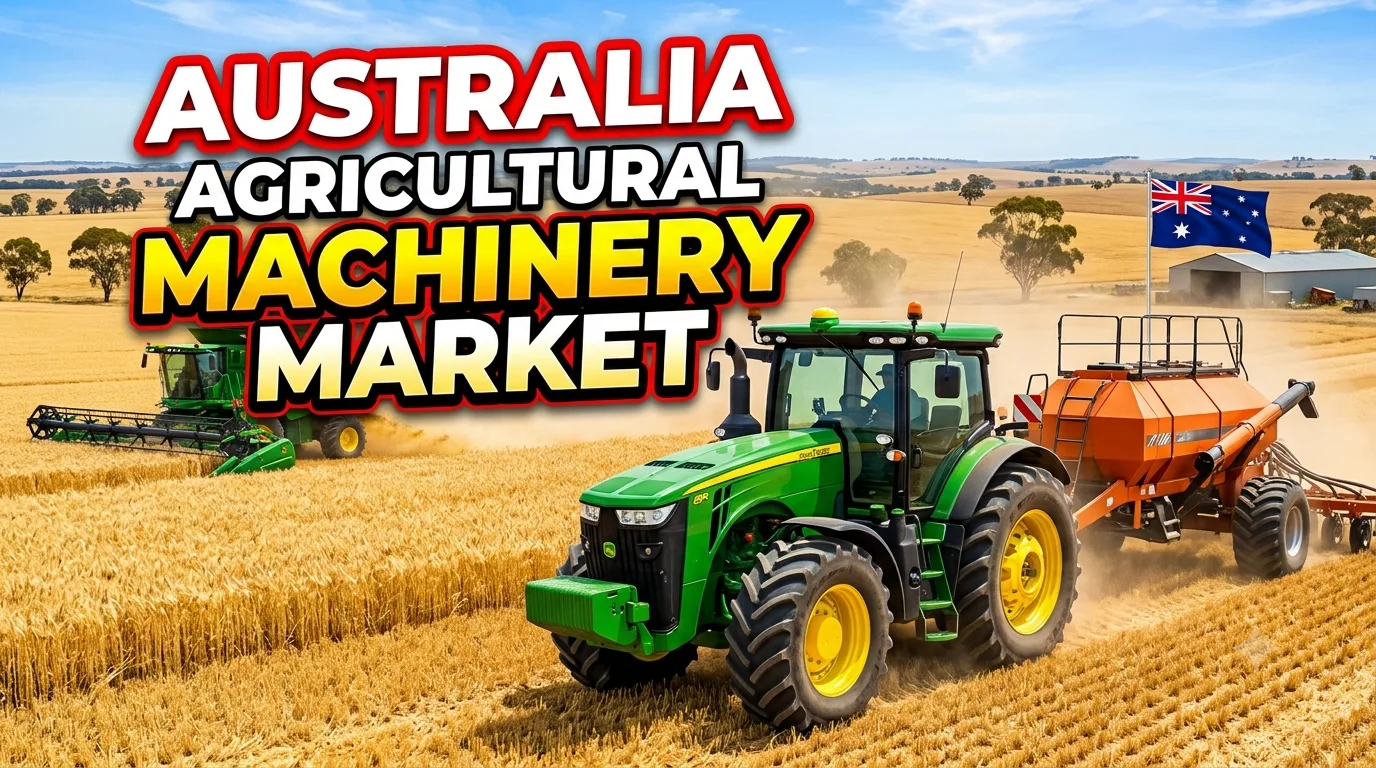
The Australia agricultural machinery market grew from USD 4.3 Billion in 2025 to USD 4.5 Billion in 2026. Looking forward, the market is expected to reach USD 6.5 Billion by 2034, exhibiting a growth rate (CAGR) of 4.77% during 2026–2034. The market is propelled by increasing demand for food and agricultural products, growing emphasis on sustainable farming practices, government policies and financial incentives, and rising adoption of smart technologies such as GPS guidance systems.
The market encompasses tractors, ploughing and cultivating machinery (ploughs, harrows, cultivators and tillers), planting machinery (seed drills, planters, spreaders), harvesting machinery (mowers, balers), haying machinery, and irrigation machinery across Australian states and territories.
AUSTRALIA AGRICULTURAL MACHINERY MARKET SUMMARY
The Australia agricultural machinery market encompasses tractors, tillage, planting, harvesting, haying, and irrigation equipment, integrating global machinery manufacturers, regional distributors and dealers, agricultural research organizations, and farmers across Australian states and territories.
The ecosystem spans global agricultural machinery manufacturers, regional distributors and dealership networks, agricultural research and development organizations, government agricultural agencies, and farmers across broadacre cropping, livestock, and horticultural operations.
By Product Type, the market is segmented into Tractors, Ploughing and Cultivating Machinery (Ploughs, Harrows, Cultivators and Tillers, Others), Planting Machinery (Seed Drills, Planters, Spreaders, Others), Harvesting Machinery (Mowers, Balers, Others), Haying Machinery, and Irrigation Machinery. By Region, the market serves Australia Capital Territory & New South Wales, Victoria & Tasmania, Queensland, Northern Territory & Southern Australia, and Western Australia.
Key trends shaping the market include government policies and monetary benefits, rising demand for food, and shift toward sustainable farming.
PORTER'S FIVE FORCES ANALYSIS – AUSTRALIA AGRICULTURAL MACHINERY MARKET
Competitive Rivalry: High. The market features competition among global agricultural machinery manufacturers including John Deere, which announced significant improvements to its popular 6M tractor series for Model Year 2025, expanding the range to thirteen models with increased speed and power capabilities, alongside regional distributors and dealership networks competing across product types and price segments. Competition centres on technological sophistication, precision agriculture capabilities, after-sales service, and financing options. Business implication: Manufacturers must differentiate through precision agriculture technology, telematics, and dealership service networks while building long-term relationships with farmers.
Supplier Power (Global Machinery Manufacturers): High. Critical inputs including tractors equipped with telematics, image sensors, and automated adjustments, precision agriculture technologies including GPS guidance systems, autonomous steering, and variable rate application systems are concentrated among a limited number of global manufacturers. Advanced equipment requires significant capital investment, specialised manufacturing capability, and comprehensive dealer service networks. Business implication: Farmers must build long-term dealer relationships, secure maintenance contracts, and plan for technology upgrades while managing capital investment requirements.
Buyer Power (Farmers): High. Australian farmers with an average farm size of approximately 500 hectares exercise purchasing power through equipment selection, technology requirements, and financing arrangements. Favorable weather conditions coupled with improved farming practices have resulted in higher gross values of agricultural production, creating stronger financial capacity for machinery procurement. Government subsidies, concessional loans, and tax benefits including accelerated depreciation reduce financial barriers and influence purchasing decisions. Business implication: Manufacturers must offer financing flexibility, demonstrate productivity gains, and align offerings with government incentive programmes to win farmer procurement decisions.
Threat of Substitutes: Moderate. Traditional machinery faces competition from contract farming services, equipment leasing and sharing models, and precision agriculture technologies that optimise existing equipment utilisation. Conservation tillage, precise irrigation, and targeted application of inputs substitute for intensive machinery use. However, mechanisation remains essential for large-scale broadacre farming operations across Australia's vast geography. Business implication: Demonstrating superior productivity, precision, and sustainability relative to alternative models is essential to defend market position.
Threat of New Entrants: Moderate. Barriers to entry include substantial capital requirements for manufacturing, dealer network establishment, and technology development for precision agriculture and autonomous systems. However, the growing adoption of smart technologies including GPS guidance systems and telematics creates opportunities for technology-focused entrants, while government research and development investment supports innovation through cooperation between government, research organizations, and manufacturers. Business implication: Incumbents must leverage dealer networks, technology portfolios, and brand heritage while monitoring technology-native entrants targeting precision agriculture and autonomous farming segments.
KEY ASPECTS REQUIRED FOR THE AUSTRALIA AGRICULTURAL MACHINERY MARKET
Market Performance: USD 4.3 Billion in 2025, growing to USD 4.5 Billion in 2026, and projected to reach USD 6.5 Billion by 2034, driven by food demand, sustainable farming practices, government incentives, and smart technology adoption.
Market Outlook: A 4.77% CAGR through 2034 reflects steady growth led by tractors as a leading product type and Australia Capital Territory & New South Wales as a significant regional market, with precision agriculture and automation shaping the forecast.
Growth Drivers: Increasing demand for food and agricultural products with a 2.1% annual increase in indicative food production from $65 billion to $117 billion between 1988-89 and 2016-17; growing emphasis on sustainable farming practices with 85% of broadacre cropping farms keeping stubble, 68% minimizing tillage, and 61% of livestock farms using rotational grazing; government policies and financial incentives including subsidies, concessional loans, tax benefits, and accelerated depreciation; rising adoption of smart technologies including GPS guidance systems, autonomous steering, and variable rate application; increasing farm mechanization with average farm size of approximately 500 hectares; rising agricultural production and export requirements; federal agricultural research and development investment; On Farm Connectivity Program with an additional $20 million allocated for Round 3 in 2025; Queensland's Rural Economic Development grants; Regional Investment Corporation concessional loans.
Competitive Landscape: A market featuring global agricultural machinery manufacturers and regional distributors, with recent developments including John Deere announcing significant improvements to its popular 6M tractor series for Model Year 2025 in August 2024, expanding the range to thirteen models with increased speed and power capabilities, with four models exceeding 200 horsepower with 50 kph transmission systems addressing growing demand for high-performance agricultural machinery in Australia's diverse farming operations.
Value Chain Analysis: From machinery manufacturing and technology development through regional distribution and dealership networks, farmer procurement and financing, deployment across broadacre cropping and livestock operations, and after-sales service and parts support, with global manufacturers capturing the highest value through precision agriculture technology and comprehensive dealer networks.
Industry Trends: Precision farming adoption with GPS guidance systems and variable rate application; automation and robotics including autonomous steering; sustainable and energy-efficient equipment demand supporting conservation tillage and precise irrigation; increasing use of telematics and image sensors; rising preference for advanced tractors, harvesters, and smart irrigation systems; government support through research and development investment and connectivity programmes.
Strategic Recommendations: Invest in precision agriculture technologies including GPS guidance systems, autonomous steering, and variable rate application systems; develop tractors equipped with telematics, image sensors, and automated adjustments; expand high-performance tractor offerings with increased speed and power capabilities responding to diverse farming operations; develop autonomous farming and robotics capabilities; pursue sustainable and energy-efficient equipment supporting conservation tillage and precise irrigation; leverage government incentives including subsidies, concessional loans, and accelerated depreciation in sales strategies; target On Farm Connectivity Program funding for ag-tech solutions; expand dealership service networks across regional areas; develop smart irrigation systems optimising water use; strengthen presence in Australia Capital Territory & New South Wales; pursue Queensland Rural Economic Development grants and Regional Investment Corporation loans for customer financing; develop connected equipment capabilities supporting soil quality monitoring and livestock management automation.
Request for Sample Report – https://www.imarcgroup.com/australia-agricultural-machinery-market/requestsample
MARKET GROWTH DRIVERS
Government Policies and Monetary Benefits
Governmental policies and monetary benefits serve as major drivers for the agricultural machinery market in Australia. The Australian government has given various policies and subsidies to uplift its agricultural sector, thus encouraging farmers to use modern agriculture machinery. Supportive grants and other soft loans are frequently given toward new investment in machinery for the growers, especially equipment applied to increase productivity and environmental sustainability. These efforts make the accessibility of advanced machinery easier and encourage the modernization of the farming sector. Besides those, tax benefits and agricultural investment write-offs bring extra financial easing to the farmers. Thus, government support is opening up a stronger market as it lessens the financial burden of farming and opens more avenues toward the acceptance of newer, efficient technologies.
Rising Demand for Food
The increasing demand for food and agricultural products is another key factor driving the growth of the agricultural machinery market in Australia. According to the Australian Department of Agriculture, Fishery, and Forestry, a 2.1% annual increase in indicative food production occurred from $65 billion to $117 billion, a 2.3% annual increase in household food consumption expenditures occurred from $49 billion to $92 billion, and a 1.5% annual increase in net food exports occurred from $16 billion to $25 billion between 1988-89 and 2016-17 in Australia. As the population continues to grow, there is a heightened need for food security, which puts pressure on the agricultural sector to enhance productivity. Australian farmers are thus compelled to adopt more efficient farming practices and invest in machinery that can help maximize output. The export of agricultural products from Australia is a significant contributor to the economy, requiring farmers to maintain high standards and meet international demand.
Shift Toward Sustainable Farming
A growing emphasis on sustainable farming practices is also driving the market share. As environmental concerns become more pronounced, there is a strong push toward reducing the ecological footprint of farming operations. According to the Australian Department of Agriculture, Fishery, and Forestry, many farms that practice broadacre cropping keep their stubble (85% of farms), minimize tillage (68% of farms), and maximize the use of fertilizer and herbicides while reducing their reliance on them (65% of farms). Besides, numerous livestock farms use a range of grazing management techniques, including rotational, trip, or cell grazing (61% of farms) and establishing a requirement for long-term groundcover (61% of farms). Modern agricultural machinery plays a crucial role in this transition by enabling more efficient use of resources such as water, fertilizers, and pesticides. Equipment that supports conservation tillage, precise irrigation, and targeted application of inputs helps minimize environmental impact while maintaining or enhancing productivity.
Increasing Farm Mechanization and Technological Advancement
The escalating adoption of farm mechanization across Australia's agricultural sector serves as a primary catalyst for machinery demand. With an average farm size of approximately 500 hectares, Australian farmers are increasingly investing in sophisticated equipment to optimize operational efficiency and reduce labor dependency. The integration of precision agriculture technologies, including GPS guidance systems, autonomous steering, and variable rate application systems, is transforming traditional farming practices. Modern tractors equipped with advanced features such as telematics, image sensors, and automated adjustments are becoming essential tools for contemporary agricultural operations. This technological revolution enables farmers to maximize productivity while minimizing resource waste, driving sustained investment in cutting-edge agricultural machinery throughout the country.
Rising Agricultural Production and Export Requirements
Australia's significant agricultural production growth, particularly in wheat, canola, and beef cattle sectors, is fueling substantial machinery investments. The country's role as a major agricultural exporter necessitates consistent production quality and efficiency to maintain competitive advantages in global markets. Favorable weather conditions coupled with improved farming practices have resulted in higher gross values of agricultural production, creating stronger financial capacity for machinery procurement. The export-oriented nature of Australian agriculture requires farmers to adopt advanced harvesting, processing, and handling equipment that meets stringent international standards. These commercial imperatives drive continuous modernization of agricultural machinery fleets to ensure optimal product quality and operational reliability.
Technology Integration and Connectivity Programs
The Albanese Government's expansion of the On Farm Connectivity Program represents a significant initiative supporting agricultural technology integration, with an additional $20 million allocated for Round 3 in 2025. This program specifically targets ag-tech connectivity solutions that enable farmers to optimize soil quality monitoring, automate livestock management systems, and safeguard farming equipment through advanced monitoring technologies. The initiative demonstrates government commitment to bridging digital divides in rural areas while promoting smart farming practices that require sophisticated agricultural machinery. These connectivity-focused programs create essential infrastructure foundations that support the deployment and operation of modern, connected agricultural equipment. Various state governments also implement targeted programs to accelerate agricultural mechanization, with Queensland's Rural Economic Development grants providing co-contribution funding and the Regional Investment Corporation offering concessional loans specifically designed to help farmers invest in productivity-enhancing machinery and infrastructure.
AUSTRALIA AGRICULTURAL MACHINERY MARKET SEGMENTATION
Product Type Insights: Tractors represent a significant product type segment, driven by demand for high-performance models equipped with telematics, image sensors, and automated adjustments, with John Deere expanding its 6M tractor series to thirteen models including four exceeding 200 horsepower with 50 kph transmission systems. Ploughing and cultivating machinery including ploughs, harrows, cultivators, and tillers serves tillage operations, with conservation tillage practices adopted by 68% of broadacre cropping farms driving demand for minimum-tillage equipment. Planting machinery including seed drills, planters, and spreaders serves precision seeding and fertilization operations, with variable rate application systems enabling targeted input placement. Harvesting machinery including mowers and balers serves crop harvesting operations, with advanced equipment meeting stringent international quality standards for export markets. Haying machinery serves hay and fodder production for livestock operations. Irrigation machinery serves water-efficient irrigation operations, with precise irrigation equipment minimizing water use while maintaining productivity.
Region Insights: Australia Capital Territory & New South Wales represent a significant regional market, with broadacre cropping and livestock operations driving demand for tractors, tillage equipment, and harvesting machinery. Victoria & Tasmania benefit from diverse agricultural production including dairy, horticulture, and cropping, with sustainable farming practices driving demand for precision agriculture equipment. Queensland captures growth from cattle grazing and cropping operations, with Rural Economic Development grants supporting mechanization investment. Northern Territory & Southern Australia represent growing markets with large-scale broadacre operations requiring high-capacity machinery and irrigation equipment. Western Australia is anchored by wheat and canola production, driving demand for high-performance tractors and harvesting machinery across vast farming areas.
COMPETITIVE LANDSCAPE
The market research report has also provided a comprehensive analysis of the competitive landscape. Competitive analysis such as market structure, key player positioning, top winning strategies, competitive dashboard, and company evaluation quadrant has been covered in the report. Also, detailed profiles of all major companies have been provided.
The Australia agricultural machinery competitive landscape features global agricultural machinery manufacturers and regional distributors competing across product types and price segments, with competition centring on technological sophistication, precision agriculture capabilities, after-sales service, and financing options. In August 2024, John Deere announced significant improvements to its popular 6M tractor series for Model Year 2025, expanding the range to include thirteen models with increased speed and power capabilities, with the enhanced lineup now featuring four models exceeding 200 horsepower with 50 kph transmission systems, addressing the growing demand for high-performance agricultural machinery in Australia's diverse farming operations. Manufacturers are investing in precision agriculture technologies including GPS guidance systems, autonomous steering, and variable rate application systems, with modern tractors equipped with telematics, image sensors, and automated adjustments becoming essential tools.
Investment opportunities exist in precision agriculture technologies, autonomous farming and robotics, smart irrigation systems, connected equipment supporting soil quality monitoring and livestock management automation, and sustainable and energy-efficient equipment.
REGIONAL ANALYSIS
Australia Capital Territory & New South Wales represent a significant regional market, with broadacre cropping and livestock operations driving demand for tractors, tillage equipment, and harvesting machinery. The region benefits from proximity to agricultural research organizations and government agricultural agencies supporting technology adoption, with sustainable farming practices including stubble retention and minimum tillage driving demand for conservation-focused equipment.
Victoria & Tasmania benefit from diverse agricultural production including dairy, horticulture, and cropping, with sustainable farming practices and precision agriculture adoption driving demand for advanced machinery. The region's emphasis on environmental sustainability supports demand for equipment enabling efficient resource use and reduced ecological footprint.
Queensland captures growth from cattle grazing and cropping operations, with Rural Economic Development grants providing co-contribution funding to support primary producers in adopting modern farming equipment and technologies. The state's diverse agricultural landscape, from tropical to temperate zones, requires versatile machinery capable of handling varied farming systems.
Northern Territory & Southern Australia represent growing markets with large-scale broadacre operations requiring high-capacity machinery and irrigation equipment. Government initiatives to improve rural agricultural access and productivity support machinery investment across these regions.
Western Australia is anchored by wheat and canola production, with the state's vast farming areas driving demand for high-performance tractors and harvesting machinery. Favorable weather conditions and improved farming practices have resulted in higher gross values of agricultural production, creating stronger financial capacity for machinery procurement.
RECENT INDUSTRY DEVELOPMENTS
2025–2026 Activity: The Australia agricultural machinery market grew from USD 4.3 Billion in 2025 to USD 4.5 Billion in 2026, on track toward USD 6.5 Billion by 2034 at a CAGR of 4.77%, supported by government incentives, food demand, and smart technology adoption.
2025: The Albanese Government expanded the On Farm Connectivity Program with an additional $20 million allocated for Round 3, targeting ag-tech connectivity solutions that enable farmers to optimize soil quality monitoring, automate livestock management systems, and safeguard farming equipment through advanced monitoring technologies.
August 2024: John Deere announced significant improvements to its popular 6M tractor series for Model Year 2025, expanding the range to include thirteen models with increased speed and power capabilities. The enhanced lineup now features four models exceeding 200 horsepower with 50 kph transmission systems, addressing the growing demand for high-performance agricultural machinery in Australia's diverse farming operations.
FREQUENTLY ASKED QUESTIONS
Q1: What is the current size of the Australia agricultural machinery market?
A: The market grew from USD 4.3 Billion in 2025 to USD 4.5 Billion in 2026 and is projected to reach USD 6.5 Billion by 2034, exhibiting a CAGR of 4.77% during 2026–2034.
Q2: What are the key drivers of the Australia agricultural machinery market?
A: The market is driven by: (i) increasing demand for food and agricultural products with a 2.1% annual increase in indicative food production; (ii) growing emphasis on sustainable farming practices with 85% of broadacre cropping farms keeping stubble and 68% minimizing tillage; (iii) government policies and financial incentives including subsidies, concessional loans, tax benefits, and accelerated depreciation; (iv) rising adoption of smart technologies including GPS guidance systems, autonomous steering, and variable rate application; (v) increasing farm mechanization with average farm size of approximately 500 hectares; (vi) rising agricultural production and export requirements; and (vii) federal agricultural research and development investment, On Farm Connectivity Program, Queensland Rural Economic Development grants, and Regional Investment Corporation concessional loans.
Q3: What are the major segments in the Australia agricultural machinery market?
A: Major segments include Product Type (Tractors, Ploughing and Cultivating Machinery including Ploughs, Harrows, Cultivators and Tillers, Others; Planting Machinery including Seed Drills, Planters, Spreaders, Others; Harvesting Machinery including Mowers, Balers, Others; Haying Machinery; Irrigation Machinery) and Region (Australia Capital Territory & New South Wales, Victoria & Tasmania, Queensland, Northern Territory & Southern Australia, Western Australia). Tractors represent a significant product type driven by demand for high-performance models with precision agriculture capabilities.
Q4: Which region leads the Australia agricultural machinery market?
A: Australia Capital Territory & New South Wales represent a significant regional market, with broadacre cropping and livestock operations driving demand for tractors, tillage equipment, and harvesting machinery. Victoria & Tasmania benefit from diverse agricultural production including dairy and horticulture, Queensland captures cattle grazing and cropping growth with Rural Economic Development grants, and Western Australia is anchored by wheat and canola production driving demand for high-performance tractors and harvesting machinery.
Q5: What are the challenges facing the Australia agricultural machinery market?
A: Key challenges include high capital investment requirements for advanced machinery with precision agriculture technologies, the need for continuous investment in technology upgrades to maintain competitiveness, dependency on favorable weather conditions affecting farm incomes and machinery purchasing capacity, and the need for dealer service networks and parts availability across Australia's vast geography.
Q6: What is the outlook for the Australia agricultural machinery market?
A: The market is projected to grow at a 4.77% CAGR through 2034, reaching USD 6.5 Billion, driven by expanding export opportunities, rising farm mechanization, supportive government subsidies, increased farmer incomes, strong research and development investments, evolving agribusiness models, demand for productivity enhancement, and modernization of post-harvest management practices. Key trends include precision farming adoption, automation and robotics, sustainable and energy-efficient equipment demand, government support, increasing use of telematics, and rising preference for advanced tractors, harvesters, and smart irrigation systems.
Q7: Who are the key players in the Australia agricultural machinery market?
A: The market features global agricultural machinery manufacturers and regional distributors competing across product types and price segments, with competition centring on technological sophistication, precision agriculture capabilities, after-sales service, and financing options. In August 2024, John Deere announced significant improvements to its popular 6M tractor series for Model Year 2025, expanding the range to include thirteen models with increased speed and power capabilities, with four models exceeding 200 horsepower with 50 kph transmission systems addressing growing demand for high-performance agricultural machinery in Australia's diverse farming operations.
Note: If you need any specific information that is not covered currently within the scope of the report, we will provide the same as a part of customization.
Report Format, Delivery, and Customization Details
Report Format Mode: PPT, PDF, and Excel
Report Delivery Mode: Online Delivery, Physical Delivery
Report Delivery Time: Report Delivered Over Email within 24 to 48 hours. If requested by the client, a physical copy will be delivered within three to ten days.
Report Confirmation Mode: Yes via Email
Report Customization Mode: Yes via Email / Call
Report Table of Content: Yes
Report List of Figures: Yes
Report Methodology Mode: Yes
Request For Sample Report: Yes