Market Overview
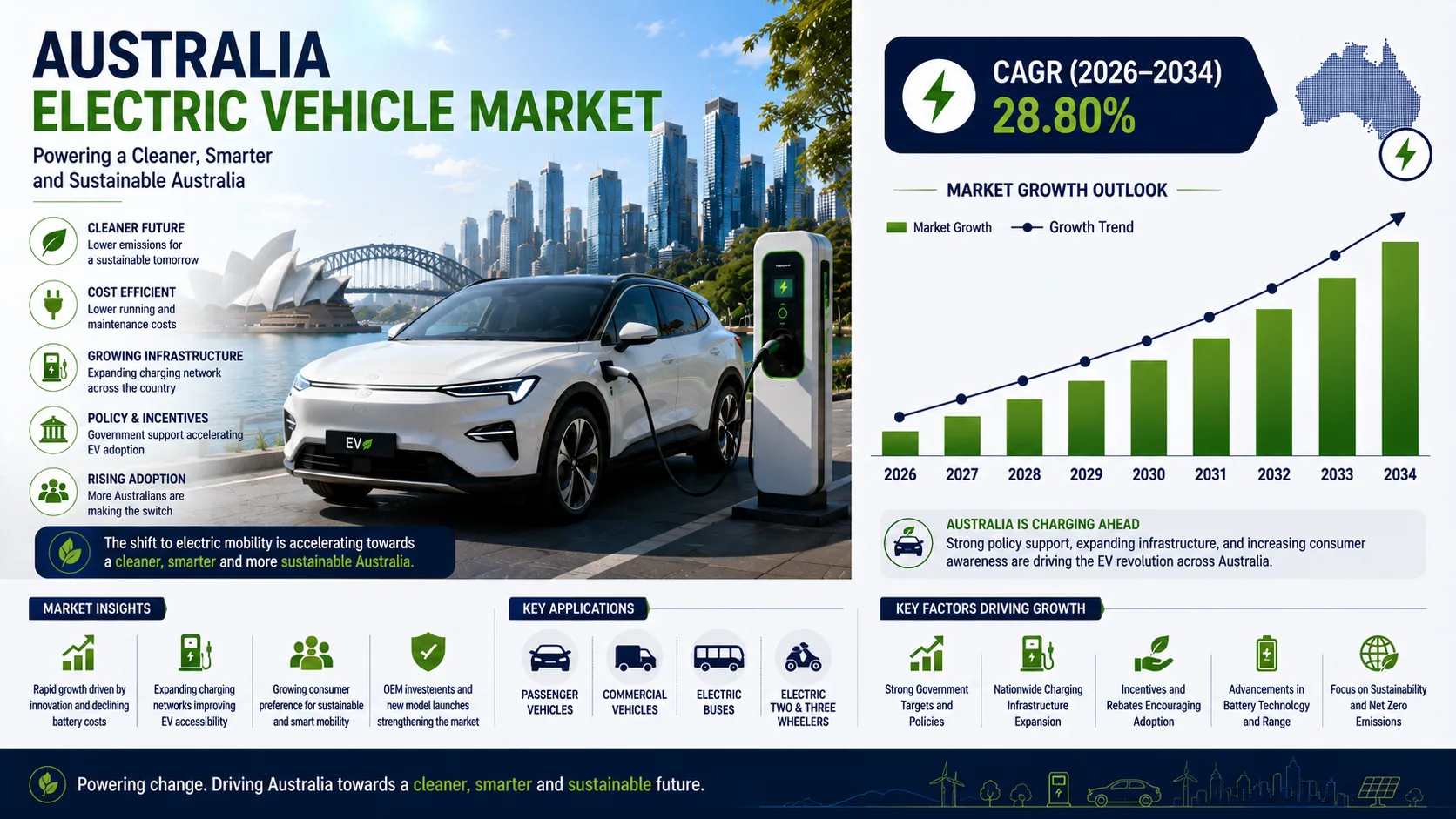
The Australia electric vehicle market size reached USD 21.06 Billion in 2025 and is projected to reach USD 221.02 Billion by 2034, growing at a compound annual growth rate (CAGR) of 28.80% from 2026 to 2034. Rising adoption of electric vehicles by businesses to meet sustainability objectives, growing mass production improving affordability, rapid expansion of charging infrastructure, and the implementation of the New Vehicle Efficiency Standard are the key growth drivers.
Request a Sample Report for In-Depth Market Insights: https://www.imarcgroup.com/australia-electric-vehicle-market/requestsample
Australia Electric Vehicle Market Summary
- The Australia electric vehicle market encompasses passenger vehicles, commercial vehicles, and specialty vehicles powered fully or partially by electric motors, drawing energy from onboard battery packs. This includes battery electric vehicles (BEVs), hybrid electric vehicles (HEVs), and plug-in hybrid electric vehicles (PHEVs).
- These vehicles are valued for their role in reducing carbon emissions, lowering fuel costs, providing advanced technology features, and supporting sustainability objectives for both individual and corporate buyers.
- The ecosystem includes raw material and battery cell suppliers, vehicle manufacturers and importers, charging infrastructure operators, software and fleet management providers, government policy bodies, and end consumers across private, corporate, and public sectors.
- Major segments identified in the market include vehicle type (passenger vehicles, commercial vehicles, others), price category (mid-range, high/luxury range), propulsion type (BEV, HEV, PHEV), and region.
- The market is benefiting from government incentives and policy support, expansion of EV charging infrastructure, corporate and fleet electrification commitments, and technological advances in battery systems.
- The competitive landscape is intensifying, with a mix of established automakers, rapidly expanding Chinese brands, and premium EV manufacturers competing across all price segments.
PORTER'S FIVE FORCES ANALYSIS
- Competitive Rivalry: High. The market includes established automakers, rapidly expanding Chinese brands, and premium manufacturers competing on price, features, range, and technology. The top five brands account for ~65-70% of new EV deliveries, but fragmentation is increasing. Business implication: Companies must differentiate through technology, branding, and charging network access.
- Supplier Power: Moderate. Battery and component suppliers have some leverage, but the presence of multiple global suppliers and the ability of large automakers to secure long-term contracts or vertically integrate moderates this power. Business implication: Secure diverse supply agreements and invest in local battery and component manufacturing.
- Buyer Power: Moderate to High. Consumers have an expanding choice of 153 EV models across price points, with low switching costs and increasing access to information. However, the essential need for personal mobility provides some balance. Business implication: Build brand loyalty through technology, service, and total cost of ownership advantages.
- Threat of Substitutes: Moderate. Internal combustion engine vehicles, public transport, and micromobility solutions compete, but the compelling economics and environmental benefits of EVs are driving a structural shift. Business implication: Emphasize total cost of ownership, environmental benefits, and technology leadership.
- Threat of New Entrants: Moderate. High capital requirements, established supply chains, and brand building create barriers, but Chinese EV brands are demonstrating rapid market entry capabilities. Business implication: Build defensible positions through technology, charging infrastructure, and brand reputation.
MARKET GROWTH DRIVERS
Government Incentives and Policy Support
Federal and state government incentives have materially reduced the total cost of EV ownership, supporting the growth of the Australia electric vehicle market. The New Vehicle Efficiency Standard passed by the Australian Parliament is projected to deliver more than AUD 95 billion in fuel savings and reduce carbon dioxide emissions by approximately 321 million tons by 2050, further encouraging EV adoption.
Expansion of EV Charging Infrastructure
Australia had 1,272 fast-charging locations with over 3,436 plugs by mid-2025, representing approximately 20% growth year-on-year. The Australian Government announced a AUD 40 million investment in September 2025 to expand kerbside and fast-charging infrastructure across suburbs and regional communities.
Corporate and Fleet Electrification Commitments
Major logistics, car rental, utilities, and rideshare operators are leading the transition through bulk procurement, dedicated leasing models, and fleet charging infrastructure. IKEA Australia significantly scaled its zero-emission delivery efforts, with over 76% of customer deliveries completed using zero-emission vehicles as of August 2025.
Technological Advances in Battery Systems
Continuous improvements in battery energy density, charging speed, and cycle life are extending driving ranges, reducing charging times, and lowering per-kWh production costs, making EVs increasingly competitive with conventional ICE vehicles across price segments.
AUSTRALIA ELECTRIC VEHICLE MARKET SEGMENTATION
Vehicle Type Insights
- Passenger Vehicles
- Commercial Vehicles
- Others
Price Category Insights
- Mid-Range
- High/Luxury Range
Propulsion Type Insights
- Battery Electric Vehicle (BEV)
- Hybrid Electric Vehicle (HEV)
- Plug-In Hybrid Electric Vehicle (PHEV)
Regional Insights
- Australia Capital Territory & New South Wales
- Victoria & Tasmania
- Queensland
- Northern Territory & Southern Australia
- Western Australia
COMPETITIVE LANDSCAPE
The Australia electric vehicle market exhibits intensifying competitive dynamics, with multinational automakers, established Japanese brands, and rapidly expanding Chinese manufacturers competing across all price segments. The market structure is moderately concentrated at the premium tier, while the mid-range and entry-level segments are increasingly contested by a growing number of brands offering feature-rich vehicles at competitive price points.
Key players mentioned in the report context include:
- Tesla is Australia's dominant EV brand, maintaining market leadership through its comprehensive product lineup (Model Y, Model 3), proprietary Supercharger network, and direct-to-consumer sales model. In March 2026, Tesla announced plans to build its largest Supercharger station in Australia with more than 25 high-power stalls.
- BYD Company Ltd is the world's largest EV manufacturer and Australia's fastest-growing EV brand, leveraging vertically integrated battery manufacturing and an extensive model range (Atto 3, Seal, Dolphin, Sealion 6, Shark 6). In April 2026, BYD expanded its Shark 6 range with trade-focused and performance variants.
- MG Motor has established a strong presence through value-oriented positioning and broad dealership distribution, with models including the MG4, MG S5 EV, and Cyberster. In August 2025, MG introduced a more affordable front-wheel-drive MG 4 EV variant.
- Hyundai Motor Company offers premium EV technology with 800V ultra-fast charging across its IONIQ 5, IONIQ 9, and Kona Electric models, supported by strong brand trust and an established dealer service network.
- Kia Corporation competes with award-winning designs including the EV5, EV3, EV9, and EV6, with a strong SUV lineup appealing to Australian family buyers.
REGIONAL ANALYSIS
- Australia Capital Territory & New South Wales: Leads with a 34.5% revenue share in 2025, supported by comprehensive government rebate programs, stamp duty exemptions, and the most extensive public charging network in Australia (357 locations). A AUD 5.9 million regional grant announced in November 2025 extends this leadership into regional areas.
- Victoria & Tasmania: Accounts for 20.0%, supported by ZEV targets, public transport electrification commitments, and a government fleet electrification mandate. Features a dense urban charging network and expanding regional corridors.
- Queensland: Holds 18.5%, driven by a state ZEV strategy, AUD 3,000 EV rebate, and growing fleet adoption. Brisbane and the Gold Coast are emerging as particularly active EV markets.
- Western Australia: Represents 15.0%, supported by the completion of the EV Highway connecting Perth to regional areas, mining sector EV adoption, and state net-zero targets.
- Northern Territory & South Australia: Accounts for 12.0%, with growing renewables integration, state fleet targets, and developing charging infrastructure corridors.
RECENT INDUSTRY DEVELOPMENTS
April 2026: BYD expanded its presence in the Australian utility vehicle segment with the expansion of its Shark 6 range, including a trade-focused cab-chassis variant and a new performance-oriented flagship designed to broaden the appeal of its Dual Mode (DM) plug-in hybrid ute platform.
March 2026: Tesla announced its plans to build its largest Supercharger station in Australia with more than 25 high-power stalls, surpassing the current 20-stall location in Goulburn, NSW, and expanding its charging network advantage.
August 2025: MG Motor Australia broadened its small electric vehicle lineup by introducing a second version of the MG 4 EV, a more affordable front-wheel-drive hatch that sits below the existing rear- and all-wheel-drive models in the range.
2025: Battery electric vehicle sales exceeded 100,000 units for the first time, reaching 103,269 deliveries, a 13.1% increase year-on-year, with BEVs now representing 8.3% of all new vehicle deliveries in Australia.
Key Aspects Required for the Australia Electric Vehicle Market
- Market Performance: USD 21.06 Billion in 2025, with a projected trajectory to USD 221.02 Billion by 2034.
- Market Outlook: A 28.80% CAGR through 2034 indicates exceptional growth across vehicle types, price categories, and propulsion types, driven by policy support, infrastructure expansion, and technological advancement.
- Growth Drivers: Government incentives and policy support (New Vehicle Efficiency Standard); expansion of EV charging infrastructure; corporate and fleet electrification commitments; technological advances in battery systems; and growing model diversity.
- Competitive Landscape: An increasingly dynamic and competitive market with established automakers, Chinese brands, and premium manufacturers. Differentiation occurs through technology, charging networks, brand reputation, and pricing.
- Value Chain Analysis: From raw material extraction and battery component manufacturing through vehicle assembly, import and distribution, charging infrastructure, and fleet services to end-use by private, corporate, and government consumers, with sustainability and technology trends shaping market dynamics.
- Industry Trends: Rising production and model diversity; growing adoption of sustainability across corporate and government sectors; technological advancements in battery systems (solid-state, V2G); expansion of public and private charging infrastructure; and development of second-hand EV and battery recycling markets.
- Strategic Recommendations: Invest in expanding charging infrastructure, particularly in regional areas; develop commercial and fleet electrification solutions; focus on the mid-range price segment for volume growth; integrate V2G technology and smart charging; build local battery recycling and second-life capabilities; and leverage Australia's renewable energy resources for integrated solar-EV solutions.
Note: If you need any specific information that is not currently covered within the scope of the report, we will provide the same as a part of customization.
Speak to an analyst: https://www.imarcgroup.com/request?type=report&id=21951&flag=C
Report Format, Delivery, and Customization Details
- Report Format Mode: PDF and Excel (Editable version in PPT/Word format available on special request)
- Report Delivery Mode: Online Delivery, Physical Delivery
- Report Delivery Time: report delivered over email within 24 to 48 hours. If requested by the client, a physical copy will be delivered within three to ten days.
- Report Confirmation Mode: Yes, via email
- Report Customization Mode: Yes, via Email / Call
- Report Table of Content: Yes
- Report List of Figures: Yes
- Report Methodology Mode: Yes
- Request For Sample Report: Yes
About Us
IMARC Group is a global management consulting firm that helps the world's most ambitious changemakers to create a lasting impact. The company provides a comprehensive suite of market entry and expansion services. IMARC offerings include thorough market assessment, feasibility studies, company incorporation assistance, factory setup support, regulatory approvals and licensing navigation, branding, marketing and sales strategies, competitive landscape and benchmarking analyses, pricing and cost research, and procurement research.
Contact Us
IMARC Group
134 N 4th St., Brooklyn, NY 11249, USA
Email: [email protected]
Tel No: (D) +91 120 433 0800
United States: +1-201-971-6302