
Market Overview
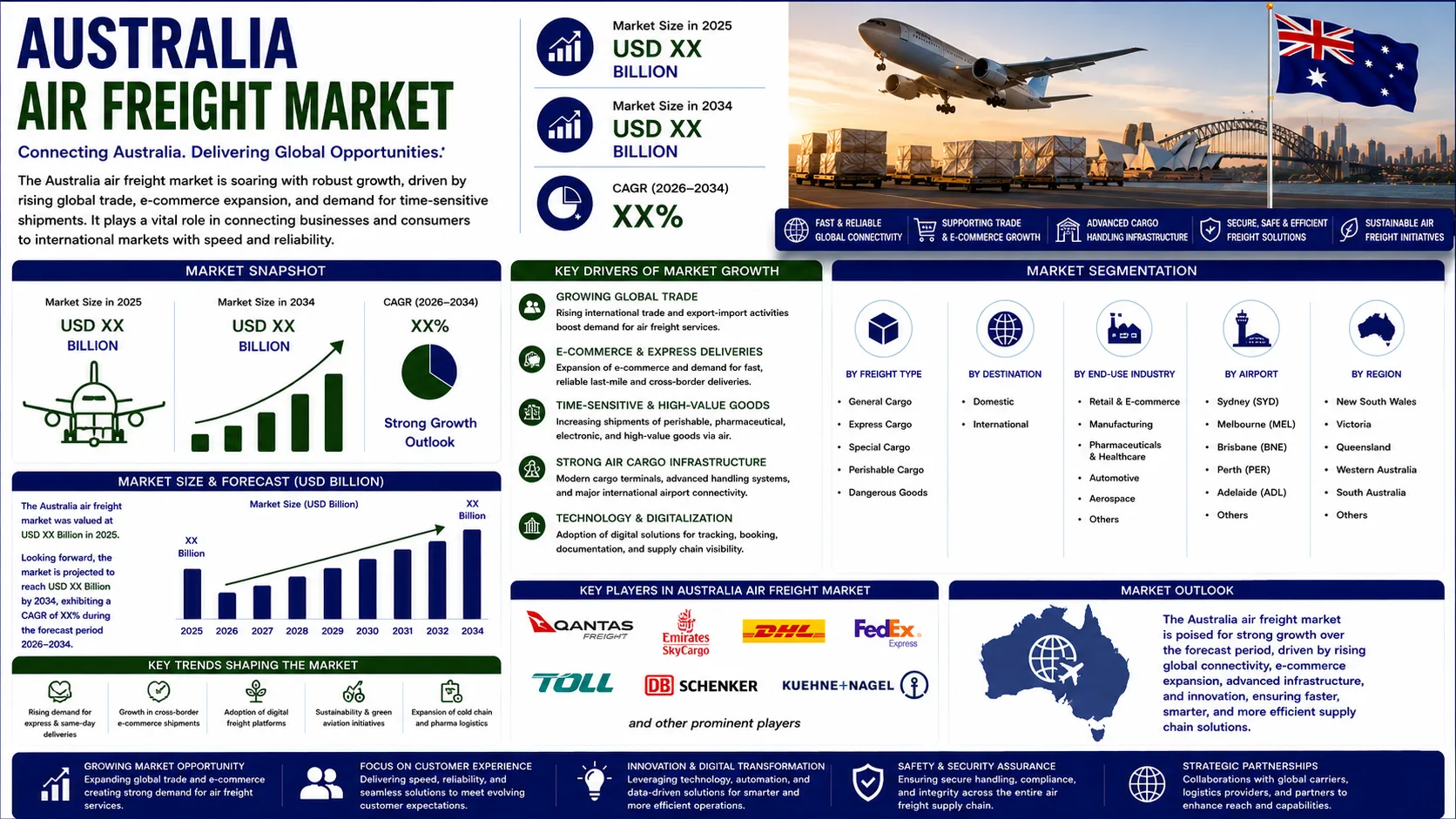
The Australia air freight market grew from USD 2.0 Billion in 2025 to USD 2.1 Billion in 2026. Looking forward, IMARC Group estimates the market to reach USD 3.7 Billion by 2034, exhibiting a CAGR of 7.12% from 2026-2034. The market is expanding due to growing e-commerce demand, expansion of global trade, technological advancements in logistics, and infrastructure development in airports.
This market is strategically important to Australia's trade and supply chain economy, supporting the nation's position as a major importer of high-value goods and exporter of premium agricultural and pharmaceutical products. The Australian air freight market encompasses domestic and international air cargo services, including freight forwarding, express delivery, and specialized handling for perishable and high-value cargo.
The Australia air freight market is poised for sustained expansion, underpinned by e-commerce growth, infrastructure investment, and regulatory modernization. With a projected CAGR of 7.12% through 2034, the market presents significant opportunities for providers focusing on cold chain logistics, digital transformation, and airport infrastructure expansion.
AUSTRALIA AIR FREIGHT MARKET SUMMARY
The Australia air freight market encompasses the transportation of goods by air, including domestic and international freight services, express delivery, and specialized cargo handling for industries requiring speed and reliability.
The ecosystem spans airlines, freight forwarders, logistics companies, ground handlers, and airport operators serving industries including e-commerce, retail, healthcare, manufacturing, and perishable goods.
By Service, the market is segmented into Freight, Express, and Others.
By Destination, the market serves Domestic and International.
By Carrier Type, the market serves Belly Cargo and Freighter.
By End Use, the market serves Private and Commercial.
By Region, the market serves New South Wales, Victoria, Queensland, Western Australia, Australian Capital Territory, and Others.
Key trends shaping the market include e-commerce-driven demand growth, Western Sydney International Airport development, enhanced air cargo screening requirements, digital transformation in logistics, and sustainable aviation fuel adoption.
PORTER'S FIVE FORCES ANALYSIS – AUSTRALIA AIR FREIGHT MARKET
Competitive Rivalry: Moderate to High. The market features competition among major airlines including Qantas, Singapore Airlines, and Cathay Pacific, alongside freight forwarders and logistics companies . Competition centres on network coverage, reliability, pricing, and specialized handling capabilities. Business implication: Companies must differentiate through service quality, network expansion, and technology integration.
Supplier Power (Airlines and Airport Operators): High. Airlines control belly cargo capacity and freighter operations, while airport operators manage slot allocations and cargo facilities. Capacity constraints at major airports create supply-side pressure. Business implication: Strategic partnerships with airlines and long-term capacity agreements can reduce supplier dependency.
Buyer Power (Shippers and Freight Forwarders): Moderate to High. Large shippers and freight forwarders have significant purchasing power and demand competitive rates, reliable schedules, and specialized handling. However, the need for speed and reliability in air freight moderates pure price-based buyer power. Business implication: Providers must offer competitive pricing, service reliability, and value-added capabilities.
Threat of Substitutes: Low to Moderate. Sea freight represents a slower but cost-effective alternative for non-time-sensitive cargo. However, air freight remains essential for perishable, high-value, and time-critical shipments.
Threat of New Entrants: Moderate. Significant capital requirements for aircraft, airport slots, and regulatory compliance create barriers. However, the growth of dedicated freighter services and e-commerce logistics players has enabled new entrants focused on niche segments.
KEY ASPECTS REQUIRED FOR THE AUSTRALIA AIR FREIGHT MARKET
Market Performance: USD 2.0 Billion in 2025, projected to reach USD 3.7 Billion by 2034, driven by e-commerce growth, global trade expansion, and infrastructure investment.
Market Outlook: A 7.12% CAGR through 2034 reflects strong growth led by e-commerce demand, cold chain logistics, and airport infrastructure development.
Growth Drivers: Increasing e-commerce demand; expansion of global trade; technological advancements in logistics; infrastructure development including Western Sydney International Airport; enhanced air cargo screening regulations.
Competitive Landscape: A mix of major airlines, freight forwarders, and logistics companies. Key players include Qantas Airways, Tasman Cargo Airlines, Kuehne & Nagel Australia, Federal Express (Australia), and Freight and Customs .
Value Chain Analysis: From cargo collection and screening through airport handling, airline transport, customs clearance, and final delivery across domestic and international routes.
Industry Trends: Digital transformation in logistics; sustainable practices including SAF adoption; on-demand air cargo services; AI and automation integration; cold chain logistics expansion .
Strategic Recommendations: Invest in cold chain logistics capabilities; expand e-commerce logistics partnerships; develop digital platforms for tracking and customs clearance; pursue sustainable aviation fuel initiatives; target Western Sydney International Airport opportunities; strengthen security compliance capabilities.
Request for Sample Report: https://www.imarcgroup.com/australia-air-freight-market/requestsample
MARKET GROWTH DRIVERS
Increasing E-commerce Demand
The rapid growth of e-commerce in Australia is a primary driver of air freight demand. Australian consumers are increasingly purchasing goods online from domestic and international retailers, requiring fast and reliable delivery. E-commerce platforms and logistics providers are utilizing air freight services to meet consumer expectations for rapid order fulfilment. The growth of cross-border e-commerce is further driving demand for international air freight services, particularly for high-value goods and time-sensitive shipments .
Expansion of Global Trade
Australia's integration into global trade networks is driving air freight demand, particularly for high-value exports and imports. International air freight accounts for a small share of total merchandise trade by volume but accounts for around 21 per cent of total trade by value . Key air freight imports include machinery, electronics, clothing, and pharmaceutical products, while exports include premium agricultural products and specialized equipment. Australia's trade relationships with Asia-Pacific economies, the United States, and Europe sustain demand for reliable air cargo services.
Infrastructure Development in Airports
Significant infrastructure investment is transforming Australia's air freight capabilities. Western Sydney International (Nancy-Bird Walton) Airport opened for freight operations in 2026, featuring a 24-hour cargo precinct that is expected to be a boon for both importers and exporters . Melbourne Airport is preparing to construct a third runway to expand capacity. These infrastructure developments are expected to support long-term industry growth by increasing cargo handling capacity and enabling new routes and services .
Enhanced Air Cargo Screening Requirements
The Australian government has implemented enhanced air cargo examination (EACE) requirements, mandating that all outbound international air cargo must be examined regardless of destination before being loaded onto aircraft . This regulatory requirement is driving investment in screening technology and compliance capabilities, creating opportunities for providers with advanced security infrastructure.
Technological Advancements in Logistics
Digital transformation is reshaping the air freight industry, with providers investing in AI, automation, and digital platforms for cargo tracking, customs clearance, and supply chain visibility. The integration of AI and automation is improving operational efficiency and enabling on-demand air cargo services . Paperless digital ecosystems are being developed through partnerships between airlines, software providers, and cargo stakeholders.
AUSTRALIA AIR FREIGHT MARKET SEGMENTATION
Segmentation analysis provides a detailed view of the Australia air freight market by category:
Service Insights: Freight – representing the largest segment, involving the transportation of a wide range of products including perishable items, industrial equipment, and high-value goods . Express – serving time-critical shipments with guaranteed delivery windows. Others – including specialized services and mail.
Destination Insights: International – dominating the market, driven by Australia's trade relationships and e-commerce imports. Domestic – serving interstate freight requirements, particularly for perishable goods and urgent shipments.
Carrier Type Insights: Belly Cargo – representing the majority of air freight capacity, utilizing cargo space on passenger aircraft. Freighter – dedicated cargo aircraft operated by Qantas Freight, Qatar Airways, Singapore Airlines, Cathay Pacific, and e-commerce logistics players .
End Use Insights: Commercial – representing the largest segment, serving businesses across retail, manufacturing, healthcare, and e-commerce. Private – serving specialized and personal shipments.
Regional Insights: New South Wales – representing the largest regional market, with Sydney serving as the country's central hub for air cargo . Victoria – serving significant import and export volumes through Melbourne Airport. Queensland – benefiting from agricultural exports and growing e-commerce demand. Western Australia – serving mining equipment and perishable exports. Australian Capital Territory – supporting government and high-value shipments.
COMPETITIVE LANDSCAPE
The competitive landscape of the Australia air freight market features a mix of major airlines, freight forwarders, and logistics companies competing across domestic and international services.
Qantas Airways is a leading domestic and international air freight provider, operating dedicated freighter services and utilizing belly cargo capacity on passenger flights. The airline serves as a key player in Australia's air cargo infrastructure.
Tasman Cargo Airlines operates dedicated freighter services connecting Australia with key international markets. Kuehne & Nagel Australia provides freight forwarding and logistics services across air, sea, and road transport modes. Federal Express (Australia) offers express delivery and air freight services for time-sensitive shipments.
Recent Developments:
Western Sydney International Airport opened for freight operations in 2026, with a 24-hour cargo precinct expected to boost import and export capabilities .
Avalon Airport and Teleport signed a strategic partnership agreement to improve access to East Asian air freight for Australian consumers .
Qantas, Singapore Airlines, and Cathay Pacific are among the biggest companies operating in Australia's Air Freight Services industry .
Investment opportunities exist in cold chain logistics, digital platforms, and sustainable aviation fuel initiatives.
REGIONAL ANALYSIS
New South Wales represents the largest regional market for air freight, with Sydney serving as the country's central hub for air cargo . Sydney Airport handled approximately 501.9 thousand tonnes of international air freight in 2022-23, supported by dense population, business concentration, and high-value freight requirements . The concentration of inbound activity at Sydney Airport reflects its proximity to key distribution centres and the large number of freight and passenger services operated.
Victoria serves significant import and export volumes through Melbourne Airport, which has experienced growth in international air freight volumes since 2010-11. Melbourne Airport is preparing to construct a third runway to expand capacity .
Queensland benefits from agricultural exports including premium beef and seafood, alongside growing e-commerce demand. Brisbane Airport accommodates significant international air freight movements.
Western Australia serves mining equipment and perishable exports, with Perth Airport handling international air freight for the resources sector and agricultural exports.
Australian Capital Territory supports government and high-value shipments, benefiting from Canberra's role as the national capital.
RECENT INDUSTRY DEVELOPMENTS
2026 Activity: The Australia air freight market continued its growth trajectory from USD 2.0 Billion in 2025 to USD 2.1 Billion in 2026 toward USD 3.7 Billion by 2034 at a CAGR of 7.12%.
2026: Western Sydney International (Nancy-Bird Walton) Airport officially opened for freight operations, with a 24-hour cargo precinct .
2026: Avalon Airport and Teleport signed a strategic partnership agreement to improve access to East Asian air freight .
2025: The Australian government announced that all outbound international air cargo must be examined under the enhanced air cargo examination (EACE) program.
FREQUENTLY ASKED QUESTIONS
Q1: What is the current size of the Australia air freight market?
A: The Australia air freight market grew from USD 2.0 Billion in 2025 to USD 2.1 Billion in 2026 and is estimated to reach USD 3.7 Billion by 2034, exhibiting a CAGR of 7.12% from 2026-2034.
Q2: What are the key drivers of the Australia air freight market?
A: The market is driven by: (i) increasing e-commerce demand; (ii) expansion of global trade; (iii) technological advancements in logistics; (iv) infrastructure development including Western Sydney International Airport; and (v) enhanced air cargo screening regulations.
Q3: What are the major services in the Australia air freight market?
A: Major services include Freight, Express, and Others.
Q4: What are the major destinations in the Australia air freight market?
A: Major destinations include Domestic and International.
Q5: Which region leads the Australia air freight market?
A: New South Wales represents the largest regional market, with Sydney serving as the country's central hub for air cargo.
Q6: How is technology impacting the Australia air freight market?
A: Digital transformation, AI, automation, and paperless digital ecosystems are improving operational efficiency, cargo tracking, and customs clearance processes.
Q7: Who are the major players in the Australia air freight market?
A: Major players include Qantas Airways, Tasman Cargo Airlines, Kuehne & Nagel Australia, Federal Express (Australia), and Freight and Customs .
Q8: What are the challenges facing the Australia air freight market?
A: Key challenges include capacity constraints at major airports, high operational costs, regulatory compliance requirements, and environmental regulations.
Note: If you need any specific information that is not covered currently within the scope of the report, we will provide the same as a part of customization.
https://www.imarcgroup.com/request?type=report&id=24715&flag=E
Report Format, Delivery, and Customization Details
Report Format Mode: PPT, PDF, and Excel
Report Delivery Mode: Online Delivery, Physical Delivery
Report Delivery Time: Report Delivered Over Email within 24 to 48 hours. If requested by the client, a physical copy will be delivered within three to ten days.
Report Confirmation Mode: Yes via Email
Report Customization Mode: Yes via Email / Call
Report Table of Content: Yes
Report List of Figures: Yes
Report Methodology Mode: Yes
Request For Sample Report: Yes