Market Overview
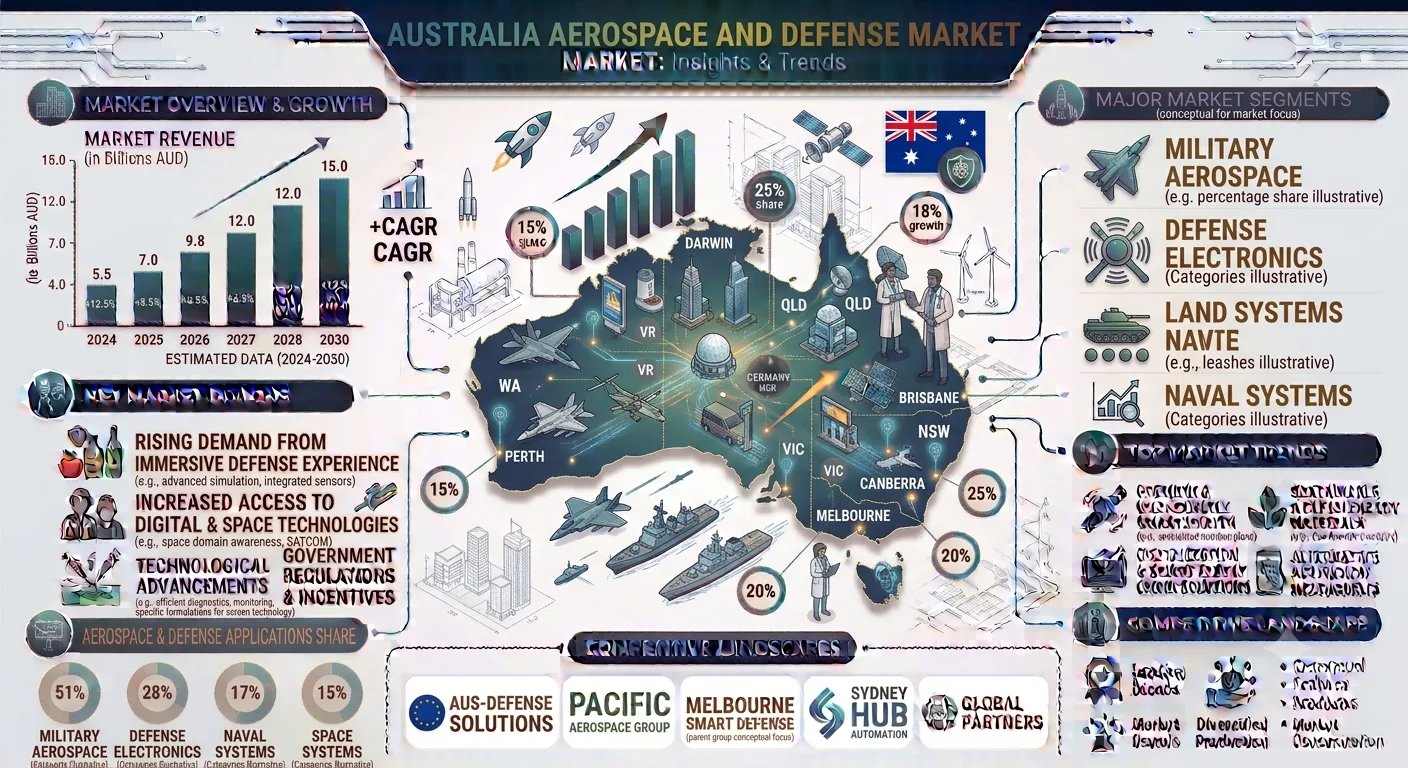
The Australia aerospace and defense market size reached USD 13.6 Billion in 2025. Looking forward, IMARC Group expects the market to reach USD 21.4 Billion by 2034, exhibiting a growth rate (CAGR) of 5.04% during 2026-2034. The market is driven by unprecedented government defense investment, strategic fleet modernization initiatives, the development of sovereign guided weapons manufacturing capabilities, and the expansion of Australia's space and hypersonic technology sectors.
This market is strategically important to Australia's national security and industrial sovereignty, supporting the country's position as a significant Indo-Pacific defense player and emerging aerospace innovator. The Australia aerospace and defense market encompasses commercial and general aviation, military aircraft and systems, unmanned aerial systems, missiles and weapons, and space systems and equipment, serving government defense agencies, commercial aviation operators, and space industry participants across Australia Capital Territory & New South Wales, Victoria & Tasmania, Queensland, Northern Territory & Southern Australia, and Western Australia.
The Australia aerospace and defense market is poised for sustained expansion, underpinned by record defense spending, sovereign manufacturing initiatives, and the growth of private aerospace companies. With a projected CAGR of 5.04% through 2034, the market presents significant opportunities for providers focusing on guided weapons production, hypersonic technology, sovereign launch capabilities, and advanced manufacturing.
AUSTRALIA AEROSPACE AND DEFENSE MARKET SUMMARY
The Australia aerospace and defense market encompasses the provision of aircraft, systems, weapons, and space technologies designed to support national defense, commercial aviation, and space exploration objectives.
The ecosystem spans global defense contractors, Australian sovereign manufacturers, aerospace startups, component suppliers, maintenance and repair organizations (MROs), and government agencies serving defense, commercial, and civil space customers throughout Australia.
By Sector, the market is segmented into Commercial and General Aviation (dominating), Military Aircraft and Systems, Missiles and Weapons, Unmanned Aerial Systems (Commercial, Military), and Space Systems and Equipment (Space Launch Vehicle, Spacecraft, Ground Systems, Satellites).
By Region, the market serves Australia Capital Territory & New South Wales (dominating), Victoria & Tasmania, Queensland, Northern Territory & Southern Australia, and Western Australia.
Key trends shaping the market include sovereign guided weapons manufacturing, hypersonic technology development, commercial space launch capabilities, defense workforce development, and diversification of international partnerships.
PORTER'S FIVE FORCES ANALYSIS – AUSTRALIA AEROSPACE AND DEFENSE MARKET
Competitive Rivalry: Moderate to High. The market features competition among global defense contractors including Lockheed Martin, Raytheon, Kongsberg, and Thales, alongside emerging Australian sovereign manufacturers and aerospace startups. Competition centres on technology transfer, local content requirements, workforce capabilities, and government contracting relationships. Business implication: Companies must differentiate through sovereign capability development, technology partnerships, and workforce investment.
Supplier Power (Component and Technology Providers): Moderate to High. Manufacturers rely on suppliers of advanced materials, propulsion systems, avionics, and precision components. The shift toward sovereign manufacturing is increasing dependency on local supply chain development and technology transfer arrangements. Business implication: Strategic partnerships, vertical integration, and local supplier development can reduce dependency and strengthen sovereign capabilities.
Buyer Power (Government Defense Agencies and Commercial Operators): High. The Australian Defence Force and government agencies dominate procurement, leveraging significant purchasing power to negotiate favorable terms and local content requirements. Commercial aviation operators represent a secondary buyer segment. Business implication: Providers must demonstrate compliance with local content requirements, technology transfer commitments, and workforce development plans.
Threat of Substitutes: Low. Aerospace and defense platforms and systems serve specialized functions with limited practical substitutes. Alternative defense strategies and commercial off-the-shelf solutions represent partial substitutes in certain applications. Business implication: Demonstrating superior capability, interoperability, and sovereign sustainment is essential.
Threat of New Entrants: Moderate. Significant capital requirements, regulatory complexity, and established defense relationships create barriers. However, government support for sovereign capability and the growth of aerospace startups have enabled new entrants focused on niche technologies including hypersonic systems, autonomous platforms, and space launch. Business implication: Incumbents must leverage scale, technology leadership, and government relationships while monitoring emerging sovereign innovators.
KEY ASPECTS REQUIRED FOR THE AUSTRALIA AEROSPACE AND DEFENSE MARKET
Market Performance: USD 13.6 Billion in 2025, projected to reach USD 21.4 Billion by 2034, driven by defense modernization, sovereign manufacturing, and space sector growth.
Market Outlook: A 5.04% CAGR through 2034 reflects steady growth led by military aircraft, missiles and weapons, and sovereign industrial development.
Growth Drivers: Record government defense investment (A$55.7 billion in 2024–25); Guided Weapons and Explosive Ordnance (GWEO) program with A$26–36 billion planned spending; sovereign manufacturing initiatives; hypersonic technology development; commercial space launch capabilities; defense workforce development; diversification of international partnerships.
Competitive Landscape: A dynamic mix of global defense contractors and emerging Australian sovereign manufacturers. Key players include Lockheed Martin, Raytheon, Kongsberg, Thales, BAE Systems Australia, Gilmour Space, and Hypersonix.
Value Chain Analysis: From component manufacturing and technology development through systems integration, platform assembly, testing and evaluation, sustainment, and maintenance across defense and commercial applications.
Industry Trends: Sovereign guided weapons manufacturing; hypersonic flight testing; commercial space launch; autonomous ISR platforms; defense workforce development; AUKUS Pillar II collaboration.
Strategic Recommendations: Invest in sovereign guided weapons manufacturing capabilities; develop hypersonic technology and testing infrastructure; expand commercial space launch capabilities; pursue defense workforce training and development; diversify international partnerships beyond traditional suppliers; target GWEO program opportunities; expand MRO and sustainment capabilities for military aircraft; develop autonomous ISR and loitering munition technologies.
Request for Sample Report: https://www.imarcgroup.com/australia-aerospace-defense-market/requestsample
MARKET GROWTH DRIVERS
Unprecedented Government Defense Investment
Australia's commitment to significantly increasing defense expenditure is creating a structurally significant demand channel across aerospace and defense sectors. In the 2024–25 defense budget, the government allocated a record A$55.7 billion for national defense spending, with the 2024 Integrated Investment Program outlining A$330 billion in defense spending through 2033-34 . Defense market spending hit USD 50 billion in 2024, projected to reach USD 81.44 billion by 2034, with major investments in air, maritime, and missile systems . Long-term defense budgeting provides forward procurement visibility that supports sustained institutional purchasing activity across platforms, systems, and sustainment services.
Guided Weapons and Explosive Ordnance (GWEO) Program
Australia's Guided Weapons and Explosive Ordnance (GWEO) program represents a major structural driver of the aerospace and defense market. According to its 2026 National Defence Strategy, Australia plans to set aside between A$26 billion and A$36 billion ($18.16 to $25.14 billion) in funding for GWEO . The program has four official partners: Kongsberg, Thales, Lockheed Martin, and Raytheon, alongside two local companies tapped as Enterprise and Support Partners . Australia has already test-fired locally produced Lockheed GMLRS rockets, found local industry partners to produce GMLRS components, and entered an agreement to develop and produce Precision Strike Missiles . Kongsberg Australia is building a missile-production facility in Williamtown, New South Wales, scheduled to begin production of Naval Strike Missiles and Joint Strike Missiles by the end of 2027 .
Sovereign Manufacturing and Industrial Capability Development
A defining structural trend within the Australia aerospace and defense market is the accelerating policy emphasis on building a sovereign defense industrial base. Government strategies prioritise enabling local firms to participate in the manufacture, assembly, and sustainment of military platforms and systems. The Defence Industry Development Grants program will provide approximately A$170 million across 2024-2028 to small and medium-sized Australian businesses . Over A$17 million has been allocated across 44 Australian businesses in January 2026, bringing total program spending to over A$51 million, with 8 projects funded by the Australian Submarine Agency to support the AUKUS submarine program . This investment fosters technology transfer and indigenous capability development.
Hypersonic Technology and Testing Capabilities
Australia is developing significant expertise in hypersonic technology, driven by growing demand for hypersonic testing from defence customers. In September 2026, Gilmour Space Technologies and Hypersonix signed an agreement to develop hypersonic flight-test options for defence and commercial programs . The partnership brings together Gilmour Space's rocket propulsion, launch, and flight-test capabilities with Hypersonix's scramjet propulsion and hypersonic vehicle technology . Hypersonix CEO Matt Hill stated that "defence customers need more frequent, responsive and accessible ways to test technologies in representative hypersonic conditions," with the partnership exploring solutions for Australian and allied programs, including under AUKUS Pillar II . This emerging capability positions Australia as a significant player in hypersonic technology development.
Commercial Space Launch and Space Sector Growth
Australia's space sector is experiencing rapid growth, driven by government support and private sector innovation. The sector generates roughly A$4.6 billion in annual turnover, supporting 17,000 full-time roles . Gilmour Space Technologies, which owns the Bowen Orbital Spaceport in North Queensland, has secured $217 million in funding led by the federal government's National Reconstruction Fund Corporation and superannuation giant Hostplus . The company's Eris rocket is a three-stage vehicle designed to deliver up to 305kg to low Earth orbit . Australia's southern hemisphere location offers access to orbital paths congested American spaceports cannot easily reach, and US launch queues stretching beyond two years have identified sovereign launch capability as a strategic priority .
Defense Workforce Development and Skills
Workforce development is a critical enabler of Australia's aerospace and defense ambitions. The United States Studies Centre at the University of Sydney called Australia's current industrial workforce planning "largely neglected" in a June report, calling on the Australian government to "address current trends of deferred responsibility, ambiguous demand signals and ad hoc, incremental coordination across industry, state governments and training providers" . The report noted that Australia's technical workforce tends to be geographically immobile, requiring better coordination for siting of GWEO facilities . Addressing these workforce gaps is essential for delivering on sovereign manufacturing and defense capability objectives.
AUSTRALIA AEROSPACE AND DEFENSE MARKET SEGMENTATION
Segmentation analysis provides a detailed view of the Australia aerospace and defense market by category:
Sector Insights: Commercial and general aviation dominates the Australia aerospace and defense market, encompassing commercial aircraft, air traffic management, training and flight simulators, airport services, and structures including airframe, engine and engine systems, cabin interiors, landing gear, avionics and control systems, electrical systems, environmental control systems, fuel and fuel systems, and MRO services. The commercial aviation sector is rebounding strongly, with fleet renewals, airport upgrades, and the rebound of international and domestic travel driving growth. The aviation market was valued at USD 4.26 billion in 2024 . Military aircraft and systems represent a significant segment, including combat aircraft (structures and avionics), non-combat aircraft, and associated systems. In 2024, the Royal Australian Air Force completed its acquisition of 72 F-35A Lightning II fighter aircraft, with BAE Systems Australia establishing a maintenance facility at RAAF Base Williamtown employing approximately 750 personnel . Missiles and weapons constitute a growing segment, with GWEO program investments driving demand for guided weapons, munitions, and associated systems. Unmanned aerial systems represent an emerging segment, with military applications including ISR and strike missions, and commercial applications including surveying, agriculture, and logistics. Space systems and equipment represent a growing segment, including space launch vehicles, spacecraft, ground systems, and satellites. The space sector generates roughly A$4.6 billion in annual turnover, supporting 17,000 full-time roles .
Regional Insights: Australia Capital Territory & New South Wales represents a significant regional market, driven by concentration of federal defense agencies, major defense contractors, and aerospace manufacturing facilities. The ACT hosts the Department of Defence headquarters and major procurement agencies, while New South Wales is home to significant defense industrial facilities including the Williamtown missile production facility and RAAF Base Williamtown F-35 maintenance operations. Victoria & Tasmania constitute a significant regional market, with aerospace manufacturing, MRO activities, and defense industry presence. Queensland represents a growing market, with the Bowen Orbital Spaceport in North Queensland, Gilmour Space Technologies' Gold Coast headquarters, and Hypersonix's Brisbane operations driving space and hypersonic technology development. Northern Territory & Southern Australia collectively contribute to the market, with RAAF Base Edinburgh hosting the MC-55A Peregrine aircraft and defense infrastructure supporting operations. Western Australia is a significant market, with defense facilities including HMAS Stirling supporting naval operations and the AUKUS submarine program.
COMPETITIVE LANDSCAPE
The competitive landscape of the Australia aerospace and defense market features a dynamic mix of global defense contractors and emerging Australian sovereign manufacturers competing across platforms, systems, and sustainment services. Competition centres on technology transfer, local content requirements, workforce capabilities, and government contracting relationships. Major global players including Lockheed Martin, Raytheon, Kongsberg, and Thales maintain strong positions through established defense relationships and technology leadership. Australian sovereign manufacturers including BAE Systems Australia and emerging aerospace startups including Gilmour Space and Hypersonix are building capability in specific domains including F-35 sustainment, space launch, and hypersonic technology.
Lockheed Martin is a major partner in Australia's GWEO program, working on GMLRS battlefield missiles and PrSM ballistic strike missiles. The company is already assembling GMLRS rounds in South Australia .
Raytheon is a partner in the GWEO program, contributing to guided weapons manufacturing and technology development.
Kongsberg Defence & Aerospace is a key partner in Australia's GWEO program. In September 2024, Australia signed an AUD142 million (USD96 million) contract with Kongsberg to acquire Joint Strike Missiles (JSMs) for its F-35A Lightning II aircraft . Kongsberg Australia is building a missile-production facility in Williamtown, New South Wales, scheduled to begin production of NSM and JSM by end of 2027 . Kongsberg has signed an MoU with Zone 5 Technologies for manufacturing guided missiles, exploring collaboration on affordable, mass producible long-range strike and air-defence missiles.
Thales is a partner in the GWEO program and operates the Lithgow Arms facility for precision manufacture of next-generation weapon systems.
BAE Systems Australia established a maintenance facility at RAAF Base Williamtown to support the F-35 fleet's sustainment needs, with plans to employ approximately 750 personnel . In December 2024, BAE Systems Australia completed the successful first flight of its STRIX VTOL uncrewed aerial vehicle, designed for ISR and strike missions .
Gilmour Space Technologies is an Australian-owned company developing and manufacturing launch vehicles, satellites, and high-speed flight-test services. The company owns and operates Bowen Orbital Spaceport in North Queensland and secured $217 million in funding in 2026 led by the National Reconstruction Fund Corporation and Hostplus . The company's Eris rocket is a three-stage vehicle designed to deliver up to 305kg to low Earth orbit .
Hypersonix Launch Systems is a Brisbane-based startup building hydrogen-fuelled hypersonic aircraft. The company closed a US$46 million Series A and successfully flew its DART AE demonstrator from NASA's Wallops Flight Facility in February 2026, marking the first Australian hypersonic flight test conducted in the United States .
Shield AI and Innovaero Technologies announced a collaboration to give the Australian Defence Force greater strike capability, integrating Shield AI's Hivemind mission autonomy software on Innovaero's One-Way Loitering (OWL) family of precision munitions .
Recent Developments:
September 2026: Gilmour Space and Hypersonix signed an agreement to develop hypersonic flight-test options for defence and commercial programs .
October 2026: Kongsberg Australia signed an MoU with Zone 5 Technologies for manufacturing guided missiles .
September 2024: Australia signed an AUD142 million contract with Kongsberg to acquire Joint Strike Missiles for its F-35A Lightning II aircraft .
December 2024: BAE Systems Australia completed the successful first flight of its STRIX VTOL uncrewed aerial vehicle .
January 2026: First MC-55A Peregrine aircraft arrived at RAAF Base Edinburgh, supporting Australia's ISR capabilities .
Investment opportunities exist in sovereign guided weapons manufacturing, hypersonic technology, commercial space launch, autonomous ISR platforms, and defense workforce development.
REGIONAL ANALYSIS
Australia Capital Territory & New South Wales represents a significant regional market, driven by concentration of federal defense agencies, major defense contractors, and aerospace manufacturing facilities. The ACT hosts the Department of Defence headquarters and major procurement agencies, while New South Wales is home to significant defense industrial facilities including the Williamtown missile production facility and RAAF Base Williamtown F-35 maintenance operations . The region benefits from proximity to government decision-makers and established defense industry infrastructure.
Victoria & Tasmania constitute a significant regional market, with aerospace manufacturing, MRO activities, and defense industry presence. The region hosts aerospace component manufacturers and maintenance facilities supporting both commercial and military aviation.
Queensland represents a growing market, with the Bowen Orbital Spaceport in North Queensland, Gilmour Space Technologies' Gold Coast headquarters, and Hypersonix's Brisbane operations driving space and hypersonic technology development . The state is emerging as a hub for sovereign space launch and hypersonic technology capabilities.
Northern Territory & Southern Australia collectively contribute to the market, with RAAF Base Edinburgh hosting the MC-55A Peregrine aircraft and defense infrastructure supporting operations . The region supports ISR capabilities and defense sustainment activities.
Western Australia is a significant market, with defense facilities including HMAS Stirling supporting naval operations and the AUKUS submarine program. The state hosts significant defense infrastructure and supports maritime defense capabilities.
RECENT INDUSTRY DEVELOPMENTS
2026 Activity: The Australia aerospace and defense market continued its growth trajectory from USD 13.6 Billion in 2025 toward USD 21.4 Billion by 2034 at a CAGR of 5.04%.
October 2026: Kongsberg Australia signed an MoU with Zone 5 Technologies for manufacturing guided missiles .
September 2026: Gilmour Space and Hypersonix signed an agreement to develop hypersonic flight-test options for defence and commercial programs .
January 2026: First MC-55A Peregrine aircraft arrived at RAAF Base Edinburgh, supporting Australia's ISR capabilities .
December 2024: BAE Systems Australia completed the successful first flight of its STRIX VTOL uncrewed aerial vehicle .
September 2024: Australia signed an AUD142 million contract with Kongsberg to acquire Joint Strike Missiles for its F-35A Lightning II aircraft .
FREQUENTLY ASKED QUESTIONS
Q1: What is the current size of the Australia aerospace and defense market?
A: The Australia aerospace and defense market reached USD 13.6 Billion in 2025 and is projected to reach USD 21.4 Billion by 2034, exhibiting a CAGR of 5.04% from 2026-2034.
Q2: What are the key drivers of the Australia aerospace and defense market?
A: The market is driven by: (i) unprecedented government defense investment; (ii) Guided Weapons and Explosive Ordnance (GWEO) program; (iii) sovereign manufacturing initiatives; (iv) hypersonic technology development; (v) commercial space launch capabilities; and (vi) defense workforce development.
Q3: What are the major sectors in the Australia aerospace and defense market?
A: Major sectors include Commercial and General Aviation (dominating), Military Aircraft and Systems, Missiles and Weapons, Unmanned Aerial Systems (Commercial, Military), and Space Systems and Equipment (Space Launch Vehicle, Spacecraft, Ground Systems, Satellites).
Q4: Which region leads the Australia aerospace and defense market?
A: Australia Capital Territory & New South Wales represents a significant regional market, driven by concentration of federal defense agencies, major defense contractors, and aerospace manufacturing facilities.
Q5: Who are the major players in the Australia aerospace and defense market?
A: Major players include Lockheed Martin, Raytheon, Kongsberg, Thales, BAE Systems Australia, Gilmour Space, and Hypersonix, among others.
Q6: What are the challenges facing the Australia aerospace and defense market?
A: Key challenges include workforce shortages in specialized technical roles, dependence on the United States for guided weapons, funding uncertainties, complex international technology transfer restrictions, and geographic dispersion of the technical workforce.
Q7: What is the outlook for the Australia aerospace and defense market?
A: The market is projected to grow at a 5.04% CAGR through 2034, with growth driven by defense modernization, sovereign manufacturing, and space sector growth. The shift toward sovereign guided weapons manufacturing, hypersonic technology, commercial space launch, and diversified international partnerships are expected to shape the market's evolution.
Note: If you need any specific information that is not covered currently within the scope of the report, we will provide the same as a part of customization.
https://www.imarcgroup.com/request?type=report&id=28803&flag=E
Report Format, Delivery, and Customization Details
Report Format Mode: PPT, PDF, and Excel
Report Delivery Mode: Online Delivery, Physical Delivery
Report Delivery Time: Report Delivered Over Email within 24 to 48 hours. If requested by the client, a physical copy will be delivered within three to ten days.
Report Confirmation Mode: Yes via Email
Report Customization Mode: Yes via Email / Call
Report Table of Content: Yes
Report List of Figures: Yes
Report Methodology Mode: Yes
Request For Sample Report: Yes