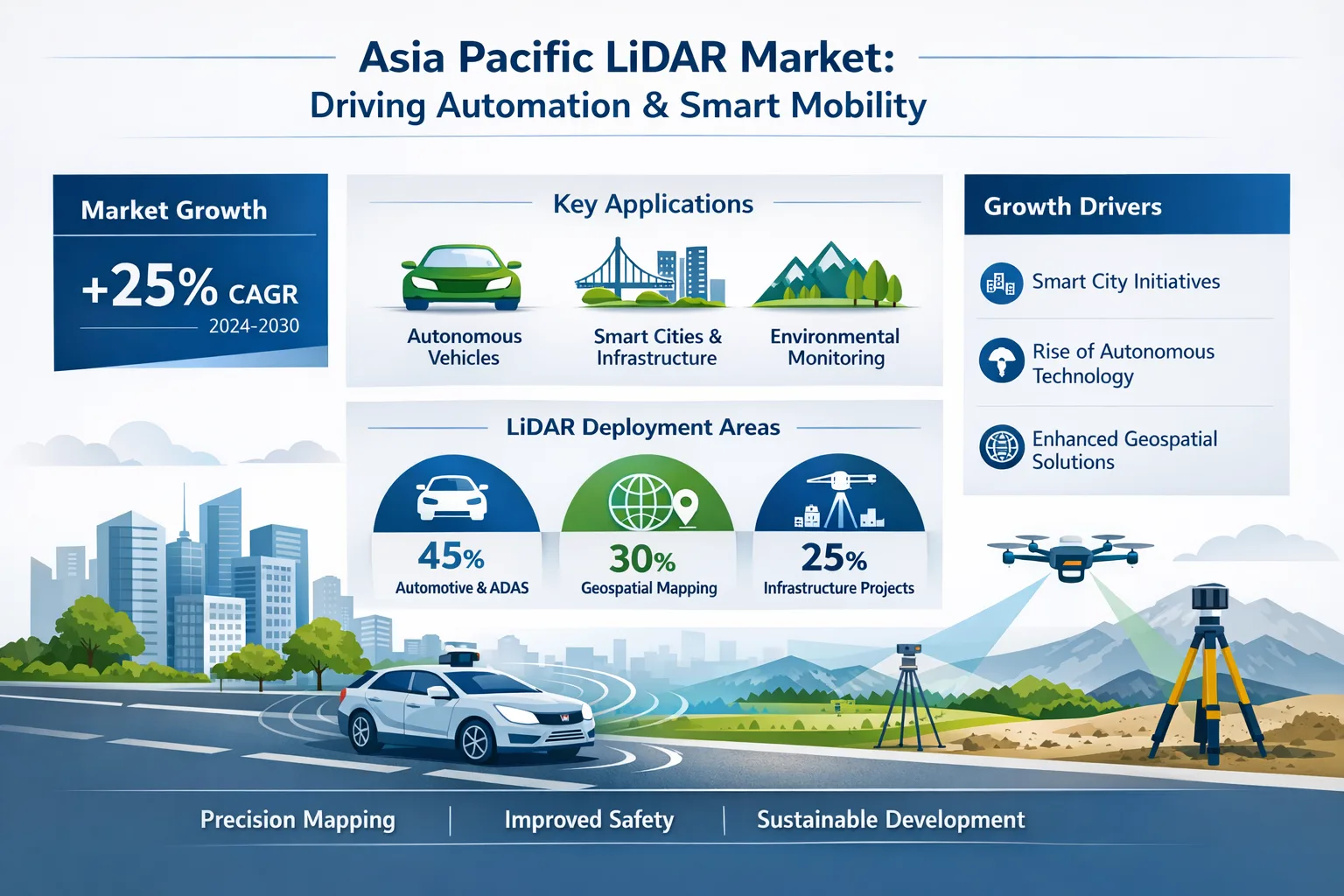
The Asia Pacific LiDAR Market is rapidly transforming into a critical enabler of automation, precision mapping, and smart mobility ecosystems. The market is witnessing accelerated expansion due to rising integration across automotive, infrastructure, and environmental monitoring sectors. Governments across the region are pushing smart city projects while enterprises are investing heavily in autonomous technologies. The increasing deployment of LiDAR in ADAS systems and geospatial mapping is strengthening the market outlook significantly. This growth trajectory highlights how LiDAR is no longer a niche technology but a core infrastructure component shaping future industrial efficiency.
Asia Pacific LiDAR Market Growth Accelerates Across Smart Infrastructure
The expansion of LiDAR adoption is strongly linked to infrastructure modernization and smart city initiatives. As urban planning becomes data driven, governments are deploying LiDAR for high precision mapping and monitoring. Within this transformation, the Asia Pacific LiDAR Market growth is being fueled by increasing investments in intelligent transportation systems and urban digitalization strategies. Countries like China and Japan are leading adoption with extensive use in construction planning and disaster management systems.
- Urban mapping demand is rising due to large scale smart city projects
- Infrastructure digitization is enabling real time terrain analysis
- Government funding is accelerating LiDAR deployment across sectors
Q: How is Asia Pacific LiDAR Market growth influencing smart cities?
A: The growth is enabling real time mapping, improved traffic systems, and disaster management. With increasing infrastructure investments and urban digitization, LiDAR plays a crucial role in enhancing planning efficiency and operational accuracy.
Asia Pacific LiDAR Industry Trends Shape Autonomous Technology Evolution
The market is witnessing strong technological evolution driven by advancements in sensor accuracy and cost efficiency. Emerging innovations are making LiDAR systems more compact and affordable, allowing wider adoption across industries. A key trend includes the integration of LiDAR in autonomous vehicles, where Asia Pacific LiDAR industry trends indicate a shift toward solid state LiDAR solutions. These systems offer improved durability and lower production costs, making them highly scalable.
- Sensor miniaturization is enabling integration in consumer applications
- Cost reduction strategies are expanding adoption across SMEs
- AI integration is enhancing LiDAR data processing capabilities
Data Insight: Solid state LiDAR adoption is increasing rapidly due to reduced costs and improved scalability, while automotive applications dominate usage across the region.
Asia Pacific LiDAR Industry Opportunities Expand Across Multiple Sectors
The diversification of LiDAR applications is opening new growth avenues beyond automotive. Industries such as agriculture, mining, and environmental monitoring are increasingly leveraging LiDAR for precision analytics. The rise of drone based mapping solutions is further strengthening demand, where Asia Pacific LiDAR sector opportunities are expanding across aerial surveying and defense applications. This diversification ensures long term sustainability of market growth.
- Agriculture applications are improving crop monitoring efficiency
- Mining operations are leveraging LiDAR for safety and mapping
- Drone adoption is enhancing surveying capabilities
Key Takeaway: The market’s expansion beyond automotive into agriculture and industrial sectors ensures long term resilience and diversified revenue streams.
Asia Pacific LiDAR Industry Challenges Impact Market Scalability
Despite strong growth, the market faces certain constraints that could limit its scalability. High initial investment costs and technical complexities remain key barriers for widespread adoption. Additionally, regulatory uncertainties in autonomous vehicle deployment create challenges for manufacturers. Within this context, Asia Pacific LiDAR sector challenges highlight the need for standardization and cost optimization strategies to unlock full potential.
- High deployment costs limit adoption among smaller enterprises
- Regulatory frameworks are still evolving in many countries
- Technical integration issues slow down implementation
Q: What are the key challenges in Asia Pacific LiDAR Market adoption?
A: The major challenges include high costs, regulatory uncertainties, and integration complexities. These factors can slow down adoption, especially in emerging markets where infrastructure readiness is still developing.
Conclusion
The future outlook remains highly promising as continuous innovation and strategic investments reshape the competitive landscape. With insights derived from Ken Research Analysis, businesses can better understand emerging trends and position themselves effectively in this evolving ecosystem.