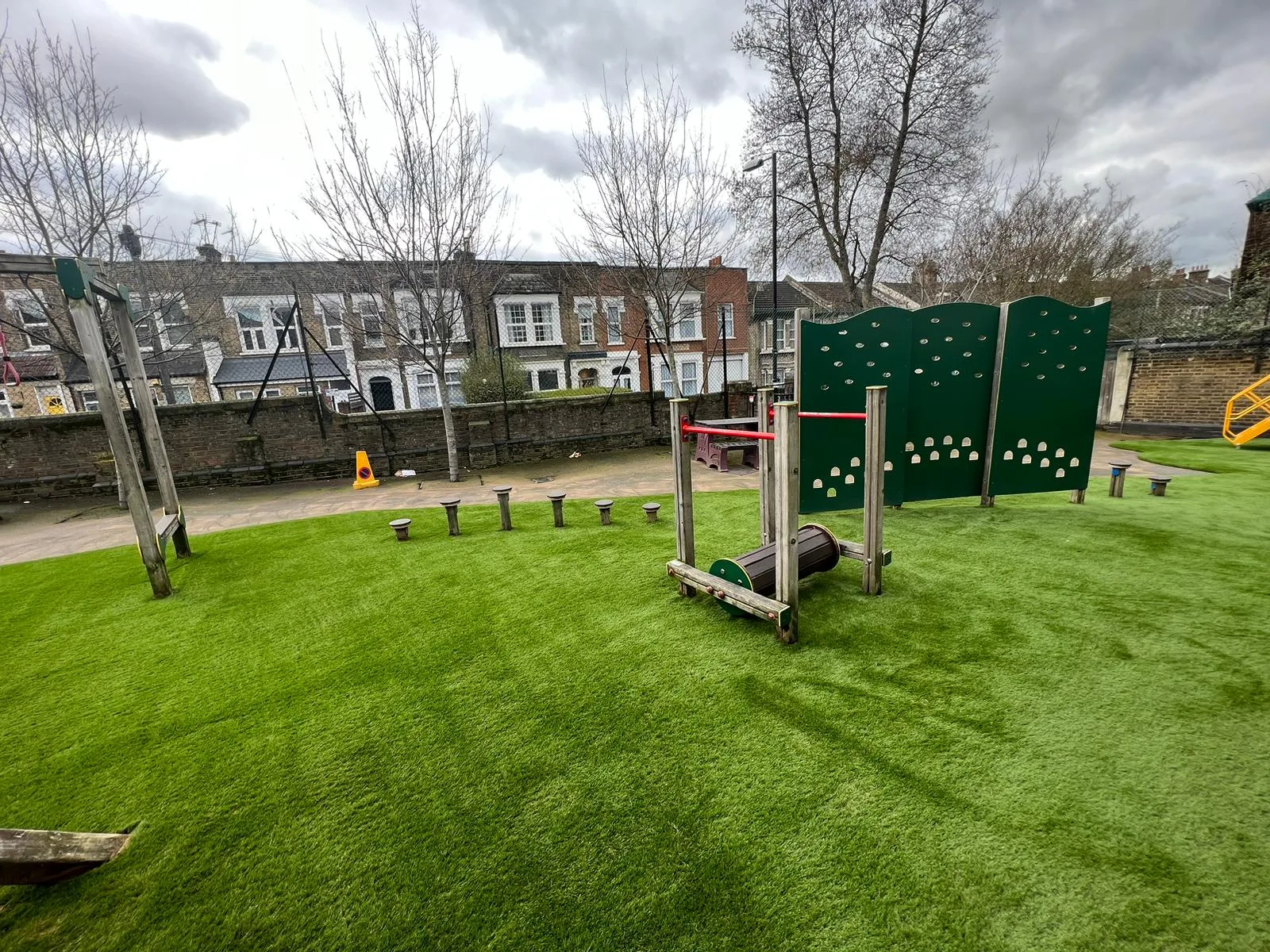
North London homeowners are fitting artificial grass in serious numbers. The combination of clay-heavy soil that drains badly, gardens put under pressure by kids and dogs, and the appeal of a lawn that looks the same in February as it does in July is driving a lot of interest.
If you’re weighing it up for your garden, here’s what to expect.
Why North London Gardens Are Good Candidates for Artificial Grass
The soil profile across much of North London — from Barnet and Enfield through Islington and Hackney — tends toward clay. Clay retains water, compacts under foot traffic, and turns slippery in autumn. Natural lawns on clay soil are genuinely hard to maintain to any reasonable standard, especially in gardens that get daily use.
Artificial grass on a properly constructed sub-base drains freely regardless of what’s underneath. The water moves through the turf, through a drainage membrane, through a compacted stone base, and into the ground below. The surface stays clean and firm.
Shade is the other issue. North London has some of the densest housing in the country. Rear gardens are often overlooked, partially shaded by fences or neighbouring buildings. Natural grass struggles badly in those conditions. Artificial grass is indifferent to them.

What Does Artificial Grass Cost in North London?
Expect to pay between £60 and £90 per m² for a mid-range install in North London. Premium installs — thicker pile, shock pad, aluminium edging, high-spec drainage membrane — sit at £90–£120 per m². Budget options start around £40–£55 per m², though these often involve thinner sub-bases that show problems within four or five years.
For a typical 25–30m² rear garden, the fully fitted cost lands between £1,500 and £2,700. Gardens with difficult access, significant level changes, or drainage complications can push above that.
Finding Reliable Artificial Grass Installers in North London
This is where most homeowners get unstuck. There are a lot of fitters operating across London, and the gap between a well-run crew and a rushed one shows up in the finished lawn two years later, not two weeks later.
When shortlisting, ask specifically about their sub-base specification — how deep, what material, how it’s compacted. Ask to see photos of completed installs in North London gardens, not just product samples. Check whether they include a workmanship warranty alongside the turf manufacturer’s guarantee. A good starting point is artificial grass installers serving North London who have direct experience with North London ground conditions and can provide a detailed, itemised quote rather than a rough estimate.

Choosing the Right Turf for a North London Garden
Pile height matters more than most people expect. A 20–25mm turf suits low-traffic areas — a side return, a balcony, a border strip. For a garden with kids or dogs in regular use, a 30–40mm pile with a thatch layer is worth the extra cost. It cushions better, wears more evenly, and holds its shape longer.
Colour affects how natural the lawn looks over time. Dual-tone turfs with two or three shades of green look considerably more realistic than single-colour products. If the garden catches direct sun for part of the day, UV stability matters — cheaper turfs fade noticeably within three to four years in exposed positions.
Backing quality is easy to overlook when you’re looking at samples. A heavier, perforated backing drains better and holds the pile roots more securely. It’s the difference between a turf that performs well in year ten and one that starts to shed fibres by year five.
What the Installation Process Involves
A standard artificial grass installation in North London takes one to two days for a typical rear garden. The crew removes the existing surface, excavates to the required depth, lays and compacts the sub-base, fits the drainage membrane, cuts and seams the turf, and finishes the perimeter with edging.
The two-day estimate assumes reasonable access and straightforward ground. Gardens with restricted access, heavy tree root interference, or significant level differences take longer. Always ask for a site visit before agreeing to a fixed price — a reputable fitter will want to see the garden before quoting.
After installation, the turf needs a light brush with a stiff broom every few weeks to keep the pile upright and the surface draining cleanly. That’s broadly the maintenance commitment for the next fifteen to twenty years.

Final Thoughts
Artificial grass in North London makes practical sense for most gardens once you factor in clay soil, shade from neighbouring buildings, and the ongoing cost of keeping natural grass in usable condition year-round. Get the sub-base right, choose a turf matched to how the garden will actually be used, and the investment pays off steadily.