The exponential growth of distributed data across hybrid and multi-cloud environments presents a severe structural challenge for enterprise IT architecture. As organizations deploy workloads across on-premises servers, public clouds, and hyperconverged infrastructure (HCI), the attack surface expands. Managing this fragmented data requires a unified, systematic approach to data protection.
Legacy backup protocols often rely on disjointed, agent-heavy software that degrades system performance and complicates recovery operations. These outdated frameworks struggle to maintain visibility across dynamic cloud instances, leaving mission-critical data vulnerable to ransomware, accidental deletion, or hardware failure.
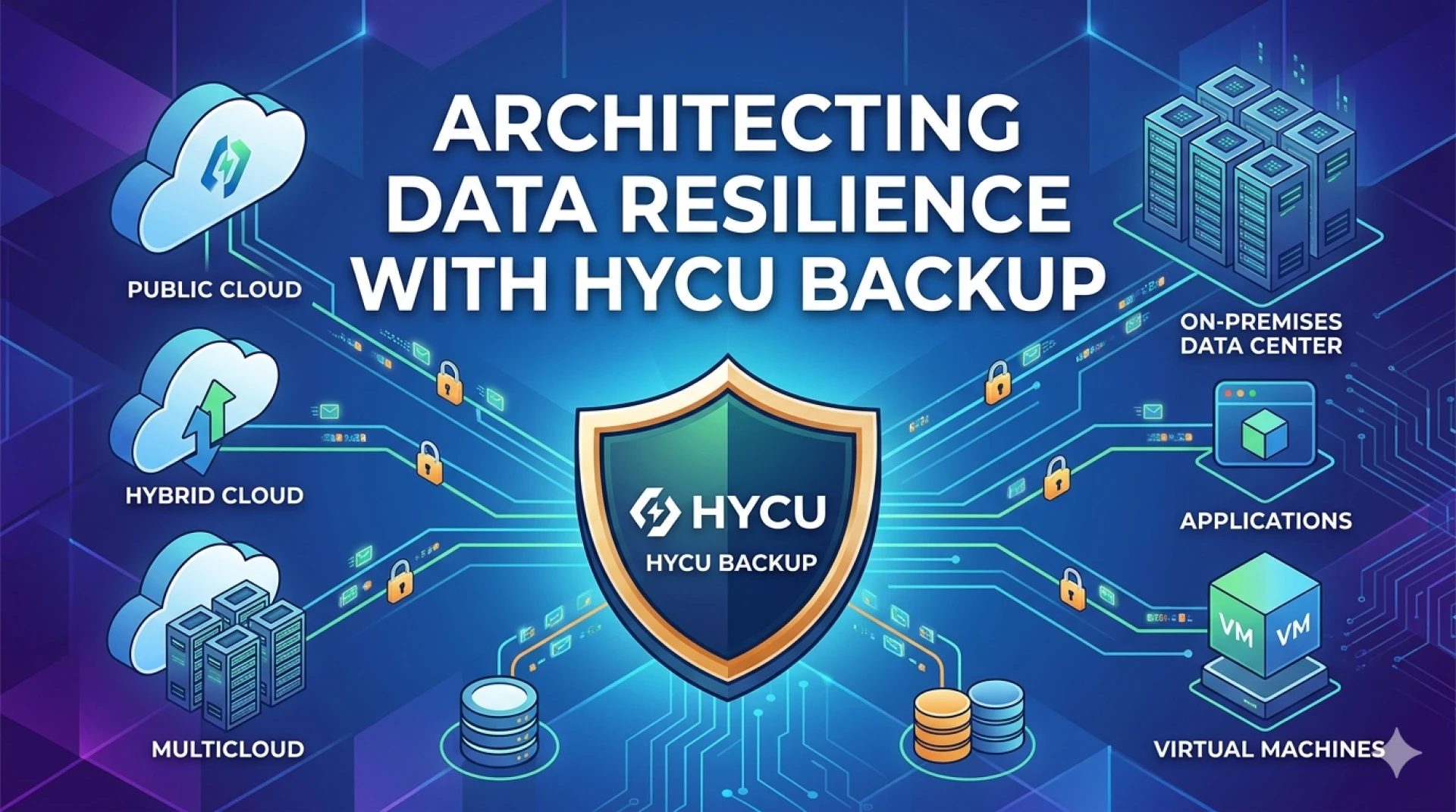
HYCU Backup emerged as a purpose-built solution to this precise architectural flaw. By integrating natively with cloud platforms and hypervisors, HYCU backup delivers agentless, application-consistent data protection. This guide examines how implementing HYCU transforms enterprise data management, secures hybrid environments, and guarantees business continuity.
The Strategic Advantage of HYCU in Hybrid Clouds
Managing backups across disparate cloud ecosystems generally leads to administrative overhead and unpredictable storage costs. HYCU operates seamlessly across multi-cloud and hybrid environments, including Google Cloud, Microsoft Azure, AWS, and on-premises Nutanix clusters.
Rather than treating the cloud as a mere storage target, HYCU utilizes native cloud APIs and identity access management (IAM) protocols. This deep integration ensures that backup policies map directly to the underlying infrastructure. Administrators gain a centralized control plane to monitor workloads, enforce compliance standards, and execute failovers without migrating data through external gateways.
Core Capabilities and Technical Features
HYCU brings several advanced engineering principles to enterprise data protection.
Automated Protection via Policy-Based Management
Manual backup scheduling introduces human error. HYCU leverages intelligent, policy-driven automation. Administrators define Recovery Point Objectives (RPO) and Recovery Time Objectives (RTO) within the platform. HYCU automatically discovers new virtual machines, databases, and applications, applying the appropriate backup tier based on predefined SLAs.
Rapid Recovery and Granular Restores
Downtime directly impacts revenue. HYCU accelerates recovery operations through application-aware snapshots and rapid cloning. Whether an organization needs to restore a complete virtualized environment or recover a single database table, the system executes granular restores rapidly. This capability bypasses the need to mount entire server images just to extract specific files.
Cost-Efficiency and Resource Optimization
Storage bloat is a common issue in disaster recovery planning. HYCU mitigates this by utilizing dynamic resource allocation. The platform dynamically spins up compute resources only when a backup or restore job is actively running, tearing them down immediately upon completion. Combined with advanced deduplication and compression algorithms, this approach drastically reduces cloud infrastructure spending.
Legacy Systems vs. HYCU Architecture
Traditional data protection solutions force administrators to install and maintain local agents on every virtual machine. This agent-centric model consumes high CPU cycles, requires constant patching, and creates security vulnerabilities.
HYCU eliminates this friction through an entirely agentless architecture. By interfacing directly with hypervisor and cloud-native APIs, the platform captures application-consistent backups with zero impact on production workloads. Upgrades happen transparently on the backend, removing the maintenance burden from internal engineering teams and drastically simplifying the disaster recovery topology.
Deployment Pipeline: Getting Started with HYCU
Implementing HYCU into an existing technology stack is a streamlined, systematic process. Follow this deployment pipeline to establish baseline protection:
- Environment Assessment: Catalog your current infrastructure, identifying mission-critical applications, databases, and standard virtual machines.
- Native Integration: Deploy the HYCU virtual appliance or activate the managed cloud service. Connect the platform directly to your hypervisor or cloud provider using native IAM credentials.
- Target Configuration: Define your backup targets. Connect your preferred object storage (such as Amazon S3, Google Cloud Storage, or Azure Blob) for immutable, off-site retention.
- Policy Assignment: Build your backup appliance policies. Assign specific RTOs and RPOs to your workload clusters, ensuring compliance with internal security mandates.
- Validation Testing: Execute a test restore to validate data integrity and measure actual recovery times against your defined SLAs.
Ensuring Uninterrupted Business Continuity
A robust disaster recovery posture requires technology that adapts to infrastructure changes automatically. HYCU Backup provides the exact technical precision, security, and scalability necessary to protect advanced hybrid deployments. By removing the operational friction of legacy software and utilizing cloud-native automation, organizations can focus their engineering resources on innovation rather than maintenance.
To fortify your data architecture and streamline your disaster recovery protocols, evaluate HYCU within your own staging environment. Deploy a proof of concept today to measure the immediate impact on your organization's business continuity operations.