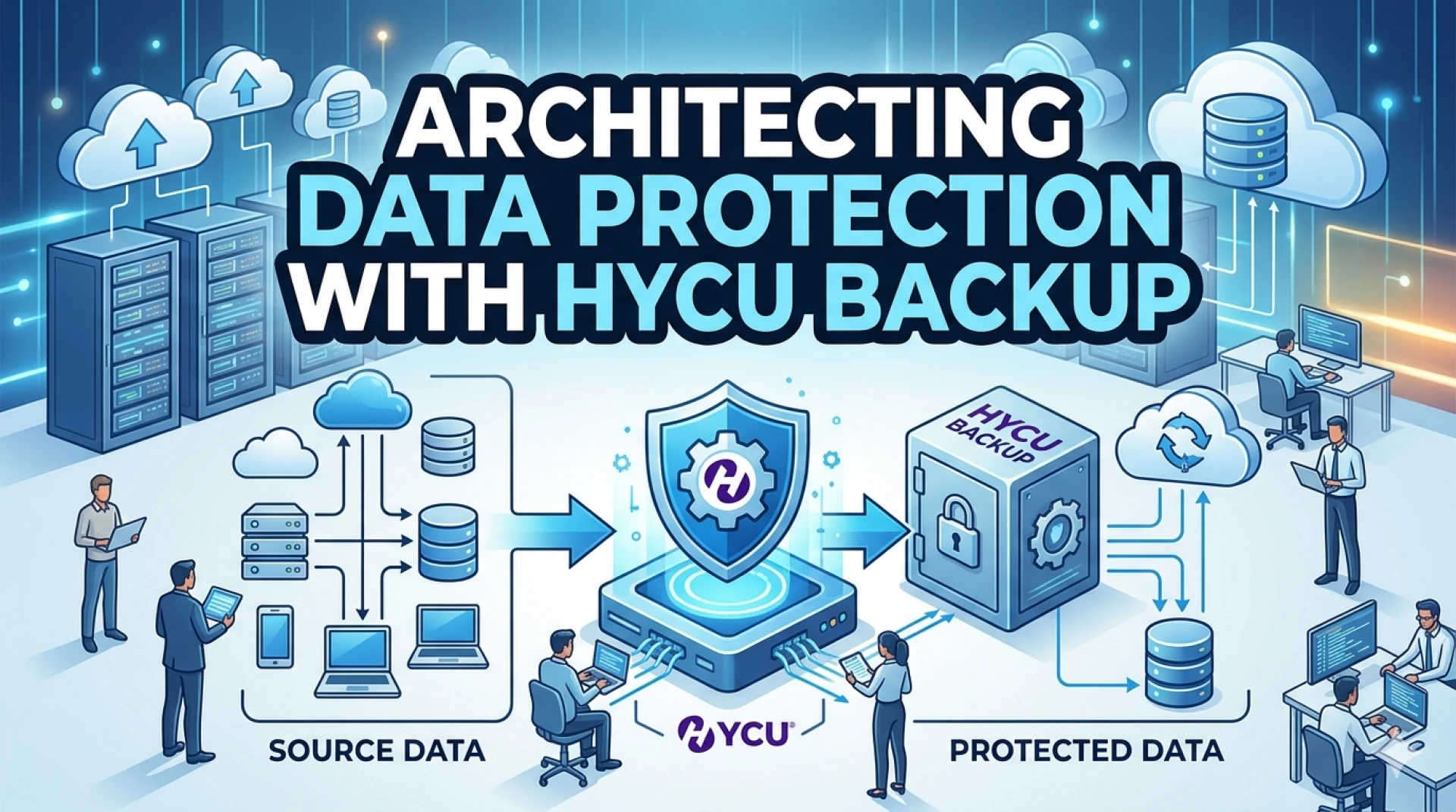
Modern enterprise environments demand robust data protection frameworks that align closely with their underlying infrastructure. HYCU Backup addresses this requirement by delivering a purpose-built, hybrid cloud data management solution. Designed natively for environments like Nutanix, VMware, and public clouds, HYCU tightly integrates with hypervisor and storage layers. This integration ensures seamless snapshot management and reliable data recovery mechanisms for complex IT ecosystems.
Reliable backup solutions are no longer optional components of an infrastructure strategy; they are critical safeguards against data loss, ransomware, and operational downtime. Traditional legacy backup tools often force administrators into deploying cumbersome agents or maintaining separate infrastructure silos. Implementing a native, API-driven solution minimizes the attack surface while guaranteeing stringent recovery point objectives (RPOs) and recovery time objectives (RTOs).
Understanding the technical mechanics of HYCU Backup allows IT architects to design highly resilient environments. The platform streamlines disaster recovery and data retention protocols without sacrificing advanced configuration capabilities.
Key Features and Architectural Benefits
HYCU diverges from legacy methodologies by utilizing modern architectural principles. This approach yields several distinct technical advantages for systems administrators and infrastructure engineers.
Agentless Architecture
Deploying and maintaining software agents across thousands of virtual machines introduces significant operational overhead and potential security vulnerabilities. HYCU utilizes an agentless architecture, communicating directly with hypervisor APIs. This design reduces CPU and memory overhead on the guest operating systems and completely eliminates the administrative burden of agent lifecycle management.
Application-Aware Recovery
Crash-consistent backups are insufficient for transactional databases and complex enterprise applications. HYCU provides deep application awareness, automatically discovering applications like Microsoft SQL Server, Active Directory, and Exchange. The system coordinates with native application frameworks, such as Microsoft VSS, to guarantee application-consistent snapshots. This ensures databases can be recovered in a fully operational state without requiring manual transaction log replays.
Cloud-Native Design
Rather than retrofitting a legacy on-premises tool for cloud environments, HYCU operates as a cloud-native platform. It leverages native public cloud snapshots and object storage tiers, such as AWS S3 or Google Cloud Storage. This allows organizations to implement tiered retention policies seamlessly, moving aging backups to cold storage classes to optimize expenditure.
Streamlined Interface and Operation
Despite its advanced technical capabilities, HYCU maintains a highly focused, policy-driven management interface. Administrators define data protection policies based on RTO and RPO metrics. The system then automatically applies these policies to the relevant resource groups, dynamically adjusting to infrastructure changes and newly provisioned workloads.
Evaluating HYCU Against Legacy Infrastructure
Transitioning from traditional backup methodologies to HYCU introduces measurable improvements across operational metrics.
Processing Efficiency and Backup Speed
Legacy systems often route backup traffic through centralized media servers, creating severe network bottlenecks. HYCU decentralizes this process by orchestrating data movement directly between the source storage and the backup target. This localized data transfer drastically reduces backup windows and minimizes the performance impact on production networks.
Economic Viability
Maintaining separate backup appliance infrastructure, including dedicated servers, storage arrays, and proprietary deduplication appliances, inflates capital expenditures. HYCU’s software-defined approach eliminates the need for specialized hardware. Organizations can utilize existing secondary storage or cost-effective public cloud object storage, optimizing the overall total cost of ownership.
Reduction of Architectural Complexity
Complex backup environments require specialized training and constant fine-tuning. HYCU simplifies the topology by removing the need for proxies, agents, and dedicated management nodes. The resulting architecture is flatter, easier to troubleshoot, and inherently more reliable during high-stress recovery scenarios.
Strategic Use Cases for the Enterprise
Implementing HYCU supports several critical infrastructure initiatives, providing a versatile toolset for IT operations.
Protecting Mission-Critical Applications
For databases requiring near-zero data loss, HYCU’s application-aware policies ensure that transaction logs are backed up and truncated correctly. This protects data integrity and guarantees predictable recovery operations for tier-one applications.
Formulating Disaster Recovery Strategies
HYCU facilitates cross-site replication and cloud-based disaster recovery. By orchestrating the replication of backup data to secondary data centers or public cloud regions, organizations can quickly spin up isolated recovery environments in the event of a primary site failure.
Executing Cloud Migrations
Moving workloads from on-premises hypervisors to public cloud infrastructure introduces data mobility challenges. HYCU can serve as a migration conduit, backing up virtual machines locally and restoring them as native compute instances within AWS, Google Cloud, or Microsoft Azure.
Securing Your Infrastructure Roadmap
HYCU Backup represents a paradigm shift in how enterprise data protection is architected and executed. By leveraging agentless API integration, deep application awareness, and cloud-native storage mechanics, organizations can achieve superior resilience while reducing operational complexity and cost.
To explore how HYCU can integrate with your specific infrastructure requirements, review the technical documentation or request a customized architectural demo from the HYCU engineering team.