
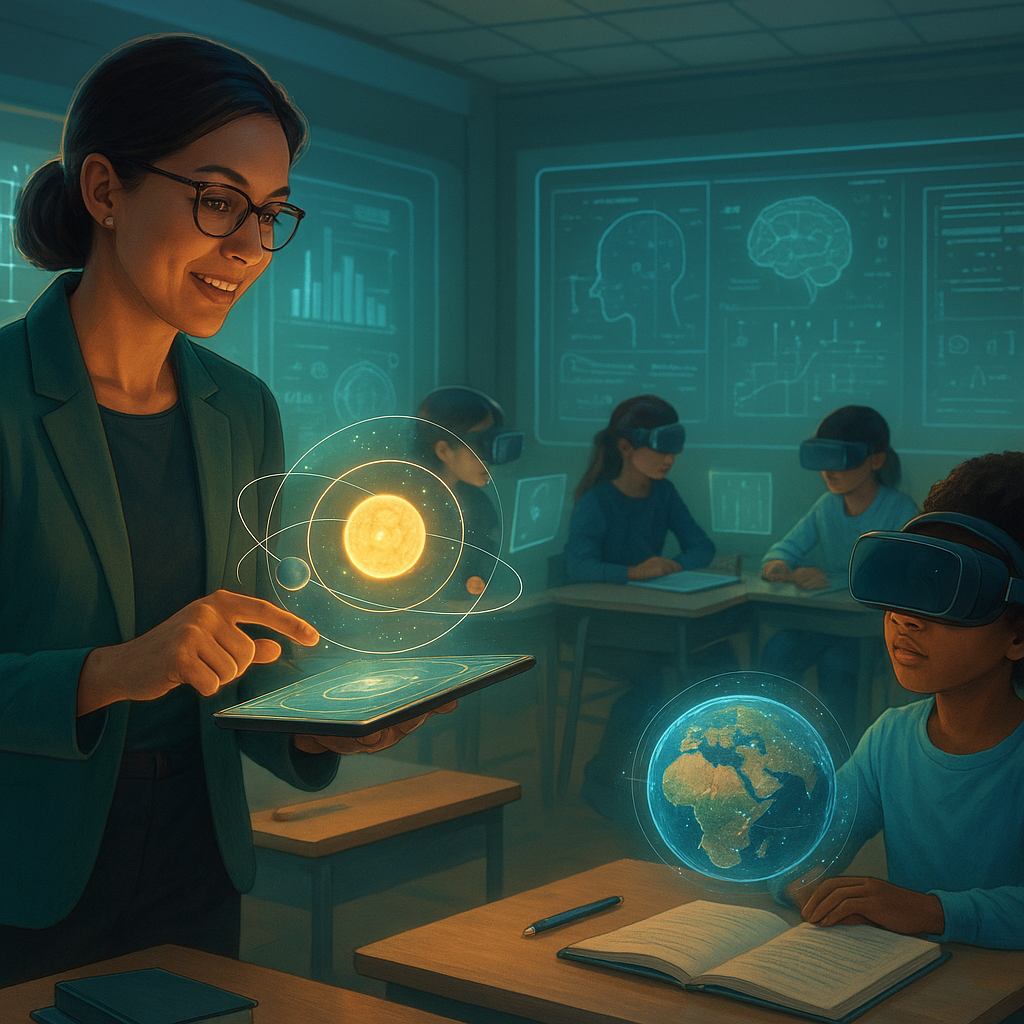
Reimagining Learning: The Dawn of a New Educational Era
Picture a classroom where students from remote villages in Africa engage in live virtual labs alongside peers in urban centers of Europe, guided by AI tutors that adapt instantly to each learner's needs. This vision is no longer futuristic fantasy but a reality unfolding in 2026, propelled by the rapid evolution of educational technology (EdTech). The global EdTech market, valued at approximately $350 billion in 2025, is projected to surpass $500 billion by 2030, signaling a transformative shift in how knowledge is disseminated and absorbed worldwide, according to industry estimates.
Today’s educational ecosystems are leveraging artificial intelligence, augmented and virtual reality, and data analytics to transcend traditional barriers of geography, accessibility, and pedagogy. These advances have spawned unprecedented opportunities — and challenges — for educators, learners, and policymakers alike. As classrooms morph into hybrid and fully digital spaces, understanding the nuances of this evolution is crucial for stakeholders aiming to harness EdTech’s full potential.
“The integration of AI-driven personalization and immersive technologies is not merely a supplement to education; it is reshaping the very foundation of how we conceive learning,” says Dr. Lina Morozova, an educational futurist and advisor to UNESCO.
Tracing the Trajectory: From Chalkboards to Neural Networks
EdTech’s journey began modestly with the introduction of computers in classrooms during the late 20th century. However, the 2010s marked a watershed moment as mobile devices, cloud computing, and online learning platforms proliferated. The COVID-19 pandemic triggered an unprecedented acceleration in digital learning adoption, forcing schools and universities globally to pivot almost overnight.
This pivot catalyzed investments in scalable online platforms, video conferencing tools, and digital content. Yet, early digital learning often replicated traditional classroom structures, limiting innovation. The past five years, however, have witnessed a paradigm shift toward intelligent systems capable of adapting in real time to individual learner profiles, powered by advances in machine learning and natural language processing.
Moreover, immersive technologies such as augmented reality (AR) and virtual reality (VR) have transitioned from niche applications to mainstream educational tools. This transition is supported by improvements in hardware affordability and software sophistication, enabling more interactive, experiential learning environments.
EdTech’s evolution is also shaped by a growing emphasis on lifelong learning and skills-based education, responding to the rapid obsolescence of knowledge in a digitized economy. Governments and enterprises increasingly collaborate with EdTech providers to upskill and reskill workforces, embedding technology deeply into educational ecosystems.
Data-Driven Insights: Measuring EdTech’s Impact in 2026
Quantifying EdTech’s effectiveness remains complex, but emerging data offers compelling evidence of its transformative impact. According to recent reports by the International Society for Technology in Education, students engaging with AI-personalized learning paths exhibit a 23% higher retention rate and a 17% improvement in critical thinking skills compared to peers in traditional settings.
Further, AR and VR have demonstrated significant efficacy in STEM education. A 2025 study by the Global Learning Analytics Consortium found that immersive simulations increased student engagement by 35% and improved conceptual understanding by 29%, especially in complex subjects like physics and biology.
Financially, EdTech startups raised over $12 billion globally in 2025, marking a 20% increase from the previous year. Major players such as Coursera, Byju’s, and emerging AI-specialized firms are expanding their offerings with modular, competency-based courses tailored to diverse learner needs.
The following list highlights key metrics illustrating EdTech’s recent performance:
- Global EdTech market size: $350 billion (2025); projected $500 billion (2030)
- AI-adaptive learning adoption: 48% of K-12 schools worldwide
- Immersive tech utilization: 38% increase in VR-based curricula usage
- Retention improvement: 23% higher with AI personalization
- Student engagement: 35% uplift via AR/VR simulations
“EdTech’s promise lies in its capacity to personalize learning at scale, breaking down one-size-fits-all paradigms,” notes Anil Verma, CEO of Lumina Learning, a leading AI-driven education platform.
EdTech in 2026: Innovations Shaping Today’s Classrooms
The current EdTech landscape is marked by several cutting-edge developments. AI has evolved from static tutoring systems to dynamic, conversational agents capable of nuanced feedback and emotional intelligence recognition. These agents help educators identify not just academic struggles but also social-emotional challenges, enabling holistic interventions.
Immersive technologies have matured with the advent of lightweight, affordable mixed reality (MR) headsets that seamlessly blend digital overlays into physical classrooms. This has expanded experiential learning possibilities, allowing students to manipulate 3D molecular models, conduct virtual archaeological digs, or practice surgical techniques in safe, simulated environments.
Blockchain technology is increasingly integrated for secure credentialing and micro-credential management, facilitating lifelong learning pathways that are portable and verifiable across institutions and employers.
Moreover, the rise of decentralized learning ecosystems empowers learners to curate personalized curricula from a vast array of global content providers, fostering autonomy and motivation.
Some of the standout 2026 trends include:
- AI-powered formative assessments: Real-time, adaptive testing adjusting difficulty based on responses
- Mixed reality classrooms: Hybrid environments combining physical and digital elements
- Blockchain certificates: Immutable academic records enhancing trust and portability
- Decentralized learning platforms: Learner-driven course assembly from diverse providers
These innovations collectively challenge educators to rethink roles, curricula, and metrics of success, pushing toward more personalized, equitable, and engaging education systems.
Voices from the Field: Expert Perspectives and Industry Impacts
Leading voices in the EdTech sector emphasize the importance of ethical frameworks and inclusive design as technologies become deeply embedded in education. Dr. Meena Patel, a cognitive scientist specializing in AI ethics, warns that “algorithmic biases must be rigorously audited to prevent reinforcing educational inequities.”
Education ministries worldwide are balancing enthusiasm with caution, investing in teacher training and infrastructure to support digital transformation while safeguarding data privacy and learner wellbeing. The World Bank reports that countries investing over 5% of their education budget in EdTech infrastructure see faster gains in literacy and numeracy, underscoring the need for sustained commitment.
From an industry standpoint, partnerships between EdTech startups, universities, and corporations are driving innovation and scaling solutions. For example, collaboration between MIT’s Open Learning initiative and several AI firms has produced open-source tools that democratize access to AI-augmented tutoring worldwide.
These developments also influence labor markets. Employers increasingly value digital literacy and adaptive learning skills fostered by EdTech, prompting a closer alignment of curricula with market demands.
“Our research confirms that EdTech’s success depends on human-centered integration, where technology amplifies, not replaces, teacher expertise,” explains Sandra Kim, chief strategy officer at EdGrowth Alliance.
Looking Ahead: What to Watch in EdTech’s Next Frontier
The trajectory of EdTech suggests several key areas to monitor in coming years. First, the convergence of AI and neuroscience promises breakthroughs in personalized cognitive training, potentially addressing learning disabilities and optimizing mental health alongside education.
Second, the expansion of 5G and satellite internet initiatives will further close the digital divide, enabling richer, synchronous learning experiences even in remote regions. This connectivity revolution will empower local educators with global resources and real-time collaboration tools.
Third, the rise of generative AI models tailored for education will likely transform content creation, enabling educators to generate customized learning materials and assessments rapidly, reducing workload and enhancing responsiveness.
Stakeholders should also anticipate evolving regulatory landscapes addressing data ethics, accessibility standards, and equitable funding models to ensure technology serves all learners fairly.
Actionable takeaways for educators and policymakers include:
- Invest in continuous professional development to integrate emerging EdTech effectively
- Prioritize inclusive design and accessibility in technology selection
- Foster partnerships across sectors to leverage diverse expertise and resources
- Implement robust data governance and privacy protections
- Engage learners and communities in co-designing educational experiences
As the sector advances, embracing these principles will be vital to unlocking EdTech’s transformative potential sustainably and equitably.
For readers interested in exploring how AI and data are shaping EdTech strategies today, TheOmniBuzz offers an insightful exploration in Harnessing AI and Data: Advanced Strategies Transforming EdTech Today. Additionally, the article How EdTech Is Redefining Learning Beyond the Classroom Walls provides a nuanced look at extending education beyond traditional boundaries.