
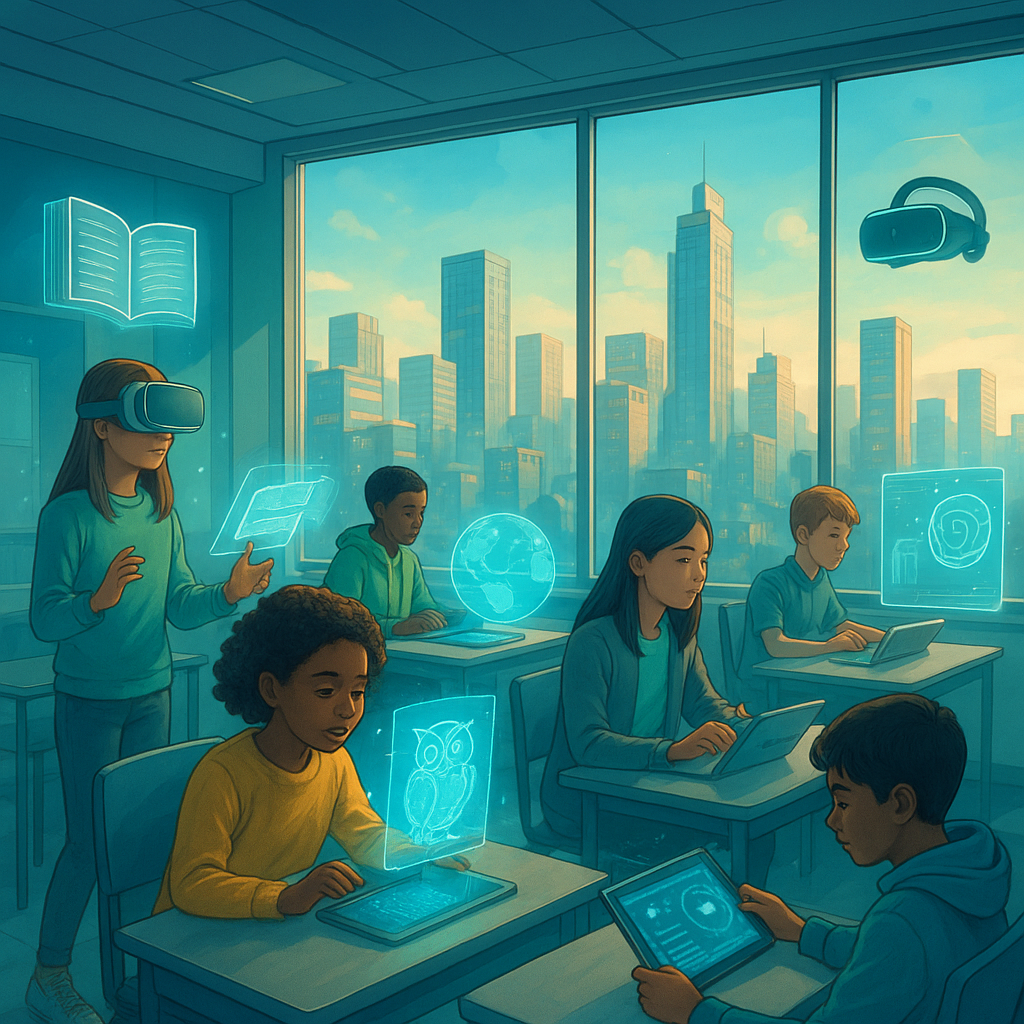
Reimagining Education: A Classroom Transformed by Technology
In a bright school in Tokyo, a group of students gathers around an interactive digital globe, their fingers tracing real-time climate changes and historical migration patterns. Nearby, a student with visual impairment leverages a tactile augmented reality device to explore molecular biology concepts. This scene, far from rare in 2026, typifies how education technology—EdTech—has evolved into a cornerstone of modern learning environments. The convergence of AI, AR/VR, and personalized learning platforms has transformed classrooms from static lecture halls into dynamic, interactive learning ecosystems.
According to the International EdTech Association, global investment in education technology surpassed $150 billion in 2025, marking a 20% increase from the previous year. The rise is fueled by increasing demand for personalized education, remote learning capabilities, and skills training aligned with rapid economic and technological shifts. This surge reflects not only a response to past disruptions but also an acknowledgment that traditional education models, long criticized for their rigidity, are no longer sufficient.
As we explore the trajectory and impact of EdTech, it is critical to understand how these innovations are reshaping pedagogy, accessibility, and the global education landscape at large.
From Chalkboards to Cloud-Based Classrooms: The Evolution of EdTech
The roots of educational technology stretch back over a century, beginning with audiovisual aids like filmstrips and overhead projectors. However, the digital revolution of the 1990s and early 2000s marked a seismic shift. The advent of the internet introduced online courses and learning management systems (LMS), while the proliferation of personal computers made digital learning more accessible.
By 2010, the emergence of Massive Open Online Courses (MOOCs) promised to democratize education globally. However, early MOOCs faced criticism for low completion rates and lack of engagement. The next decade tackled these challenges by integrating adaptive learning algorithms and gamification, enhancing user experience and outcomes.
Simultaneously, mobile technology’s ubiquity expanded learning beyond formal settings, enabling microlearning and anytime-anywhere access. The COVID-19 pandemic accelerated these trends, forcing rapid adoption of remote learning solutions and exposing stark disparities in digital access.
Today, EdTech is defined not just by content delivery but by its ability to tailor education to individual learners’ needs, leveraging data analytics, AI-driven insights, and immersive technologies. This historical context illuminates how far EdTech has come and sets the stage for its current capabilities and future potential.
Current Landscape: Key Technologies and Their Impact in 2026
EdTech’s 2026 ecosystem is a sophisticated amalgamation of technologies that enhance engagement, inclusivity, and effectiveness. Artificial intelligence stands at the forefront, powering personalized learning pathways and intelligent tutoring systems. These AI platforms analyze student performance data in real-time, adapting difficulty levels, recommending resources, and providing instant feedback.
Augmented reality (AR) and virtual reality (VR) have matured from experimental tools into mainstream educational aids. Medical students, for example, can now perform virtual dissections with haptic feedback, while history lessons transport learners to reconstructed ancient cities. These immersive experiences deepen comprehension and retention.
Moreover, blockchain technology has introduced secure credentialing and transparent academic record-keeping, addressing longstanding issues of fraud and inefficiency. Decentralized learning platforms enable peer-to-peer knowledge exchange and micro-credentialing, broadening educational pathways beyond traditional degrees.
Data from the EdTech Global Report 2026 reveals these trends:
- 75% of higher education institutions have integrated AI-driven adaptive learning systems.
- 60% of K-12 schools worldwide employ AR/VR tools for STEM education.
- 40% of learners use blockchain-based digital certificates to validate skills.
These technologies are not just enhancing learning but challenging conventional definitions of what constitutes education and achievement.
“EdTech’s true power lies in its ability to personalize and democratize education, making learning more engaging and accessible for every student, regardless of geography or background,” says Dr. Helena Park, Chief Innovation Officer at EduNext Labs.
Industry Perspectives: How EdTech Is Reshaping Stakeholders’ Roles
The rapid evolution of EdTech has profound implications for educators, students, institutions, and policymakers. Teachers are increasingly seen less as knowledge transmitters and more as facilitators and coaches, guiding learners through personalized content and projects. Professional development now includes training in digital pedagogy and data analytics to leverage these tools effectively.
Students benefit from greater agency over their learning journeys. Platforms offering competency-based progression allow learners to advance upon mastery, not seat time, which aligns better with diverse learning speeds and styles. This shift supports lifelong learning, crucial in a labor market where skills demand is in constant flux.
Institutions face both opportunities and challenges. Universities and schools that embrace EdTech gain competitive advantage by expanding their reach through hybrid and online programs. However, integrating new technologies requires substantial investment and organizational change management.
Governments and policymakers increasingly focus on digital equity and regulation. Ensuring all students have reliable internet access and devices is a top priority, particularly in rural or underserved communities. Additionally, data privacy and ethical AI use remain central concerns, prompting new frameworks and standards.
As education analyst Marcus Liu highlights, “The success of EdTech hinges not just on innovation but on the ecosystem’s ability to adapt culturally and operationally to new paradigms.”
Case Studies: Real-World Applications Demonstrating EdTech's Power
Several pioneering programs exemplify EdTech’s tangible benefits. In Finland, the Helsinki Innovation School launched an AI-powered mentorship platform that pairs students with experts worldwide for personalized guidance. Early results showed a 30% increase in project completion rates and greater student satisfaction.
In Kenya, the non-profit LearnSmart deployed solar-powered tablets with offline adaptive learning software to remote schools lacking stable internet. Over two years, literacy rates improved by 25%, demonstrating technology’s role in bridging educational gaps.
Meanwhile, corporate training has embraced EdTech through platforms like SkillForge that use VR simulations for hazardous environment training, reducing workplace accidents by 40% according to internal reports.
These examples highlight EdTech’s versatility and its capacity to serve diverse educational needs—from primary schools to professional development.
Looking Ahead: Challenges and Opportunities Shaping EdTech’s Future
Despite impressive advances, EdTech faces challenges that will determine its trajectory. Digital divide issues persist, with millions still lacking basic connectivity or devices. Equity-focused initiatives and public-private partnerships are critical to closing this gap.
Moreover, the sustainability of EdTech requires addressing data privacy, algorithmic bias, and the mental health impacts of increased screen time. Ethical frameworks and transparent governance models are emerging but require global cooperation.
The future will also see EdTech expand through emerging technologies such as quantum computing and brain-computer interfaces, promising unprecedented customization and interactivity. However, education systems must balance technological possibilities with pedagogical soundness and human-centered values.
To navigate this landscape, stakeholders should focus on:
- Investing in digital infrastructure and teacher training.
- Developing inclusive content that respects cultural diversity.
- Ensuring transparency and accountability in AI-driven decisions.
- Promoting hybrid models that blend technology with human interaction.
For those interested in deeper insights into the transformations and challenges facing education today, you might enjoy Education in 2026: Transformations, Challenges, and the Road Ahead. Additionally, to understand how digital platforms are pushing the envelope, explore How Online Learning Is Shaping Education’s Next Frontier.
EdTech's evolution is a compelling narrative of innovation meeting necessity. As technology continues to dissolve barriers and expand opportunities, the ultimate measure of success will be how effectively it empowers learners to thrive in an increasingly complex world.