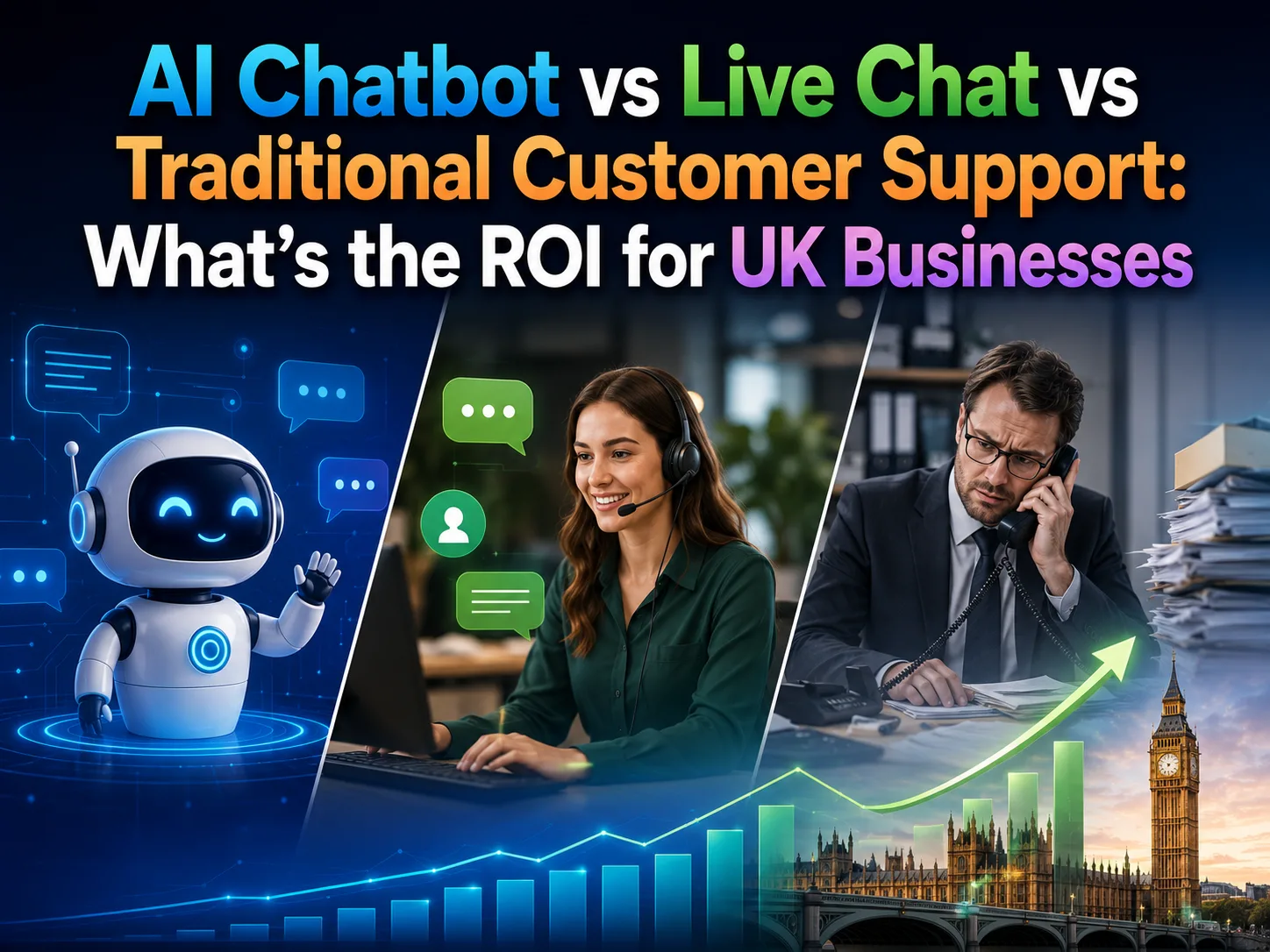
Every UK support leader eventually hits the same budget conversation: enquiry volume is climbing faster than headcount, and the phone queue is the most expensive channel by a wide margin. The average inbound call to a UK contact centre now costs £5.58 to handle — 57% more than email and 83% more than web chat, according to ContactBabel's 2024 UK Contact Centre Decision-Makers' Guide.
That gap is exactly why an AI chatbot is no longer a "nice to have" but something most operations directors are actively costing out. The real debate isn't whether to automate the support stack — it's what mix of chatbot, live chat and traditional phone or email actually delivers the best return.
AI Chatbot, Live Chat and Traditional Support: What Each One Actually Means
An AI chatbot uses a large language model to hold context-aware conversations, pull information from a knowledge base, and take actions such as checking an order or processing a return — instead of matching keywords to a pre-written script. Live chat routes the same web widget to a human agent in real time. Traditional support covers phone and email handled entirely by people, with no automation in the loop.
Many businesses badge all three as "AI chat", but only the first genuinely qualifies — live chat and phone remain 100% human-handled unless a bot sits in front of them.
AI Chatbot vs Live Chat vs Traditional Support
MetricAI ChatbotLive ChatTraditional Support (Phone/Email)Cost per interaction$0.50–$1.00 (roughly £0.40–£0.80)$5–$12 (roughly £4–£10) per Elfsight's benchmark data£5.58 per call; ~£3.55 per email (ContactBabel)First response timeUnder 10 seconds~35 seconds average, but 4 minutes 18 seconds with queueing, and 27.4% of customers abandon before being served116 seconds average speed to answer — the second-highest UK phone wait on record in 20 years (ContactBabel)Resolution rate50% average, 70–80% in optimised deployments70–79% first-contact resolutionEffectively 100%, but only one caller or email handled per agent at a timeScalabilityUnlimited concurrent conversations, 24/7, no queueCapped by agent headcount, typically 3–6 concurrent chats per agentFully serial; requires proportional headcount growth as volume risesGBP figures for AI chatbot and live chat are approximate conversions from Elfsight's USD benchmark data — confirm current FX rates before using these in a business case.
What These Numbers Mean for a UK Support Team
The cost gap alone explains most of the current chatbot ROI conversation: a resolved chatbot ticket can cost five to twelve times less than a human-handled one. 53% of UK web chats are already handled wholly or partially by bots, which is one reason AI now ranks as the top technology investment priority for UK contact centres over the next two years. But cost per ticket isn't the whole picture.
UK GDPR treats chat logs and voice recordings as personal data, so any chatbot or live chat system that stores chat content needs a retention policy and a lawful basis that satisfies the ICO. That compliance cost rarely appears on a vendor's pricing page, but it does affect the real ROI calculation — especially in regulated sectors such as finance or healthcare.
Is an AI Chatbot Better Than Live Chat?
In short: an AI chatbot usually wins on cost and speed, live chat usually wins on complex or high-stakes queries, and the strongest setup combines both rather than choosing one.
Where the AI chatbot wins:
- Cost: Five to twelve times cheaper per interaction than a human-handled one.
- Speed: Responds in under 10 seconds, versus a live chat queue that can stretch past 4 minutes.
- Behaviour overstated preference: 64% of customers say they prefer dealing with a human, yet 67% choose the chatbot when both options are shown side by side on the same page.
- Satisfaction parity: Well-built bots now satisfy 64.7% of customers, against 64.2% for live chat — a statistical tie.
Statistics sourced from Elfsight's AI Chatbot vs Live Chat analysis.
Where live chat still wins:
- Complex or emotionally sensitive queries: Complaints, disputes, anything needing empathy or judgement rather than a scripted answer.
- High-value accounts: where a wrong automated answer risks the relationship, not just the ticket.
- First-contact resolution: A human agent still edges out a chatbot on harder issue types.
Does an AI chatbot actually improve customer service? Harvard Business School research (cited via Elfsight's analysis) found that AI-assisted human agents respond 20% faster — gaining the equivalent of 1.5 years of experience. That points to the strongest setup being a chatbot in front of live chat, not instead of it, with clean escalation whenever a query gets too complex for the bot to handle confidently.
Which Model Fits Your Support Volume?
Monthly inquiry volume is the simplest starting point for the decision:
- Under 50 inquiries a month: Part-time live chat is usually cheaper than a chatbot platform's licence fee.
- 50–100 inquiries a month: This is the typical chatbot break-even point; run the numbers before committing.
- 500+ inquiries a month: A chatbot-first model with human escalation for exceptions tends to win on cost and speed.
Off-the-shelf chatbot widgets cover the basics at any of these volumes. Businesses that need the bot to talk to internal systems — CRM records, order status, ticketing — usually outgrow them quickly. That's typically the point where UK software development consultancies such as Kent-based RSK Business Solutions, which builds bespoke web and customer-facing applications, get brought in to connect a chatbot properly into existing business systems rather than leaving it as an isolated widget.
Frequently Asked Questions
Is an AI chatbot cheaper than live chat?
Yes. Chatbot interactions typically cost £0.40–£0.80 versus roughly £4–£10 for live chat and £5.58 for a phone call — five to twelve times less per interaction, based on Elfsight and ContactBabel benchmark data.
2. What's a good chatbot resolution rate?
Around 50% is average, but optimised deployments reach 70–80% first-contact resolution — comparable to live chat's 70–79%.
3. Do UK businesses need GDPR sign-off for chatbots?
Yes. Chat logs count as personal data under UK GDPR, so any chatbot or live chat system that stores conversations needs a documented retention policy and lawful basis that satisfies the ICO.
4. Should I replace live chat with an AI chatbot?
Usually not entirely. The best-performing setups put a chatbot in front of live chat for routine queries, with escalation to a human for complex or high-value cases.
5. How many monthly enquiries justify an AI chatbot?
Roughly 50 or more a month is the typical break-even point; below that, part-time live chat is often cheaper than a chatbot licence.
6. Can an AI chatbot connect to my CRM or ticketing system?
Off-the-shelf widgets handle basic FAQs, but connecting a chatbot to CRM records, order status or ticketing usually needs bespoke integration work.
Conclusion
There's no one-size-fits-all answer to the AI chatbot vs live chat debate for a UK business. It depends on which query type best fits each channel — then measuring containment rate, resolution time and cost per ticket, rather than assuming automation is automatically cheaper.
Traditional phone and email support won't disappear; it will be reserved for complex, high-value or regulated conversations where a person is genuinely needed. For most UK support teams, the best return comes from combining all three:
- A chatbot handling routine, high-volume conversations 24/7.
- Live chat for what the bot can't resolve.
- Phone or email for the cases that truly need a human touch from the first message.
Weighing up chatbot, live chat and human support for your business? Talk to RSK Business Solutions about connecting a chatbot to your existing systems.