AI Agent vs MCP - How They Work and When to Use Them
Modern enterprises are increasingly deploying AI agents to streamline processes, support decision-making, and connect employees with business data. Enterprises can now connect them with internal data resources, tools, and applications using Model Context Protocol (MCPs). Along with conversations, it enables AI agents to perform various operational tasks.
AI Agent and MCP Integration are two popular concepts that support business operations. Both are different platforms that solve entirely different problems. Knowing the differences between AI agents and MCPs helps enterprises implement the right technology according to their business goals.
Overview of AI Agent
An AI agent is a computer program that can understand an objective, consider necessary actions, use resources, and perform actions to complete a task. Unlike a conventional chatbot that only responds to user requests, an AI agent can carry out actions in several stages with minimal human intervention.
For example, an enterprise AI agent can receive a request to analyze delayed customer orders. It analyzes the data from the order management system, retrieves the information, and prepares a report for the operations department.
The AI agents are designed to meet various business needs, such as -
- Customer support
- Marketing
- Finance
- IT services
- Procurement
- Data analysis
- Employee support
The AI agent development concentrates on building the system with advanced reasoning mechanisms.
Overview of MCP in AI
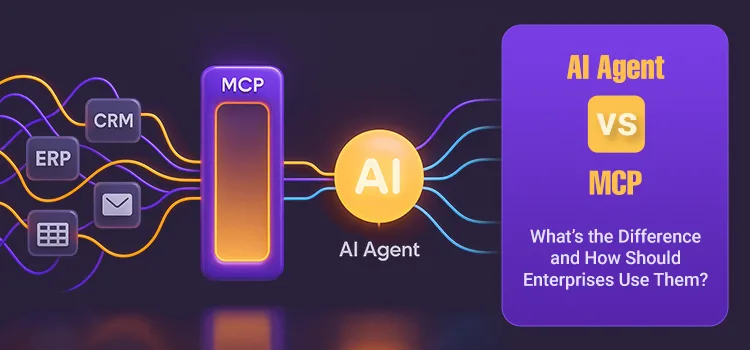
MCP refers to Model Context Protocol. It is an open protocol created to provide a standard method for AI applications to connect with external tools and data resources.
Instead of developing a new integration solution for each AI agent and system, MCP provides a standard framework where AI agents can communicate with tools.
For instance, an MCP server can offer access to -
- Company databases
- Internal documentation
- CRM systems
- Project management tools
- File storage
- Business APIs
MCP does not act as an AI agent. It serves as the communication channel that helps the AI agent interact with other systems.
The difference between the two is important when evaluating the MCP in AI systems. The MCP acts as the medium, whereas the AI agent carries out the task through this medium.
How AI Agents and MCP Work Together
AI Agent and MCP integration can result in a more flexible architecture for enterprise AI applications.
The AI system can interact with various enterprise systems through MCP-connected tools. Instead of integrating these tools manually with each enterprise system, businesses can use MCP-compatible servers and connect the AI system with their tools.
Let's take an example of an IT agent. For example, a company employee complains that he is not able to log into an internal application. In such cases, the IT agent can -
- Identify the issue the employee is facing.
- Check the relevant documents.
- Verify the credentials of an employee.
- Verify the application status.
- Generate a support ticket.
- Guide the employee on the next steps.
MCP can provide access to the documentation system, employee directory, application monitoring system, and ticketing system. The agent is responsible for reasoning through the entire process.
This separation makes the business enterprise AI agents easier to scale and manage.
Enterprise Applications of AI Agents
A business process that includes reasoning and more than one system interaction can use AI agents.
Customer Services
AI agents can handle customer queries, provide customer information, verify the order status, and transfer the issue to human representatives.
Sales Activities
AI agents can qualify prospects, investigate client accounts, update information in the CRM software, and compose emails for follow-ups.
IT Operations
IT agents can resolve everyday issues, review technical documentation, monitor systems, and generate support requests.
Finance
The AI agents assist in invoice processing, expense analysis, financial analysis, and report generation based on predefined business rules.
Procurement
They analyze supplier information, purchasing data, and unusual expense patterns and carry out routine procurement activities.
How MCP Can Help Enterprises
MCP is especially useful when a business needs a standardized way to connect AI agents to their data and other resources.
Many businesses store data on multiple platforms. Without standardization, each and every AI solution would require a connector and custom integration logic.
MCP can help share these platforms using a common protocol.
For example, a business can build its MCP servers for its CRM, knowledge base, project management, and data warehouse. Various AI applications can interact with these systems via the MCP platform, under certain authentication mechanisms and access controls.
In this way, integration becomes easier and more efficient.
Should Enterprises Choose AI Agents or MCP
In most cases, enterprises should not view AI agents and MCP as competing technologies.
They operate at different levels of an AI architecture.
Businesses should consider AI agents when they require process automation that needs reasoning, decision-making, and multiple steps.
Businesses can consider MCP when they require a standard way to integrate AI systems with business resources.
Businesses can leverage both technologies for complicated enterprise-wide systems. The AI agent acts as the reasoning and orchestration layer. The MCP facilitates standard access to the tools and data.
Key Points to Consider Before Implementation
When implementing technologies, organizations need to consider certain factors.
Define the business objective - Begin with a defined workflow instead of deploying the AI technology without a clear business goal.
Identifying tools and data - Identify the tools that the AI technology requires access to and the data that should be retrieved or modified.
Access control – The company’s AI technologies should have clearly defined permissions to avoid accidental access to confidential data.
Human approval - Certain processes require manual approval before task execution.
Performance monitoring - Enterprises need to measure accuracy, usage, failures, cost, and business impact once deployed.
Scalability - The system should allow businesses to connect more tools and increase processes in the future with ease.
The Future of Enterprise AI
Enterprise AI agents have become advanced beyond just conversations. Businesses expect AI agents to understand user intent, process business data, interact with other systems, and automate tasks.
AI agents can provide the reasoning and execution ability necessary for this transition. The MCP enables seamless connection between AI agents and business systems.
Businesses are increasingly taking interest in incorporating AI in their operations. AI agent development and standardized integration frameworks are useful in developing automation systems. A robust AI development company can help businesses choose the best approach depending on their business goals.
Conclusion
The key difference between AI agent Vs. MCP is the role they play in assisting businesses. AI agents are created to perform reasoning and decision-making tasks. The MCP provides a standardized way for connecting AI applications to other tools and information.
Businesses are not required to select only one option. Integrating AI agents with MCP allows organizations to develop their systems for decision-making along with business information access. A renowned AI development company can help businesses from various industries develop customized AI systems.